
Topics / Personal Finance
Personal Finance Podcasts
1,481 shows and 264,262 episodes sit under Personal Finance.
Curated guide to personal-finance podcasts in 2026: Money for the Rest of Us, ChooseFI, Financial Feminist, Cost of Living, Frequent Miler, The Legacy and Faith Show
Photo: Alexander Schimmeck on Unsplash · Unsplash License
Swipe · Personal Finance only
Swipe through Personal Finance
Save time discovering your next favourite podcast by listening to just the best minute of an episode.
The personal finance slate · every cover a link
All 1,481 personal finance shows →




A field guide
What Personal Finance podcasts actually cover
A personal finance podcast earns its place when it takes something you already pay and shows you the decision inside it. That might be a $17 streaming charge, a health premium or a balance that never quite clears. The best of these shows are patient with arithmetic and candid about feeling. They explain why a vacation budget collapses, why a retiree regrets claiming early, or why a tidy annuity illustration can leave out two words that matter.
The range is wide. Two planners can spend an episode arguing about whether to pay for subscriptions monthly or yearly. An estate attorney can walk through how a trust divides after a death, and a call-in show can hand the microphone to someone deep in debt. Edison Research's Infinite Dial, released in March 2026, found that 58% of Americans aged 12 and older had consumed a podcast in the previous month, though that measures podcasting in general, not money shows. Inside the genre, the arguments are about method. In September 2026, a New Yorker essay criticised a confrontational, audit-style format as exploiting vulnerable guests. Its creator argues that drama draws people toward financial education. Neither side has shown that its approach changes behaviour. Listeners also disagree about two other things: whether shows should stress personal responsibility or explain the economy around the household, and whether weekly fundamentals count as reinforcement or filler.
This guide sorts shows by the question you bring and flags where a host also sells something. A recommendation to listen is not a recommendation to act.
Running the household
Budgeting shows succeed on specifics. In The Expense Audit | Ep 586, the ChooseFI hosts build a household spending list line by line. They debate whether streaming belongs under housing, insist that payroll-deducted health premiums still count, and point out that the subscribe-and-save order arriving every six months deserves a look. Their credit card rule is blunt: if you can pay in full every month, do that. It suits anyone heading toward the FIRE & Financial Independence page. One disclosure is worth keeping in mind: ChooseFI keeps its feed ad-free by asking listeners to open travel rewards cards through its site.

Check Your Balances, with planner Ross Anderson and his co-host Dan, lets disagreement do the teaching. In Does Your Money Need Spring Cleaning?, Ross says he hates monthly subscriptions and pays annually so he stops re-judging them. Dan prefers seeing each monthly charge, because annual ones are the ones he forgets. Both positions hold up, and hearing them side by side helps you choose your own.
Financial Feminist, hosted by Tori Dunlap, brings a feminist frame and a coach's push. Budgeting For Summer Travel starts from the line that "summer travel is only stressful when it's treated like a surprise." It then orders the steps: checking balance, savings and fixed expenses come before any flight search. The instruction is clear, and the sponsor reads are long.

The Ramsey Show Highlights stays closer to crisis. In I'm 58 And Drowning In Debt, a single mother weighing bankruptcy describes $60,000 in state tax debt and $60,000 in credit card debt. She traces the spending to guilt after a divorce, and her candour is the reason to listen. The Budgeting, Saving & Debt Payoff page goes further.
Money with a point of view
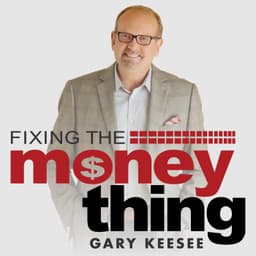
Some shows name their lens outright, which helps you weigh what they say. Fixing The Money Thing with Gary Keesee ties household finance to scripture. 10 Things You Need to Know About Finances begins with getting out of debt and restructuring it, then suggests adjusting tax withholding rather than waiting for a big refund. Near the end, it appeals for ministry partners.
The Life Planning 101 Podcast, with Angela Robinson, treats money as habit. What is Your Relationship with Money? (Rebroadcast) proposes writing down each negative money thought: "It's like a food journal."

Beyond the Spectrum.. every age, every need comes from caregiving. In Sum Day is Today, the host says financial services is his primary work. He wants to connect caregiving families with financial literacy, and he describes an industry built on quotas, single-company agents, account minimums and assets under management. That is a useful map of incentives, offered by an insider who is also promoting an event.
Retirement, insurance and what you leave behind

As the timeline lengthens, the claims need more care. In Will Social Security Go Bankrupt? | The Dale Buckner Podcast Ep. 273, Dale Buckner and guest Tom Clark sketch a worst case. With slow growth and no change from Congress, they say, there is enough money to pay all promised benefits for about 10 more years. Buckner adds that his 98-year-old mother calls claiming at 62 her biggest mistake. The episode also advertises free consultations.

Retire For Less With The Annuity Expert is most useful when it turns suspicious. In Stop! Listen To This Before Letting Your Advisor Sell You an Annuity, the host takes apart an advisor's illustration for a 71-year-old client with $1.2 million. The host says the illustration promised beneficiaries a guaranteed $1,260,000 but omitted the effect of withdrawals, even though the client planned to draw income immediately. The host recommends annuities himself, so his preferences deserve scrutiny.
The Legacy and Faith Show, with estate and tax attorney Paul Grant, makes trusts concrete. In 04/08/26 - Beneficiaries pt.2, Grant illustrates how $50,000 for a church becomes $5,000 a year through a 10-year trust. Grant also warns that most trusts he reviews do not work this way.

Check Your Balances covers a risk the hosts think many workers ignore in What Might Bust Your Bracket?. The hosts use a surgeon with a hand tremor to show how a disability policy's definitions decide what it pays. On Money Guy Show, Die With Zero? Watch This First. pushes back on a popular book: "a warning against over-saving is not the message that most people need."
The Retirement Planning, Tax & Estate Planning and Insurance pages each go deeper.
Investing with the doubt left in
The investing shows worth trusting explain what could go wrong. Money for the Rest of Us is hosted by J. David Stein. In There Is No Perfect Portfolio. Just Good Enough, he reviews risk parity funds, cites one with a 2.6% annualized five-year return, and lists complexity, leverage costs and fees among the drawbacks. Near the end, he says he has not provided investment advice. In Burnout, Breaks, and the Courage to Spend with David Bach, he says he didn't necessarily agree with his guest's flat-tax proposal, and he lets the disagreement stand.

Canadian Wealth Secrets, from former math teachers Kyle Pearce and Jon Orr, takes on borrowing to invest in How Risky Is Leveraged Investing? Have Canadian Investors Been Thinking About Risk All Wrong?. Borrowing at 4.95% to aim for 7% "sounds like free money," one host says, before the two separate the math from the risk of a falling market. The material is Canada-specific, and the episode offers a strategy call near the end.

Goldrichtig investieren - Ersparnisse absichern, Vermögen aufbauen & für die Rente vorsorgen is German-language, crisis-minded and published by a precious-metals seller. #162 - Aktien vs. Gold-Performance: Das haben Lars Erichsen und ich in 20 Jahren Krisen beobachtet pauses for a gold-card promotion while the guest defends stocks. The Investing page and the Real Estate Investing page continue from here.
Points, perks and fine print
Frequent Miler on the Air treats rewards cards as arithmetic. In Rove Miles: Transferable Points without a credit card | Frequent Miler on the Air Ep349 | 3-13-26, the hosts work out that an extra 1% on dining, capped at $50,000 of spending, won't cover a $695 annual fee. In Fine Hotels + Resorts® vs The Edit by Chase Travel℠ | Coffee Break Ep93 | 2-17-26, a host books one hotel back to back through both programs. Both stays were supposed to include an upgrade, and neither did. It is best for listeners who already play the points game.
The economy at kitchen-table scale
Cost of Living (CBC), hosted by Paul Haavardsrud, connects household prices to larger forces. How does all the weird food end up at Winners? includes a segment with the founder of the National Day Calendar, a database of more than 3,000 holidays. The segment's point is that National Pizza Day exists to sell more pizza.

The CU2.0 Podcast looks from the lender's side. In CU 2.0 Podcast Episode 397 Union Credit's Dave Buerger on Consumer Confidence - and How to Strengthen It, Robert McGarvey cites a survey from Buerger's company in which 54% of respondents felt cautious and 45% anxious. Buerger's firm sells lending technology to credit unions, so he has a stake in the story. The Economics page, the Finance page and the Business & Finance category guide widen the view.
Where to start
- If you want one quick win: Check Your Balances, What can you do TODAY to improve your finances? Small, specific changes you can make the same day.
- If you're mapping your spending: ChooseFI, The Expense Audit | Ep 586. A line-by-line method for finding what your life costs.
- For a retirement worry: The Dale Buckner Podcast, Will Social Security Go Bankrupt? | The Dale Buckner Podcast Ep. 273. A calm walk through a question that often arrives as panic.
- For the skeptical investor: Money for the Rest of Us, There Is No Perfect Portfolio. Just Good Enough. Tradeoffs stated plainly.
- To see prices in daily life: Cost of Living (CBC), How does all the weird food end up at Winners? A curious, light route into why things cost what they do.
Featured shows below are part of the PlayNext catalog. Updated weekly.
Featured shows
8 shows, described rather than listed
A short write-up for each, plus the job it does in this guide.
David Stein's decade-long investing/portfolio show. Honest about uncertainty, structured in delivery, willing to walk back earlier calls when the data changes. The closest thing the slate has to a portfolio-management graduate course.
FIRE-movement show that matured beyond early-retirement-or-die framing. Travel rewards, frugality, parenting-without-trust-fund. Entry point for the FIRE conversation without the cultishness that haunts older corners of the movement.
Tori Dunlap's show — the slate's most explicit cultural-criticism strand. Personal finance at the intersection with women's economic specifics and the cultural baggage mainstream finance advice usually flattens.
Credit-card rewards, airline-program arbitrage, travel-hacking specifics. The slate's strongest example of a podcast that has been right about its own scope for years. Unapologetically niche.
Dustin Heiner's real-estate investing show. The more aggressive end of the spectrum — closer to wholesaling/tactical than to buy-and-hold-thirty-years. Take with the same care as any tactics show.
CBC's personal-economy reporting show. Consumer-economy questions worked with reporting rather than advice. The slate's strongest example of personal finance that doesn't pretend the listener's choices happen in a vacuum.
The slate's estate-planning specialist. Christian-faith framing not every listener will share, but the underlying mechanics (beneficiary designations, trusts, succession) are the same any estate-planning conversation needs to cover.
Lighter-touch financial planning across insurance, exit planning, action-taking. General-audience complement to *The Legacy and Faith Show*.
Where to start
4 routes in, one per reader
*There Is No Perfect Portfolio. Just Good Enough* is a clean introduction to the show's posture. Analytically careful entry point.
*Parent Like a Millionaire Without Being One | Ep 591* and *The Value Matrix | Where's The Joy In That ? | Ep 592* tell you whether the show's current life-optimization framing fits your situation.
*Build Wealth Without Leaving Your Culture Behind with Bricia Lopez* reframes what you think personal-finance advice is supposed to look like.
*Wells Fargo journeys forward | Ep354* is a recent starter. The show's archive is the actual depth.
Glossary
Terms worth knowing before you listen
Movement that emphasises high savings rates and index-fund investing to enable early retirement or work-optional living. *ChooseFI* is the slate's standard-bearer; recent show framing has broadened toward life optimization rather than strict early retirement.
Niche sub-genre that treats credit-card rewards and airline-program arbitrage as a legitimate optimization domain. *Frequent Miler on the Air* is the slate's specialist.
Format that works through investment-portfolio construction systematically. *Money for the Rest of Us* is the slate's standard-bearer; episodes typically address one investment question (e.g., asset allocation, risk-on/risk-off) per episode.
Sub-genre that explicitly addresses how standard finance advice doesn't fit listeners whose family-economic situation differs from the implied audience. *Financial Feminist* is the slate's exemplar; covers women, immigrants, first-generation wealth, etc.
Format that reports on consumer-economy questions rather than dispensing advice. *Cost of Living* (CBC) is the slate's example — adjacent to personal finance but closer to journalism than to coaching.
Sub-genre covering wills, trusts, beneficiary designations, succession planning. Largely avoided by mainstream personal-finance shows. *The Legacy and Faith Show* is the slate's specialist; *The Life Planning 101 Podcast* is the lighter-touch complement.