Topics / Film Reviews
Film Reviews Podcasts
1,108 shows and 199,253 episodes sit under Film Reviews.
Curated guide to film-review podcasts in 2026: The Rewatchables, The Evolution of Horror, Faculty of Horror, Micheaux Mission, Horror Movie Talk, The Tragedy of Cinema
Photo: Shane Monarc on Unsplash · Unsplash License
Swipe · Film Reviews only
Swipe through Film Reviews
Save time discovering your next favourite podcast by listening to just the best minute of an episode.
The film reviews slate · every cover a link
All 1,108 film reviews shows →

The guide
How Film Reviews podcasts differ, and which to try
The credits finish; the argument doesn’t. Was that performance restrained or simply blank? Did the film earn its last scene? Why does a movie you can practically recite still make you stop whatever you’re doing when it turns up? A good conversation gives those questions room to breathe. It can identify the gesture, cut or absurd little detail that makes a film worth remembering.
The choice now is partly about how much conversation you want around the criticism. Listener debates turn on the space given to awards and business, whether a long digression is welcome company, and whether sceptical hosts make enthusiasm more credible or merely harder to enjoy. Some shows help choose tonight’s viewing; others expect you to arrive knowing the ending. The strongest match gives your curiosity somewhere specific to go.
New releases: reasons behind the verdict
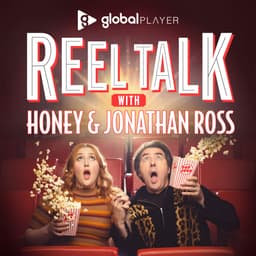
A recommendation becomes useful when you can hear what produced it. On Reel Talk with Honey & Jonathan Ross, EP 112: Scream 7, How to get to Heaven from Belfast, The Moment moves from family catch-up into Honey’s dissatisfaction with Scream 7’s character relationships. Jonathan complicates the discussion of its AI ideas by suggesting that rapidly changing technology can outpace a script during production. A disappointed reaction becomes a conversation.
Linoleum Knife makes its verdict tangible in 696. Backrooms, Obsession, Is God Is, The Mandalorian and Grogu, Pressure. The hosts read Obsession through a man’s deprivation of a woman’s agency, praise Indy Navarone’s performance and acknowledge narrative situations they find goofy. They explicitly withhold the worse events that follow. A prospective viewer gets the film’s concerns and the hosts’ reservations without spending its surprises.
For listening tied to what is arriving on screen, continue to the New Release Reviews page. The Movie Reviews page is another route when your choice begins with a particular film.
Rewatching: familiarity under friendly pressure
Knowing a movie well changes the questions you ask of it. The Rewatchables uses recurring categories to turn affection into something the panel can argue over: the scene worth replaying, the memorable shot, the food that somehow deserves recognition. In ‘F1’ With Bill Simmons, Chris Ryan, and Van Lathan, the panel considers how the film explains racing to an audience, comparing it with financial dramas in which characters need complicated ideas translated into ordinary language. A sports-movie conversation becomes a question about how storytelling teaches.
The social pleasure is visible in A CR Month Mailbag! A listener proposes an award for terrible on-screen athleticism; another suggests recognising Bill Simmons’s mispronunciations. Listeners can help revise the rules of the game. It rewards familiarity with the hosts as well as the films.
Awesome Movie Year puts affection under different pressure in The Goonies (1985 Jason's Pick). Josh Bell finds the overlapping chatter an obstacle to understanding the setup; Jason Harris defends it as the way children behave. Neither saw the film as a child, yet they describe different attachments to it. Admiration has to explain itself. Watch the film before either detailed discussion, then follow the Classic & Cult Films page for more retrospective listening.
Film history: looking beyond the usual landmarks
History can begin with a performer in the corner of the frame. On Micheaux Mission, Len Webb and Vincent Williams give supporting actors attention alongside the leading names. Trepass (1992) travels through actor connections and television credits before reaching the film itself. Their praise of Walter Hill’s direction becomes specific to the warehouse space and the images they say could hold attention even with the sound off. Arrive willing to follow a career conversation before the review.
In Rye Lane (2023), their attention turns to colour, costumes and the urban landscape they see the film celebrating. Earlier, discussing an Eddie Murphy documentary, they ask what it would mean to hear Murphy reflect on a particular television appearance instead of leaving it unexplored. Representation involves choices about whose perspective gets developed.
Trylove approaches a familiar filmmaker through a close argument. In Episode 377: THIEF (1981) with Kelly Krantz, the roundtable discusses the force of the Tangerine Dream score, then considers Frank’s hope of combining criminal work with an unaffected personal life. One participant wishes the film gave more space to his partner’s earlier life. The conversation keeps asking what the film shows, and what it leaves outside the frame. Choose this when you want interpretation to accompany the return to a classic.
Horror: choose your spoiler distance
Horror makes the before-or-after decision unusually consequential. The Evolution of Horror announces full spoilers at the start of MAN-MADE MONSTERS #27: Pulse (2001) & One Missed Call (2003) and asks listeners to watch both films first. Mike Muncer and Stacie Ponder distinguish Pulse’s ghosts from the murderous adversaries viewers might expect, interpreting its fear through loneliness. Their discussion revisits the early internet as something exciting and unknowable. The pairing gives the films a shared technological setting without flattening their differences.
Horror Movie Talk offers a more argumentative room. Black Phone 2 Review begins with brief reviews and scores before moving into spoilers. The panel’s disagreement develops into a concrete objection: one participant thinks a repeated phone conversation fails to become more illuminating as the film returns to it. Enjoying a supernatural horror movie and finding its storytelling persuasive are separate questions here.

Fright Mic makes the effort of following a film audible. In Now Playing: It's What's Inside, Sam and Liz admire the actors’ body-switching performances, then repeatedly correct themselves while sorting out who occupies which body. Their enthusiasm survives the confusion. This is company for someone who has already watched and wants to puzzle it through, with patience for conversational backtracking. Continue to the Horror Film Reviews page for more genre listening.
Craft and business: how the choices reach the screen
A review can raise a question that an interview then answers. /Film Weekly combines those forms in undertone (with Writer/Director Ian Tuason), V For Vendetta's 20th Anniversary (with James McTeigue), and More. The reviewers question how undertone portrays podcast recording; Tuason explains how studying Paranormal Activity helped him work out what would make the film’s audio recordings frightening. Save it until after viewing if you want to preserve the discovery: their discussion reaches plot details.
The Evolution of Horror provides a different entry in 28 Years Later: The Bone Temple (2026) with Nia DaCosta. Muncer introduces the interview as largely spoiler-free, with minor plot details, and the subsequent discussion as spoiler-free. DaCosta explains that violence should earn its place, describing her own restraint rather than pressure from the filmmakers. It gives listeners a production principle to consider when watching.

Business talk becomes revealing when it changes how you understand a film’s presentation. In The Filmcast’s Ep. 861 - The Wrecking Crew, the hosts debate an advertisement that omits the movie’s title. They suggest it may be selling a subscription more than an individual film, while joking about knowing what to search for. Their interpretation of the marketing has a recognisable viewer problem attached. For a wider route across screen conversation, use the TV & Film page.
Specialist fandom: enthusiasm with an eye for detail
Recognition becomes criticism when someone explains why it matters. Masters of the Nerdiverse Podcast does that in MOTN Reviews: The Super Mario Bros. Movie (2023). Mike G and Wash linger on musical memories and the staging of the pipe sequences, praising how the film makes the game’s navigation legible on screen. Their delight is emphatic and assumes an appetite for Mario references. Begin here if remembering the games is part of your reason for watching.
The Tragedy of Cinema brings a comparable attachment to Fantastic 4: First Steps. Jimbo and Bond praise its rounded design, pastel colours and opening-credit styling, then discuss references they think a less invested viewer might miss. Their measure of success includes respect for the characters’ comic-book history. The Animation and Comic Books pages offer further routes from those respective interests.
Where to start
- Before buying a ticket: The Evolution of Horror — 28 Years Later: The Bone Temple (2026) with Nia DaCosta. The announced spoiler-free discussion and largely spoiler-free interview offer a view of the film’s tone and DaCosta’s approach; expect minor plot details.
- After a blockbuster: The Rewatchables — ‘F1’ With Bill Simmons, Chris Ryan, and Van Lathan. Watch first, then hear the panel connect racing exposition with other films that explain complicated subjects.
- For an argument about a classic: Trylove — Episode 377: THIEF (1981) with Kelly Krantz. Bring a recent viewing and time for an extended roundtable on music, work and relationships.
- For attention to Black cinema: Micheaux Mission — Rye Lane (2023). Watch the film, then follow Webb and Williams through its colour and setting, with room for other film conversation along the way.
- For game-to-screen delight: Masters of the Nerdiverse Podcast — MOTN Reviews: The Super Mario Bros. Movie (2023). Best after watching, especially if you want someone to share your excitement about a musical cue or a familiar move.
Featured shows below are part of the PlayNext catalog. Updated weekly.
Featured shows
8 shows, described rather than listed
A short write-up for each, plus the job it does in this guide.
The Ringer's flagship watch-along show. Bill Simmons, Chris Ryan, Sean Fennessey, Mallory Rubin, Van Lathan — a film both worth rewatching and worth arguing about, treated with the seriousness of people who watched it three or four times.
Mike Muncer's themed-arc horror analysis. Current MAN-MADE MONSTERS arc pairs films thematically across decades and works through what the comparison reveals — closer to film-studies seminar than episode-per-film reviewing.
Andrea Subissati and Alexandra West, credentialed horror scholars. Closer to a recorded conference panel than to a review aggregator. The slate's deepest horror-studies entry.
Single-film horror reviews, accessible language, regular cadence. The entry point for listeners who want horror coverage without committing to themed deep dives.
Len Webb and Vincent Williams working through the entire history of Black cinema episode by episode. The slate's strongest curatorial project — comedy, drama, action, sci-fi treated systematically rather than via canonical syllabus.
Trylon Cinema's house podcast. Episode list reads like a syllabus for the rep programming the Trylon actually runs. The slate's cleanest example of film-watching organised by curatorial intent rather than streaming-service algorithm.
Single-year structural approach: a year of cinema worked through episode by episode. The constraint forces hosts to confront documentaries and animated films that drop out of standard top-of-year lists.
Most eclectic schedule on the slate. Twilight Zone series, current studio releases, anniversary specials, horror canon. The unevenness is the point — a podcast that has earned its scope by being interesting across the full range.
Where to start
4 routes in, one per reader
*L.A. Confidential* is the entry point: four hosts, a great film, ninety minutes of working out what makes it work.
MAN-MADE MONSTERS #33 (Upgrade + Invisible Man) is themed-arc analytical work at its strongest. Pair with Faculty of Horror's Last House on the Left for the academic-horror counterpart.
Recent Deep Blue Sea (1999) episode shows the format's flexibility — a B-movie treated with the same seriousness as the show treats The Glass Shield.
Recent MATEWAN (1987) and THE BAD SLEEP WELL (1960) tell you whether the Trylon's curatorial sensibility fits your taste.
Glossary
Film Reviews vocabulary, decoded
Format where one film is treated by a panel of hosts who actually rewatched it. The Ringer's *The Rewatchables* is the slate's flagship; format prioritises argument-with-hosts over single-host criticism.
Multi-episode arc that pairs horror films thematically across decades. *The Evolution of Horror*'s MAN-MADE MONSTERS series is the current exemplar; closer to film-studies seminar than to episode-per-film reviewing.
Format where credentialed scholars treat films at conference-panel depth. *Faculty of Horror* is the slate's exemplar. Distinct from review-aggregator format.
Show built around a structured curatorial program rather than reaction to current releases. *Trylove* (Trylon Cinema's house podcast) is the slate's example; episodes mirror actual repertory programming.
Show working through an entire body of filmmaking systematically rather than via canonical syllabus. *Micheaux Mission*'s coverage of Black cinema is the slate's example.
Structural-constraint format: single year of cinema worked through episode by episode. *Awesome Movie Year* is the exemplar; constraint forces confrontation with documentaries, animated films, and foreign cinema usually dropped from top-of-year lists.