Topics / Ancient History
Ancient History Podcasts
158 shows and 16,795 episodes sit under Ancient History.
The best ancient history podcasts on PlayNext: Rome, Greece, Byzantium, Egypt, and the edges of the classical world. Updated weekly.
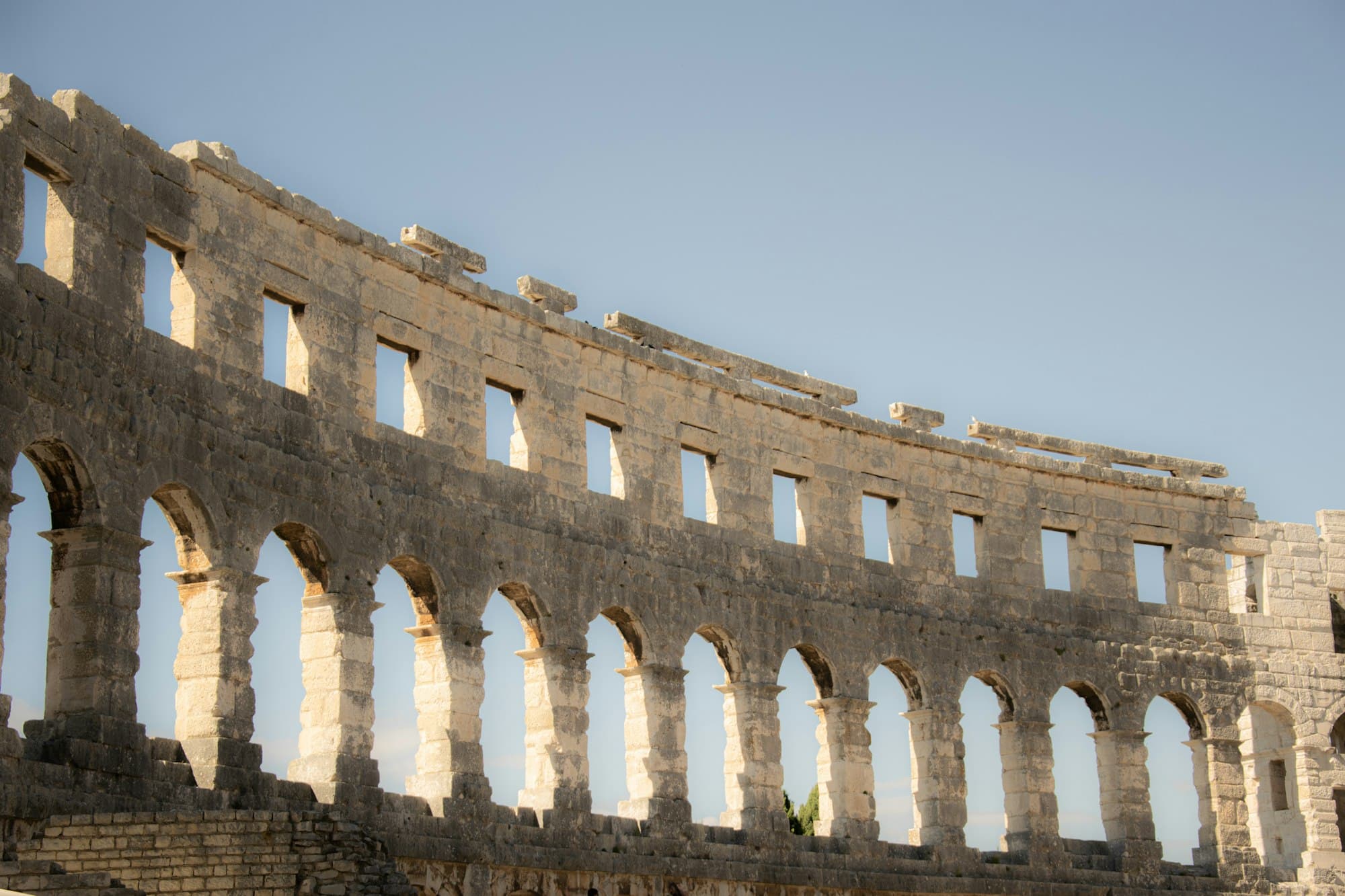
Photo: Kristóf Bogár on Unsplash · Unsplash License
Swipe · Ancient History only
Swipe through Ancient History
Save time discovering your next favourite podcast by listening to just the best minute of an episode.
The ancient history slate · every cover a link
All 158 ancient history shows →



Listening guide
Getting into Ancient History podcasts
A court decision found at Nineveh records five men caught with stolen goods worth 14 mina and 30 shekels of silver. In Neo-Assyrian Imperial Administration, Oldest Stories pauses over their names, which the host reads as signs of Aramean, Babylonian and mountain origins. It also turns to a bigger question: how far did a chief judge's authority reach across the empire? The host's answer is "I have no idea, and I'm not sure that we have the right fragments to tell us." The episode follows one small record out to an empire and leaves the gaps visible. That is what ancient history in audio does at its best.
The range is wide. Classicists argue over coins and papyri. Egyptologists describe a working day on a dig. Two hosts rank Roman emperors and sign off with a kazoo, and Gibbon is read aloud. Listeners argue about trust and taste. In July 2026 a Reddit thread asked for podcasts by professional historians or archaeologists, and one reply set non-academic narrators apart from academic history while saying they had enjoyed both. In May 2026 a listener looking for ancient history objected to sound effects and dramatic delivery, and another defended radio-style storytelling. In August 2026 a thread asking for history podcasts specified ones made without AI. These are small conversations, not surveys. They still raise the questions this guide keeps asking: who is speaking, how do they know, and what does it sound like?
One story, followed for years
Chronological serials ask the most of a listener and give continuity in return. The History of Byzantium carries Rome past 476 toward 1453. In Episode 324 - Just Another Beylik, the show argues that just 13 years after Andronicus III's death the empire no longer really deserves the name. Its rulers are simply holding on inside a Turkish world. The same habit of scepticism shows in a listener-question episode. In Episode 349 - Questions XVIII, a question about Basil I's paternity gets a blunt reply: "I'm always suspicious of poisonings and false parenthood stories. They are very popular and impossible to disprove."
Further east, History of Persia looks for causes outside the throne room. In 156: Babylon Drift, the show proposes that four volcanic eruptions between 247 and 244 BCE, in Japan, Mexico and Martinique, lowered the Nile. It then uses those low waters to explain how a Seleucid empire survived Ptolemy's advance. The argument is the show's own, built by laying two timelines side by side. 150: The Time Lord names its debts openly: a paper by James R. Russell and a newly posted dissertation by Garrett Hansen.

Near the end of Sennacherib's Inheritance, Oldest Stories plays a song adapted from a literary tablet probably composed by Sennacherib himself. The Ancient World covers an older Mesopotamia just as closely. In Episode A12 - The Flood, the loss of Eshnunna shows up in the records when Ibi-Sin's year names give way to those of a local ruler, Shu-Ili-Shu.

Casting Through Ancient Greece, hosted by Mark Selleck, moves steadily through the Peloponnesian War. 89: The Tenuous Truce asks whether Thucydides deserved exile for the fall of Amphipolis. It admits the fullest account is Thucydides' own and draws on Donald Kagan. The Maritime History Podcast tells the same century from the water. In 041 - A League of (Our) Own: The Delian League, the host rejects the tidy tale of Athens muscling Sparta aside: "I think that this is an overly simplistic way to portray things." The Layman's Historian takes the Punic Wars as far as Episode 52 - The Fall of Carthage, pausing there to correct a statement from an early episode. All of these reward starting at the beginning. The Ancient Greece & Mythology page and the Military History guide go further.
Experts at the microphone
Emperors of Rome pairs Matt Smith with Dr Rhiannon Evans and Dr Caillan Davenport. The show's strength is showing where knowledge comes from. In How the Tetrarchy Won the East, Lucius Domitius Domitianus claimed the title Augustus in Egypt in 297. No literary source names him, but his name appears on coins, papyri and ostraca. One limitation: near the end, that episode points listeners to Patreon to hear it in full. The Ancient Rome page has more.
Interviews let a specialist think aloud. The History of Byzantium marked the anniversary of Basil II's death with Episode 333 - The Bachelorhood of Basil II with Mark Masterson. In it, Masterson treats one piece of evidence about the emperor's sexuality with restraint: "It's a data point." Ancient History Fangirl's RE-RELEASE: Actium, Baby! (With Barry Strauss) explains why Antony and Cleopatra fought at sea. Octavian refused battle on land, and a march back to Egypt would have been long and hard to feed.

Kemet - l'antico Egitto in podcast, in Italian, is made by doctoral students and researchers in Egyptology. In 072 - Animali sacri e dove trovarli...in Egitto, Angelo Colonna of Sapienza University argues that animal worship should not be dismissed as a late phenomenon. He contrasts the Apis bull, which lived in the temple much as a sovereign lives in a palace, with cats mummified in enormous numbers, which became sacred only through burial. The Ancient Civilizations page is the next stop.

Listeners who want credentials should also know which kind of room they are in. Where Did The Road Go? gives Laird Scranton 77 minutes in Laird Scranton on China's Cosmological Prehistory - September 27, 2014 to argue that early symbols encode a shared cosmology. The host's follow-up questions turn to Sirius and the Electric Universe.
Below the palace
Past Lives, written and narrated by Patrick Wyman, includes early in The Tomb of Fu Hao and the Rise of the Shang Dynasty a narrated scene of captives driven off after a dawn raid. It then sets up a pair of episodes, one on the Shang elite and one on the labourers and enslaved captives beneath them. The episode treats the mass sacrifice that ended many of those lives as a product of how Shang power worked, not as spectacle. It also marks the limits of what is known. Fu Hao may have come from the steppe's edge, but only isotopic and ancient DNA evidence could prove it, and the episode says that evidence is not available.
In Kemet - l'antico Egitto in podcast, 067 - Lavorare in Egitto con Vittoria (parte 1) takes the same downward view through fieldwork. Vittoria Rapisarda describes the Lost City of the Pyramids as an ordinary fourth-dynasty settlement, whatever its Indiana Jones name suggests. She talks through measuring, photographing and drawing graves, with a second breakfast of bread, cheese and tamaya at ten. The Fall of Rome Podcast's Tides of History: Natural Disasters and the End of the Roman Empire takes another route. It follows a farming family, Thecla and Petrus, living through the cold of 536.
Laughter, and its limits

Life Of Caesar Premium Podcasts spent part of its Vespasian series on the siege of Jerusalem. Goddamn it, Carl! – Vespasian #17 sets Josephus's account of a man named Jesus prophesying the city's destruction beside the Gospel of Matthew. The hosts also run a long joke about a soldier they call Carl, whom they make the one who sets the Temple burning. The comedy runs straight through starvation and the killing of civilians. Some listeners will find that a relief, and others will find it wrong for the material.
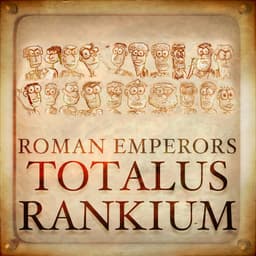

Roman Emperors: Totalus Rankium scores emperors on a points system. S2 Draw retells Justinian II's exile, the loss of his nose and his return to the throne. In S2 The Final, one host describes children acting the story out and writing diary entries from Leontius's prison cell. History For Weirdos, hosted by Stephanie and Andrew, sets aside the old theory that Tutankhamun was killed by a blow to the head in Episode 153: The Life, Discovery & Curse of Pharaoh Tutankhamun (aka King Tut). The episode traces that theory to a 1968 x-ray. Later it repeats a claim about radiation in the tombs that one host admits sounds far-fetched.
Old books, read aloud

World’s Story Volume IV- Greece and Rome is a LibriVox reading of Eva March Tappan's anthology. 092 - Peace with the Goths or war 535 AD by Felix Dahn stages an imperial council that builds toward "War! war! cried Justinian." In 082 - The winning of the first missus about 391 AD by Georg Ebers, an advertisement cuts across a chariot race. History of the Decline and Fall of the Roman Empire by Edward Gibbon offers judgment with real bite. In Chapter 03 Pt. 2, Gibbon writes: "War he detested, as the disgrace and calamity of human nature." The History guide maps the wider field.
Where to start
- For a first taste of method: Emperors of Rome, How the Tetrarchy Won the East, to hear coins and papyri rebuild a usurper whom no literary source names.
- If one conversation appeals more than a serial: The History of Byzantium, Episode 333 - The Bachelorhood of Basil II with Mark Masterson, which stands on its own.
- For ordinary lives: Past Lives, The Tomb of Fu Hao and the Rise of the Shang Dynasty, then its companion episode on the people at the bottom.
- If you understand Italian: Kemet - l'antico Egitto in podcast, 067 - Lavorare in Egitto con Vittoria (parte 1), a dig described from experience.
- For company and jokes: Roman Emperors: Totalus Rankium, S2 Draw, which recaps a season of emperors before its knockout rounds.
Whichever you choose, listen for the moment a host says what the fragments cannot tell. That admission is usually where the history starts.
Featured shows below are part of the PlayNext catalog. Updated weekly.
Recommended clips
The strongest Ancient History clips
The highest-scoring 60-second moments anywhere in ancient history, one per show.
Drawn from 2,423 playable clips across 122 shows.
New on PlayNext
Just added to Ancient History
The newest ancient history clips in the library, one per show — ordered by when the clip was made, not when the episode came out.
2 clips, one per show, added between 2026-06-17 and 2026-08-06.
Featured shows
6 shows, described rather than listed
Each one comes with a short write-up and the role it plays in this guide.
Narrative-driven episodes on Roman republicans, revolts, and women in power. Strong on Julius Caesar, Spartacus, Boudicca, and the late republic.
Question-led conversations that clear names, dates, and source problems before moving into the story. Covers Rome, Greece, and the wider ancient world.
Long-form solo narrative on the Eastern Roman Empire from Constantine to Constantinople's fall. Careful, measured, and comfortable with counterfactuals.
Focused episodes on Roman festivals, sacred geography, witches, and provincial figures. Deeper texture than the headline battles-and-emperors lane.
Academic-adjacent episodes on Greek society, Homeric epic, Spartan life, race, and classical antiquity. Mixes deep dives with broader survey entries.
Five-part Ancient Egypt survey covering daily life, religion, pharaohs, warfare, and the afterlife. Broad entry point for listeners new to the topic.
Where to start
5 routes in, one per reader
Rome Has No Kings is a clean republican entry; ALL IN ONE PLACE compilations let you cover Spartacus or Julius Caesar in one sitting.
Every episode opens by clearing the historical ground before diving in — good for listeners who want to understand the evidence, not just the story.
Episode 341 (Mehmed and Constantinople) and Episode 344 (Cold Case: Constantine XI) demonstrate the show's careful imperial-history mode.
The five-part Ancient Egypt run goes from daily life to the afterlife in order — the clearest newcomer path in the corpus for Egyptian history.
The Roman calendar series (January through June) and episodes on witches and sacred place give the ancient world a texture beyond emperors and battles.
Glossary
Speak the language
The period of Roman government (509–27 BCE) run by elected magistrates and the Senate, before the emperors. Much of the most dramatic Roman political history — Caesar, Spartacus, the civil wars — belongs here.
The eastern continuation of the Roman Empire, centred on Constantinople, that lasted from roughly the 4th century until 1453 CE. Byzantines called themselves Romans; the label 'Byzantine' is a later invention.
Broad term for the Greco-Roman world from roughly 800 BCE to 600 CE — covering the Greek city-states, Hellenistic kingdoms, the Roman Republic, and the Roman Empire.
A text or object produced at or near the time of the events it describes. Ancient historians like Thucydides, Livy, or Plutarch are primary sources; their gaps and biases are central to how modern scholars reconstruct the past.
The study of the past through physical remains — buildings, objects, inscriptions, bones. For ancient history, archaeology often fills gaps where written sources are silent or unreliable.