Topics / Science Education
Science Education Podcasts
162 shows and 12,307 episodes sit under Science Education.
Learn through classroom practice, chemistry exam prep and STEM projects with The Physics Teaching Podcast, Lab Out Loud and The Power of (STEM)2.
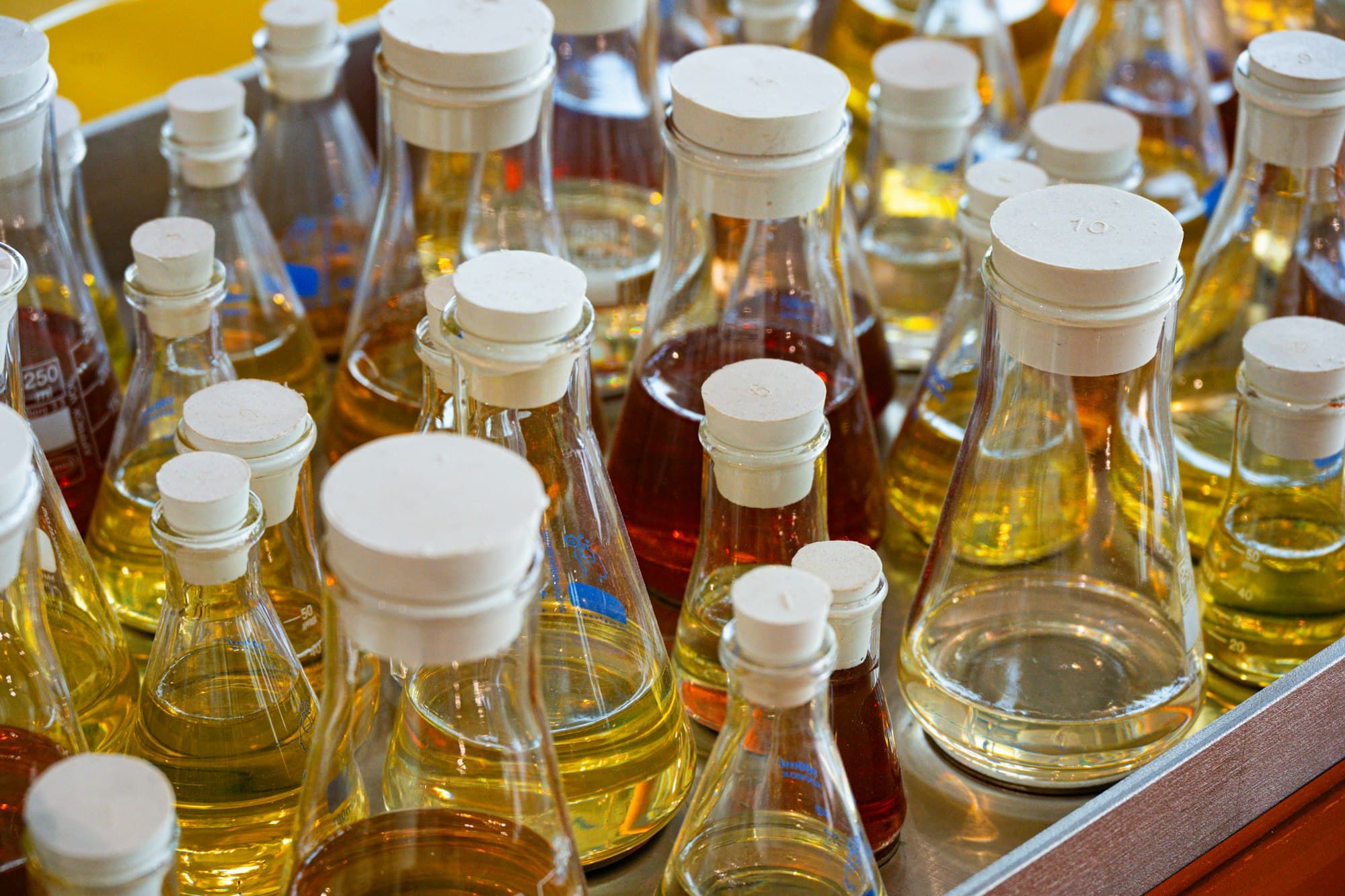
Photo: Julia Taubitz on Unsplash · Unsplash License
Swipe · Science Education only
Swipe through Science Education
Save time discovering your next favourite podcast by listening to just the best minute of an episode.
The science education slate · every cover a link
All 162 science education shows →


Before you press play
Science Education podcasts, explained
There is a particular pleasure in hearing a confident idea come apart. A term you have repeated for years turns out to be trade slang. A claim you half-believed turns out to rest on a misread experiment. The best science education podcasts live in that moment, and in its quieter twin: the second when a process you could never picture finally takes shape in your head.
The field makes two promises. Some shows teach science directly: a teacher working through the joints of the hand, siblings wrestling with phospholipids, a skeptic retracing how a microbe was shown to cause disease. Others are about teaching science, made for people who explain it to classrooms, museum crowds and children playing Minecraft. This guide covers both, and some of the best listening sits where they overlap.
Listeners are arguing about whose explanations to trust. In recommendation threads this year, one listener praised a funny, human host interviewing scientists. Another wanted researchers discussing papers together, and a third complained of a voice they took to be AI-generated. Format is moving as well. In June 2026, Edison Research reported that in the third quarter of 2025, 82% of US weekly podcast consumers watched video podcasts and 78% listened to audio-only shows, overlapping habits rather than rival camps. None of that settles what helps people learn, which is the question to carry into every show below.
Claims, tested
Skeptoid is the most direct route. In Is Germ Theory a Myth?, it sets out Koch's four criteria for proving that a microorganism causes disease. It then examines a book's claim that his samples were poisoned by a blue stain. The stain, the episode explains, was used to examine tissue, while the animals were inoculated with pure cultures. Checking a claim against the source it cites is a habit worth borrowing, and the episode states its conclusion bluntly: "Vaccines work. Antibiotics work."

Just Na Science, hosted by Lauren and Nick, covers similar ground with jokes and strong language. In Avoid Being Scammed by the Wellness Industry with Special Guest Dr. Bernie Garrett, Garrett, of the University of British Columbia School of Nursing, lists warning signs: testimonials offered as evidence, celebrity endorsements and secret cures. Shabam! teaches the method underneath. In S1:E10 - Part 2 - The Truth About The End, the episode explains why asking whether a mystery rat is black can plant the answer, while asking what color it is does not.
The Great Updraft offers dissent. Across April 2026 episodes, host Ross Edwards questioned whether science can be an ultimate account of reality. His case is philosophical. In If Science Isn’t Ultimate, How Should We Use It? he allows that science "gives you a barometer." Hear it as one thinker's case.
Learning a subject, piece by piece

When the goal is a body of knowledge, structure matters. Anatomy and Physiology - Bit by Bit comes from Dr. Steve Sullivan, who has taught A&P since 2002. In Infectious Disease & Vaccines with Dr. Anusha Viswanathan, MD - Episode 88, he breaks into the interview to define IgG and IgE. He also points listeners back to episode 58 on adaptive immunity, so the clinical talk never outruns the basics. COPD with Dr. Nina Maouelainin - Episode 87 lists early on what you should be able to explain by the end. Sullivan frames these episodes as the step from the normal A&P of his first 80 episodes into clinical application. The Higher Education page covers the wider college stage.
Lexx Education turns revision into sibling comedy. Laura Lexx retakes her science GCSEs with her brother Ron, working through the UK National Curriculum. In Business in London she tries "amphiphobic" and "amphibiotic" before landing on amphipathic and explaining which end of a phospholipid loves water. More Fish Good Heart rehearses an exam question on omega-3 and heart disease. It moves from spotting a negative correlation to asking whether outliers leave the trend inconclusive. The detours are long, and the show is frank about retention: "I don't listen and I don't store it up."

Varmints! learns alongside its audience. In Frog Article Discussion with the Cast!, the cast reads a Quanta Magazine piece by Veronique Greenwood about a gene that has jumped from snakes to frogs. Moss, billed as Science Dude, unpacks the harder passages. Herpetologist Henry Adams of the Lincoln Park Zoo answers listener questions in a four-part interview that same month.

Applied shows can be the clearest teachers. Rule Your Pool is hosted by Eric Knight for pool owners and service pros. It gives a guest the floor in Allergic to Chlorine? A Microbiology Lesson (w/ Roy Vore, Ph.D.), where true chlorine allergy is called incredibly rare. The episode also notes that in the scientific literature, "There's no such thing as a mustard algae." In pplpod's BOILING THE OCEAN!: The Science of Desalination, one voice supplies the figures while the other stops to ask, "A thermocline. Explain that for us." Its most striking point, credited to a 2005 study, is that lifting water 2,000 meters costs about as much energy as desalinating it.
For young listeners and their families
Science for children lands best when it arrives through people and stories. SolveItForKids Science podcast, hosted by Jennifer Swanson and Jeff Gonyea, brings real scientists and engineers in to talk through the problems they solve, then invites families to try a challenge themselves. Its anniversary episodes gather favorites. One is a dentist explaining how students learn by building teeth from wax. Another is an engineer describing the crawler's control room and its surprisingly small steering wheel.
Shabam! folds real science into a serialized zombie story. In S1:E9 - Part 1 - Killing Zombies, two siblings' memory of a foul-smelling VW camper becomes a lesson in long-term memory. S1:E8 - Part 1 - On The Road moves from the history of the wheel to William and Ellen Craft's escape from slavery, with historian Richard Blackett and Barbara McCaskill. Hear that one alongside a child. Season one wrapped in 2018 and rewards listening in order.
Teaching science
For educators, the question shifts from what to know to how to make it stick. Lab Out Loud is hosted by Dale Basler and Brian Bartel, both science teachers. In The One Science Every Earthling Should be Exposed to, they ask a structural geologist how to teach climate without leaving students paralyzed. She points to students applying Earth-system knowledge to events as they unfold. In Fighting Wellness Scams with Science, the hosts recall wanting a way to judge a district wellness event, then finding a book on exactly that.
The FizzicsEd Podcast, hosted by Ben Newsome, gathers educators from Australia and beyond. Eco Detectives Unite – The Race to Zero (Minecraft Education) describes a climate game the guest would play in four 45-minute blocks. It also works through the puzzle of featuring cats, which the guest describes as invasive in Australia's drylands but native to Scotland, on a global platform. The guest adds a "breakthrough behavior" category to rubrics for ideas the criteria never anticipated. In Capacity building in SciComm with Dr Graham Walker, Walker describes breaking tasks into chunks so learners can drive their own ideas without anxiety. Go further on the Teaching Methods, K-12 Education, Educational Technology and Professional Development pages. FizzicsEd's archive also includes Maths Teacher Circles with Michaela Epstein, a bridge to the Mathematics Education page.
Where to start
- If a dubious claim is nagging at you: Skeptoid, Is Germ Theory a Myth?, a compact walk through how scientists prove what causes a disease.
- For a student facing an A&P exam: Anatomy and Physiology - Bit by Bit, COPD with Dr. Nina Maouelainin - Episode 87, which states its learning goals up front.
- For revision with company: Lexx Education, More Fish Good Heart. Expect strong language.
- For curious kids and their adults: SolveItForKids Science podcast, Five Year Anniversary with Jeff's Five Favorite Episodes, a sampler of guests from the deep ocean to space.
- For teachers between lessons: Lab Out Loud, The One Science Every Earthling Should be Exposed to.
Choose the question already on your mind, play one episode, and let the next question decide where you go. The Education page maps the wider territory.
Featured shows below are part of the PlayNext catalog. Updated weekly.
Featured shows
8 shows, described rather than listed
Each has a short write-up and a note on what it does best here.
A calm, teaching-first conversation takes one systems-thinking model at a time, restating it through examples and broader principles. It suits listeners who like measured explanations of conflict, change and visible thinking.
Physics teachers talk shop in a warm, informal exchange, using follow-up questions and post-interview reflections to keep guest conversations tied to classroom misconceptions and curriculum. It suits working educators.
A brisk duo guides students through NEET chemistry with prompts, checks for understanding and plain-language cues. Episodes cover coordination compounds, block elements, kinetics, electrochemistry and solutions.
Episodes question how science relates to reality, experience and psychology, alongside spiritual awareness and non-duality. It suits listeners interested in the limits and uses of scientific knowledge.
Island-focused STEAM episodes connect school activities with culture, environment and society, from 3D island building to decolonizing education. It suits teachers seeking place-based science and technology ideas.
Episodes spotlight specific science ideas, including 3D-printed biomaterials and the one science every Earthling should encounter. It suits listeners looking for focused introductions to individual topics.
A Minecraft Education episode turns the Race to Zero into an eco-detective challenge. It suits educators and students interested in using a familiar game setting for environmental learning.
This podcast is framed around science tips for homeschooling from Elemental Science. It suits listeners looking for guidance explicitly focused on homeschool science.