Topics / Historical Events
Historical Events Podcasts
130 shows and 9,335 episodes sit under Historical Events.
Hear aviation investigations on Final Boarding Call, overlooked women on What'sHerName, and pivotal surprises on No One Saw It Coming.
Photo: LARAM on Unsplash · Unsplash License
Swipe · Historical Events only
Swipe through Historical Events
Save time discovering your next favourite podcast by listening to just the best minute of an episode.
The historical events slate · every cover a link
All 130 historical events shows →



The guide
Some great Historical Events podcasts to get to know
On 17 August 1896, gold was found in the Klondike, and nobody can say for certain who found it. George Carmack gave his biographer one version. Members of his wife's family credited her brother and nephew, Skookum Jim and Dawson Charlie, who were out moose hunting. Shaaw Tláa, known as Kate Carmack, said in old age that she found it herself, washing dishes in the creek while the men slept. What'sHerName sets out the competing versions and admits the obvious: "We will never know."
That admission is a fair test for any historical events podcast. From a distance an event is a date. Up close it is a contest between witnesses, documents and later tellings, and audio can stage that contest well: a guest's correction, a historian's hedge, a two-hundred-year-old voice read aloud. The shows below range from tightly produced weekly documentaries to long interviews and comedians working through scandals. What separates them is less polish than accountability: whether a show tells you where its story comes from, and where the record runs out.
The arguments around the form follow from that. In December 2025 a long-running history podcaster published an essay arguing that presenting atrocities as exciting stories can diminish victims' humanity. Other listeners say an immersive telling is what made a disaster's aftermath comprehensible to them. In September 2026 one listener asked for trustworthy history shows made without AI, so provenance now matters to at least part of the audience. And Edison Research's March 2026 Infinite Dial presentation measures podcast use from 2025 onward as listening or watching, so the old measure has widened.
One week, one decision

HISTORY This Week, a History Channel original made with Back Pocket Studios, works from the premise that something consequential happened this week in an earlier year. Jefferson’s Trade War Shuts Down America shows the approach at its best. It places Thomas Jefferson signing the Non-Importation Act of 1806 "likely in his private study, possibly with his pet mockingbird on his shoulder." That reconstruction keeps its hedges in view. The episode then delivers its judgment: "Jefferson is trying to fight fire with paper." By the time the trade war has hardened into an embargo, it is counting forty bankrupt mercantile companies in New York and grass growing on the wharves. Cause runs cleanly to consequence in 28 minutes.
Oil Fields, Bags of Cash, a Presidency Exposed does the same for Teapot Dome. Interior Secretary Albert Fall makes a secret drilling contract and threatens a crusading newspaper editor: "I'm going to break you." The guests include Joshua Castenberg of the University of New Mexico School of Law. Both episodes lead naturally to the American History and Political History pages. The Colosseum Becomes a Wonder | A Conversation with Barry Strauss & Alison Futrell moves from the 2007 global vote on new world wonders back to Rome. One guest describes gladiator graffiti in an underground city at Pozzuoli ("It's like you're in the New York subway"), and the conversation keeps the gladiators' celebrity in the same frame as their frequent status as slaves or prisoners of war. The Ancient History page goes further. The trade-off is scale: a single compact episode can clarify an event, but it can rarely settle a scholarly dispute.
Inside one life
An event can also be told from inside a single life, particularly a life the record barely kept. What'sHerName, hosted by the sisters Dr. Katie Nelson and Olivia Meikle, is frank about those gaps. In THE PREACHER Jarena Lee, guests Lisa Gring-Pemble and Martha Watson, authors of Your Daughters Will Prophesy, take up the account of a woman preaching on foot across the young United States in 1819. Her own text says almost nothing about her home, her family or the world around her, which is why, as the episode explains, scholars would call it a conversion narrative, though the hosts would not. The hosts set her against the Second Great Awakening and find one later trace of her, at the 1853 American Anti-Slavery Society Convention. They acknowledge the uncertainty: "We don't know when or where she died."
The Klondike episode adds a visit to the Klondike Gold Rush National Historical Park in Seattle. There, curator Lyssa Kramer recalls first meeting Shaaw Tláa on a scrap of paper among John F. Hilscher's memoirs. The sisters' warm, interjection-heavy banter will suit some listeners. Others who want brisk narration may find it slows the story down.
Witnesses and their claims
Night Fright Show is Brent Holland's paranormal and conspiracy radio program, and its history comes through long interviews, so its value depends on who is talking. In Ted Sorensen Interview Part 3, Holland revisits his conversation with Sorensen about the Cuban Missile Crisis. He covers the emotional first letter from Khrushchev, received on Friday evening, October 26th, and Bobby Kennedy delivering the reply to Ambassador Dobrynin along with two oral messages. When Sorensen interrupts to sharpen one of his points, Holland's aside, "I said to myself, looks like I passed the test," is oddly endearing. The same episode also stops for complaints about YouTube monetization and appeals for donations.
Legacy of Secrecy calls for more caution. Author Lamar Waldron argues that two of Kennedy's aides saw shots from the grassy knoll and that mafia bosses confessed roles in the killing. Holland presents these points as revelations set against the Warren Commission's lone-assassin conclusion. They are one researcher's case. A Line in the Sand gives 50 minutes to a Canadian soldier-author who argues that the war in Afghanistan was a moral one and remembers the 12 soldiers lost on his first tour. It works as testimony and as advocacy, and it is best heard as both. The Military History page is the place to set it beside other accounts.
A survivor's own words
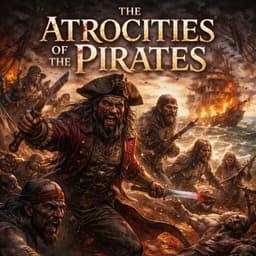
The Atrocities of the Pirates reads aloud, in numbered sections, the first-person account of a man who sailed for the West Indies in June 1821 and fell among pirates while heading home from Kingston, Jamaica. In 01 - The Atrocities of the Pirates, the pirate tells Mr. Lumsden, "Do not imagine that I am a fool, sir," and fire is later applied below decks to force out money. Torture is described plainly, and listeners should know that before they begin. Later sections complicate the picture. In 06 - The Atrocities of the Pirates the narrator partially recovers from fever with help from a woman named Serafina. 05 - The Atrocities of the Pirates includes his complaint that an act he meant to save a life was later cited against him as proof that he had joined in the pirates' brutalities. That complaint is the key to hearing the series well. This is a self-defence as much as a chronicle, written by a man with reasons to tell it his way.
Comedy at the edge

Humour is where the genre argues with itself. Stand-up comedian Dan Cummins builds Timesuck with Dan Cummins from research, swearing and asides. Short Suck #55: Stolen History: The British Museum Debate runs from the museum's 1753 founding through the Parthenon sculptures, the Benin expedition (whose public story Cummins calls a "propaganda narrative"), gems from Charles Townley's collection surfacing for sale online, and Rishi Sunak's March 2023 statement that the sculptures should remain in Britain. Cummins credits researcher Sophie Evans and admits he first thought the topic boring. The British History page picks up the thread. In Short Suck #50: Presumed Guilty: The Duke Lacrosse Scandal he lays out figures on sexual violence before the case itself, and implicates himself: "I 100% rushed to judgment myself." That candour does more work than the jokes.
Pair Of Normal Guys shows what happens when banter outruns care. Kyle and Zane take turns presenting. S1 E13 - Kyle Presents: Cursed follows Giles Corey, crushed under stones at Salem and cleared, the episode says, in 1711. S1 E16 - Zane Presents: Radiation gives a clear reason why Chernobyl differed from Three Mile Island: the reactor exploded. But S1 E18 - Both Present: Jonestown jokes about Kool-Aid and cyanide, which is the very problem that December 2025 essay named.
Where to start
- For a commute-sized story: HISTORY This Week, Oil Fields, Bags of Cash, a Presidency Exposed. It is a self-contained scandal with clear stakes.
- For listeners wary of tidy answers: What'sHerName, THE KLONDIKE QUEEN Shaaw Tláa (Kate Carmack), which weighs three versions of one discovery.
- For hearing history from the room: Night Fright Show, Ted Sorensen Interview Part 1. Begin here, because Part 3 points listeners back to the earlier instalments.
- For patient readers of old books: The Atrocities of the Pirates, 00 Preface - The Atrocities of the Pirates, then the sections in order.
- For anyone who likes their history absurd: Timesuck with Dan Cummins, Short Suck #53: Icaria!: France’s Failed Communist Utopia in America, a failed utopia played partly as comic dialogue.
Whichever you choose, listen for the moment a show says what it cannot know. On What'sHerName it was a creek, three stories and an honest admission, and the best of these shows leave room for one.
Featured shows below are part of the PlayNext catalog. Updated weekly.
Featured shows
8 shows, described rather than listed
A short write-up for each, plus the job it does in this guide.
A narration-led duo traces aviation and transport disasters through dates, procedures, aircraft systems, and investigation findings. Suits listeners who like technical detail with dry reactions.
Two aviation obsessives banter through specific accidents, translating jargon as they go and punctuating the facts with quick asides. For listeners who want technical history in a casual register.
Conversational, feminist storytelling restores women such as Jarena Lee, Juliette Gordon Low, and Queen Mother Audley Moore to view, with archival care. Suits listeners drawn to social history and expert context.
A rotating group pairs researched storytelling with tangents, interjections, corrections, and occasional profanity. Suits listeners who enjoy historical topics delivered as an irreverent group conversation.
One presenter tries to steer facts and dates while a lively panel interrupts with jokes, challenges, sports comparisons, and movie quotes. Suits listeners who like history mixed with rapid, argumentative banter.
A complementary duo turns pivotal events into brisk, information-dense explainers, moving from prompts to mechanisms and consequences. Episodes range from the Printing Press to the Cuban Missile Crisis.
A solo presenter follows chronology and concrete details in an informal, opinionated riff, complete with caveats and side observations. Suits listeners who prefer history lectures without institutional polish.
An interviewer and expert reconstruct history through direct questions, scene-setting, and accessible explanations. Episodes spotlight unlikely pivots, from an ancient steam engine to the blunder that broke the Berlin Wall.