Topics / Astronomy
Astronomy Podcasts
107 shows and 17,578 episodes sit under Astronomy.
Curated guide to astronomy podcasts in 2026: StarTalk Radio (Neil deGrasse Tyson), Science Friction (ABC) on Artemis, SpaceTime with Stuart Gary for weekly space news
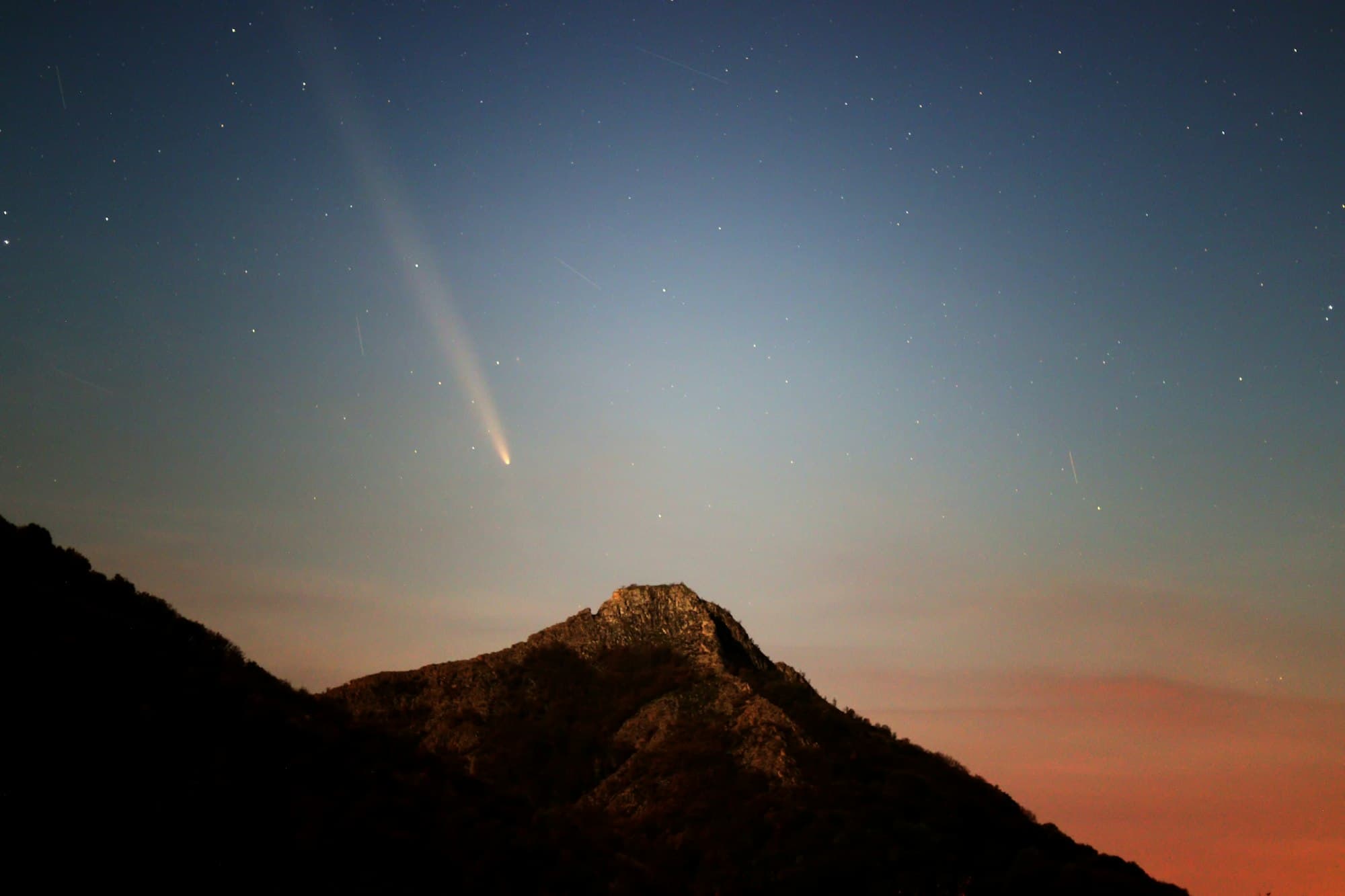
Photo: Dejan Ilić on Unsplash · Unsplash License
Swipe · Astronomy only
Swipe through Astronomy
Save time discovering your next favourite podcast by listening to just the best minute of an episode.
The astronomy slate · every cover a link
All 107 astronomy shows →
The guide
Some great Astronomy podcasts to get to know
Why do professional telescopes use mirrors rather than lenses? On The Supermassive Podcast, the answer comes after a listener asks whether dark matter could be space vampires, invisible because vampires have no reflection. Big glass lenses, one host explains, warp under their own weight, so the large instruments stick to mirrors. Then the vampire idea gets a straight-faced calculation anyway. That exchange shows most of what astronomy audio does well. It takes a question seriously, shows the working, and admits where the working stops.
The form covers a lot of ground. It includes comedy panels and weekly news desks, long interviews with working researchers, reported series about spaceflight's failures, and backyard talk about mounts and concrete footings. Podcasting in general keeps growing. In March 2026, Edison Research reported that 58% of Americans aged 12 and over had consumed a podcast in the previous month, a record. Nobody has measured how many of them choose the sky.
The live arguments are about tone and trust. Some listeners want jokes and tangents; others want an expert left alone to explain. Extraordinary claims test every show. In December 2025, Space.com quoted NASA science official Nicky Fox describing comet-like behaviour in the interstellar object 3I/ATLAS. In the same piece, author Brett Tingley argued that alien-technology claims had drawn television and podcast attention while obscuring scientific work. The question worth carrying through this guide is whether a show lets you hear the difference between an observation and a guess.
Comedy as a way in
StarTalk Radio pairs Neil deGrasse Tyson with comic co-hosts, and at its best the jokes keep a hard explanation moving. Cosmic Queries – Spontaneous Symmetry Breaking with Charles Liu is built from Patreon members' questions. Tyson cuts in to untangle a coin-flip counting problem, and the talk of entropy then lands on water boiling at 100 degrees Celsius, whose steam holds far more possible states than the liquid. The show roams, though. Busting Nutrition Myths with Jessica Knurick runs 56 minutes and discusses dietary guidelines, which suits a general science listener better than someone who came for galaxies.


StarTalk All-Stars, whose most recent listed episodes date from 2018, has astrophysicist Charles Liu fielding listener questions beside Chuck Nice. Walkabout the Galaxy is looser: a four-person panel argues about how to say "kilometer" on the way to the space news. The banter doesn't swallow this caveat. In A Whisper of a Hint of Primordial Black Holes plus Earth BLOBs, a possible small black hole detection is described as "on the hairy edge" between real signal and noise. The Cosmology & Astrophysics page and the Physics guide go further.
The weekly desk
For keeping up, SpaceTime with Stuart Gary works like a bulletin with the numbers left in. Unveiling 11,000 New Asteroids and Earth's Local Origins places the Vera C. Rubin telescope on a 2,682-metre mountain in northern Chile and gives its 8.4-metre primary mirror. It also notes that the International Astronomical Union's Minor Planet Centre confirmed the discoveries. The same 24 minutes relay Virgin Galactic's planned three-day turnaround and a revenue sum built on 750 customers a year. Hear those as projections.

EVSN: Escape Velocity Space News, with Dr Pamela L. Gay and Erik Madaus, is better at the qualifier. In The Black Hole eating star with supernova sized regrets, it lays out a proposed merger between a black hole and a dying star, then asks, "Are researchers 100% sure this is what happened? No." The Space Show, which Andrew Rennie presents for 88.3 Southern FM and the Space Association of Australia, moves more slowly. In 2026.04.01 | Looking back at Earth from the cupola of the International Space Station, a lunar astronomy talk argues that rare sites such as Faustini crater may need protecting, based on what the speaker calls a first analysis. The Stargazing & Astronomy News and Space Exploration & Missions pages track this beat.
Researchers with room

Long interviews are where the form is most generous. Starts With A Bang podcast gives Starts With A Bang #128 - Planet formation and proto-protoplanets 100 minutes. That leaves its guest, Charles, time to explain why planets must form quickly, since most disks around young stars are gone by about 10 million years. He also warns that the giant disks astronomers detect first are not necessarily typical. exocast is more personal. In Exocast-81b: A chat with Dr Matt Kenworthy about weird dips in light curves and the future of instrumentation, Kenworthy recalls a predicted transit that never came: "I would have bet my house on it." He also credits an amateur astronomer in Finland who spotted, in a different infrared catalogue, that a star had brightened years earlier.
Spacepod, hosted by asteroid scientist Dr Carrie Nugent, pairs wonder with scruple. In A newly discovered Martian volcano with Dr. Lee, the guest describes realising the team had been working inside a volcano 450 kilometres across. The same guest keeps the buried ice beneath it at "likely." In 226: The intersection of computer science and astronomy with Dr. Kubica, a hypothetical machine-learning result that is 80% accurate gets a blunt verdict: "That's one in every five things wrong. It's no good." The Planetary Science & Astrobiology page continues from here.
Stories that take time
Reported series serve a different appetite: understanding how institutions weigh risk. In 05 | The Challenger Legacy: Apollo on Steroids, Science Friction (ABC) links 1986 to the Artemis era. That includes a heat-shield problem that one voice says engineers are still struggling to understand three years on. Later the hosts turn to the engineers whose lives the disaster reshaped.

The Habitat, hosted by Lynn Levy, follows six volunteers through a year in an imitation Mars habitat on a mountain in Hawaii. Episode 6: I Feel Like A Million Dollars turns a rehearsal spacewalk into slapstick about radios people can't always hear. Episode 5: Tortilla! finds the crew split into camps inside a dome where, as one member puts it, "you don't just hear it, you feel it."
Under your own sky

Observers often need hardware talk. Cosmos Safari, with David Farina and Rob Webb, gives The Ultimate Backyard Observatory: Stargazer Roll-Off Roof Sheds with Stoltzfus Structures to observatory sheds. It goes down to why the telescope pier gets its own deep footing, so frost can't shift it. Space Junk, with Tony Darnell and Dustin Gibson, takes listener questions. Complete Telescope Systems vs Assembling From Components - Which is Better? weighs a listener's long-held complaint that packaged mounts are under-engineered. SkyTour Radio with Marc D'Antonio is chatty and disarmingly frank. In Astro Potpourri, imaging the patch of sky where an interstellar object should be yields "a tiny dash of light," which the show calls "very anticlimactic."
Speculation, labelled

Science & Futurism with Isaac Arthur trades in things that may not exist, and Cosmic Strings – Cracks in the Fabric of the Universe says so. It hangs its story on "if Cosmic Inflation Theory is right of course" and admits "Lots of uncertainty here." Enjoy the argument, and keep track of which parts have been measured.
Where to start
- If you want to laugh first: StarTalk Radio, Cosmic Queries – Spontaneous Symmetry Breaking with Charles Liu. Listener questions, interruptions, and real physics underneath.
- For a story with stakes: Science Friction (ABC), 05 | The Challenger Legacy: Apollo on Steroids. It is a late part of the series, but it bridges past and present.
- For the patient listener: Starts With A Bang podcast, Starts With A Bang #128 - Planet formation and proto-protoplanets. Long, and careful about what remains debated.
- For someone eyeing a first telescope: Space Junk, Complete Telescope Systems vs Assembling From Components - Which is Better?. Practical, opinionated and informal.
- If people interest you more than rockets: The Habitat, Episode 5: Tortilla!. Spaceflight as cabin fever.
Whichever you pick, listen for the moment someone says an answer isn't settled, and notice whether the show lets that stand.
Featured shows below are part of the PlayNext catalog. Updated weekly.
Featured shows
5 shows, described rather than listed
Each has a short write-up and a note on what it does best here.
Neil deGrasse Tyson's science-explainer-and-comedian-foil format with rotating expert guests. Big-tent astronomy, cosmology, and theoretical physics — all at a pop-science register that spans astrophysicists and casual listeners.
ABC Radio National's two-host science documentary show. Ran an eleven-episode real-time documentary on the Artemis II crewed lunar flyby in April 2026. Earlier Challenger Legacy miniseries covers the institutional history of crewed spaceflight.
Weekly science-news-bureau show covering astronomy, planetary science, and spaceflight. Dense, technically specific, broadcast-accessible. Names the instrument, the journal, and the mechanism in every story.
Long-running episode-per-topic curriculum show now past episode 789. Patient, question-driven, and unusually durable — episodes on technosignatures and rogue planets hold up years after release.
Researcher interviews and monthly sky guides spanning the amateur-to-enthusiast range. Monthly sky-guide episodes are the lowest-barrier entry into practical observational astronomy on this slate.
Where to start
5 routes in, one per reader
*Unveiling 11,000 New Asteroids and Earth's Local Origins* or *Black Hole Merger Sparks Gamma Ray Burst and Iodine Propulsion Revolution* are the entries depending on whether planetary science or high-energy astrophysics is the pull.
The *Artemis Explained* eleven-episode series (April 2026) is the entry — sequential, covers the crewed lunar flyby in real time from launch to splashdown.
*Cosmic Queries – Origins of the Universe, with Janna Levin* is the entry. Pair with *Dark Universe Decoded with Katherine Freese* for the dark-matter side of the same conversation.
*Astronomy Cast Ep. 789: What Happens When a Planet's Star Dies* is recent and self-contained. *Astronomy Cast Ep. 741: Technosignatures* is a good pacing test from the deeper catalog.
The monthly sky-guide episodes (*Astrophiz223-OctoberSkyGuide*, *Astrophiz207 - February SkyGuide*) are the entry — month-specific, concrete, no equipment required.
Glossary
Words hosts use without explaining
The branch of astronomy concerned with the large-scale structure, origin, and evolution of the universe. Podcast coverage tends to center on the Big Bang, dark matter, dark energy, and the geometry of spacetime. StarTalk's Cosmic Queries episodes are the slate's primary cosmology entry point.
A planet orbiting a star other than the Sun. Exoplanet research — detection methods (transit, radial velocity, direct imaging), atmospheric characterization, and habitability assessment — is one of the fastest-moving fields in astronomy and appears frequently across this slate.
The study of the origin, evolution, and potential distribution of life in the universe. Covers prebiotic chemistry, extremophiles, biosignature detection (via missions like JWST), and the search for technosignatures. Appears in *Astronomy Cast Ep. 788: Life's Molecules Form in Space* and StarTalk guest episodes.
The study of planets, moons, asteroids, and comets — their composition, geology, atmospheres, and formation. Distinct from astrophysics (which focuses on stars and larger structures) and cosmology (which focuses on the universe's large-scale structure). OSIRIS-REx asteroid-sample science and lunar geology fall in this category.
Observable signals that could indicate the existence of technologically capable life beyond Earth — radio signals, atmospheric industrial chemicals, megastructure transits. Distinct from biosignatures, which are biological rather than technological in origin. Covered in *Astronomy Cast Ep. 741: Technosignatures*.
A neutron star with an exceptionally powerful magnetic field — among the strongest magnetic fields known in the universe. Magnetar formation and burst events are active areas of high-energy astrophysics. Covered in SpaceTime with Stuart Gary's *Magnetar Birth and Lunar Bombardment: Cosmic Revelations Unveiled*.