A Pontefract haunting that turns ordinary household detail into daylight dread.
Uncanny Cold Cases goes back to Pontefract for the Black Monk case, and the episode is at its best when it lets small domestic details turn sour.
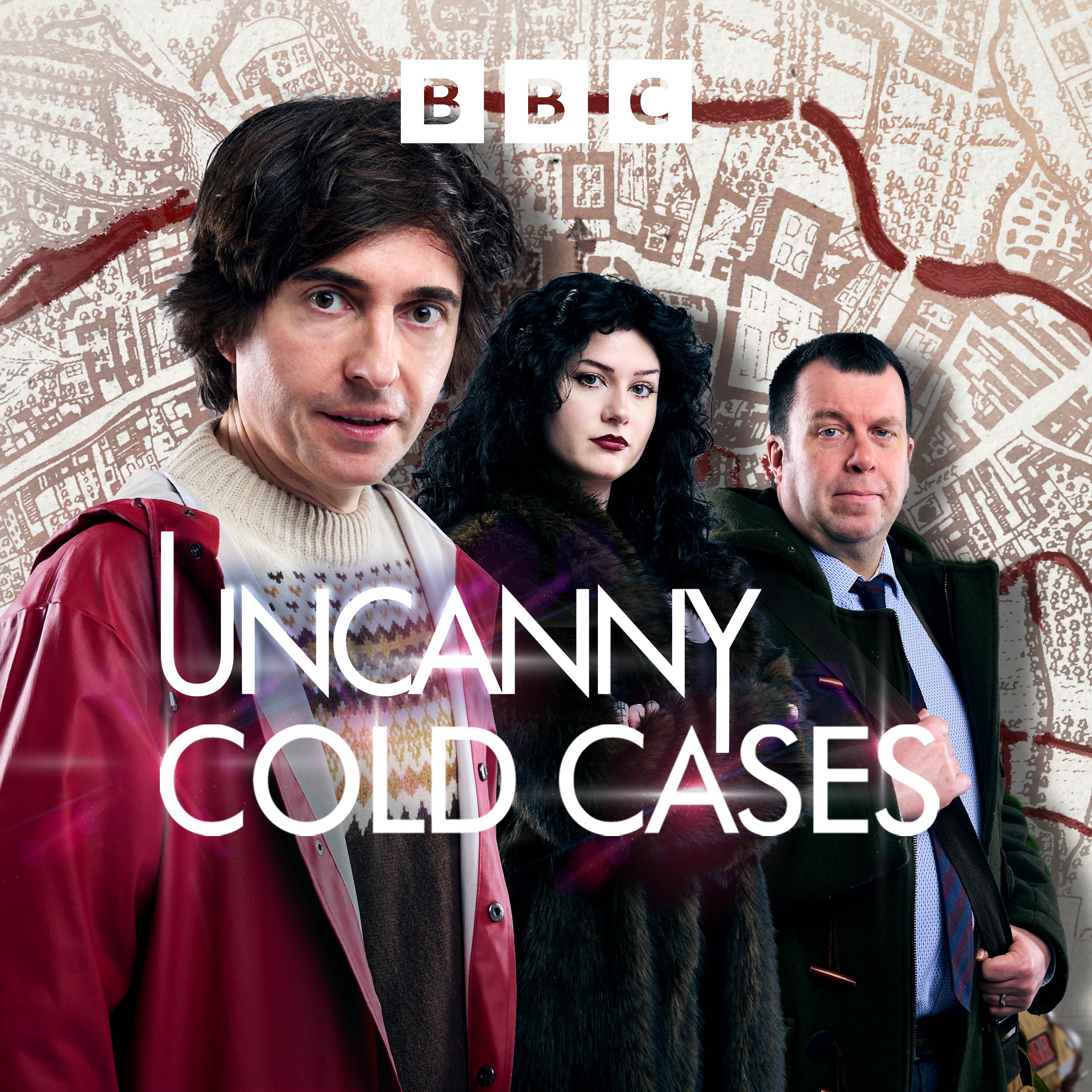
Strange cases, uneasy answers.
Uncanny treats paranormal testimony like a case file left open on the table. Witness stories, expert challenges, and uneasy details sit together without forcing the listener into belief or dismissal.
PRESS PLAY
Uncanny is a case-led paranormal series built around real people describing encounters that have stayed with them. The show's power comes from its scale. It can start with something small, like a tap, a whisper, a model, or a sound in another room, then make that detail feel suddenly impossible. Each case is treated as evidence, memory, fear, and story all at once. That tension matters. A witness may sound certain, but the show keeps testing the shape of that certainty against psychology, physics, coincidence, fraud, and folklore. The result is suspense without a hard sell. The Cold Cases episodes revisit famous hauntings, bringing older stories into contact with modern investigative thinking. Other episodes follow newer accounts from live audiences, listener messages, and case updates, where fresh witnesses or local links can change the temperature of a story fast. The show is especially good at domestic dread. Houses become strange machines. Attics, bedrooms, landings, and old streets seem to hold secrets. At the same time, it does not forget the people at the centre of the fear, including children and families trying to make sense of what is happening around them. Sceptical explanations are taken seriously. So are the moments when those explanations begin to wobble. The believer-versus-sceptic frame gives the series momentum, but the best episodes live in the gap between the two sides. It is not just about ghosts. UFOs, poltergeist claims, strange encounters, haunted streets, and unexplained physical events all sit within its range. Uncanny suits listeners who want fear with inquiry attached. It is spooky, conversational, and often unsettling, but it is also careful about the emotional weight of testimony. The show leaves the door open. That is where the chill gets in.
Made for: For listeners who like paranormal stories treated with atmosphere, witness detail, and real sceptical pressure. It fits fans of eerie testimony, cold-case structure, and mysteries that resist a neat ending.
What sets it apart: Uncanny stands apart by letting believer and sceptic readings collide inside the same case, often with new witnesses and follow-up theories reshaping the story. It makes the ordinary household detail feel as important as the headline haunting.
From ghostly phantoms to UFOs, Danny Robins investigates real-life stories of paranormal encounters. So, are you Team Believer or Team Sceptic? Written and presented by Danny Robins Editor and Sound Designer: Charlie Brandon-King Music: Evelyn Sykes Theme Music by Lanterns on the Lake Produced by Danny Robins and Simon BarnardA Bafflegab and Uncanny Media production for BBC Radio 4
Based on 6 episodes we listened to · September 2026
Uncanny turns eerie testimony into an ongoing inquiry about memory, evidence and the stories communities build around unexplained events.
Uncanny builds paranormal investigation around testimony, then keeps the explanation open. Danny Robbins reconstructs reported hauntings and apparitions before bringing competing interpretations into the conversation, from pareidolia and distorted memory to the possibility of an…
A haunted street turns your inner skeptic into the least comfortable person in the room.
Press play if you want
Short reviews from the PlayNext desk, based on the episodes we processed.
A Pontefract haunting that turns ordinary household detail into daylight dread.
Uncanny Cold Cases goes back to Pontefract for the Black Monk case, and the episode is at its best when it lets small domestic details turn sour.
A notorious haunting becomes a tense, well argued clash of fear and explanation.
Uncanny Cold Cases starts with one of the most notorious poltergeist hauntings in British history, set in Pontefract, West Yorkshire, and keeps its tension grounded in the long trail of reported activity: flying objects, moving furniture, and a family convinced something is…
A final case that keeps belief and doubt in the same room.
The final Uncanny case opens in an ancient house and stays with one witness whose account feels heavy with years of guarded memory. James reads as someone who has built walls around the experience, and that gives the interview its charge.
A seasonal ghost-story special that balances unease with wit.
Uncanny's Christmas special pulls together several of the strangest and most unsettling stories Danny Robbins has heard recently, with Diane Morgan along for the ride and clearly game for it.
A case-update episode that turns domestic oddities into a widening pattern of folklore and dread.
Revenants and Revelations gives the series a fresh charge. Danny Robbins moves through the haunted street in Bath, the Brighton Grove house, Road Ghosts, and the other cases so far, while new witnesses and theories keep the investigation in motion.
A road-ghost case that gets stranger the harder anyone tries to explain it.
A bridge above the A229 in Kent sets up a road-ghost case that never settles into one neat explanation. It begins with figures seen by drivers at the edge of the road, then lands on the stranger image: an impossible figure in the middle of a bonnet, seen by two people who should…
A morgue worker's ghost story that leaves a house in Ripon feeling deeply wrong.
The episode follows Louise, a biomedical scientist who works in a morgue, through an experience in a house in Ripon, North Yorkshire that still does not sit easily with her.
A Halloween haunting that turns one Bath street into a genuinely uneasy case.
Uncanny begins its new run with a Halloween walk through Bath, following Danny Robbins above the Georgian streets and widening a single 2009 haunting into a question about the whole road.


Ira Glass frames weekly theme-driven segments spanning family secrets to Portland's protest conflict.

Shankar Vedantam unpacks the psychology behind relationships, careers, and money through researcher interviews.

David McRaney interviews researchers on cognitive bias, motivated reasoning, and why minds change.

Ryan Holiday pairs daily Stoic lessons with long-form guest conversations at his Texas bookstore.
Danny Robbins takes Uncanny Cold Cases back to Pontefract.
Danny Robbins kicks off Uncanny Cold Cases with one of the most notorious poltergeist hauntings in British history.
This trailer introduces a BBC podcast where a host, a skeptic, and a believer investigate classic paranormal cold cases using modern techniques.
The episode closes the run with one last case: an ancient house, a witness who is still clearly uncomfortable, and the uneasy possibility of a poltergeist hanging over the room.
Christmas turns chilly fast.
Host Danny Robbins presents updates across five ongoing Uncanny cases, with the most significant development concerning the Goff poltergeist on Brighton Grove in Newcastle: Jules, a retired teacher, describes visiting the haunted house in the early 1980s and finding a human skull from Westgate Road Cemetery on the TV, and her daughter Ellen — an archaeology student — locates 1987 newspaper articles confirming two students were jailed 18 months for drilling thigh bones from that same cemetery into Tibetan thigh trumpets said to summon hungry spirits.
This episode of Uncanny, hosted by Danny Robbins, presents a mysterious and dark supernatural case involving a disturbing visual of a crooked figure with a visible ribcage.
This episode features three intriguing new paranormal stories collected from audience members during the host's live tour around the UK.
The host revisits their hometown of Newcastle to explore a personal and scary story about a poltergeist that affected a group of goths in the 1990s.
BBC Radio 4's Uncanny investigates the phenomenon of road ghosts — paranormal apparitions witnessed by drivers — through two first-person accounts from Jo, a retired British Transport Police officer, and Andrew, a retail worker from Yorkshire.
This episode of Uncanny investigates a terrifying UFO sighting from 1977 that left witnesses haunted by fear.
Meet Louise.
BBC Radio 4's Uncanny returns for a fifth series with an hour-long Halloween special hosted by Danny Robbins, investigating a potential haunting affecting multiple houses on a single Georgian street in Bath.
Danny Robins investigates real-life paranormal encounters, exploring ghostly phantoms and UFOs with believers and skeptics.
Danny Robins investigates a terrifying apparition of a dog witnessed by multiple people in a Spanish home.
Danny Robins investigates a terrifying paranormal encounter in a Spanish house, blending personal testimony with skeptical inquiry.
Danny Robins investigates a family's haunting by a ghostly little girl and an old man, with a historical parallel to a Victorian father who pushed his daughter down the stairs.
Danny Robins investigates real-life stories of paranormal encounters, exploring ghostly phantoms and UFOs with both believers and sceptics.
Danny Robins hosts a postmortem discussion of a TV episode about a charity shop poltergeist, featuring a celebrity guest and new evidence.
Danny Robins hosts a postmortem discussion of a paranormal case with a celebrity guest, exploring beliefs and theories about the supernatural.
Danny Robins and guest Rhys Shearsmith investigate new paranormal cases in a live Christmas episode of Uncanny.
Danny Robins investigates a terrifying night spent in an abandoned Scottish house called Louisbelt, promising to return with the experiencer.
Danny Robins investigates a family's paranormal experiences in their Lake District cottage, including a ghostly encounter with a child.
Danny Robins investigates a potential haunting in the Lake District, exploring real-life paranormal encounters.
Comedian Stewart Lee joins host Danny Robbins on Uncanny for a Halloween special to discuss ghostly cases, skepticism, and his lifelong fascination with the paranormal stemming from 1970s horror culture.