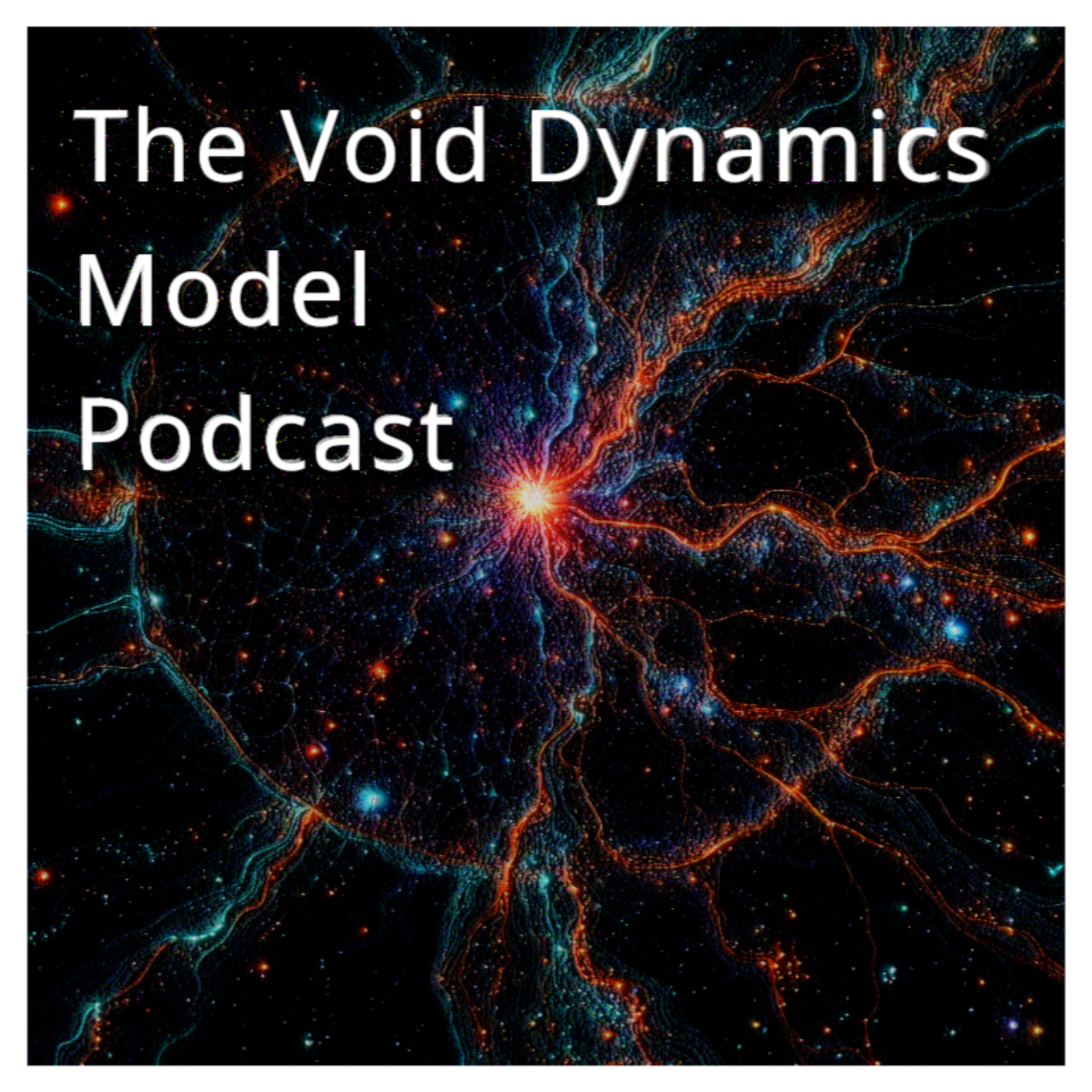
The Void Dynamics Model Podcast is a tightly argued science and philosophy series centered on the Void Dynamics Model. It is not casual background listening. The show works like a sequence of compressed lectures, using a conversational frame to push difficult ideas through clear stages. One recurring concern is origin. Episodes ask what remains if physics is stripped of its usual starting assumptions: no pre-given space, no pre-given time, no inherited geometry, and no convenient mathematical stage already waiting for matter to appear. From there, the series follows claims about primitive bifurcation, induced geometry, information burden, gravity, black holes, and phase calculus. The physics is speculative, but the presentation keeps returning to formal checks, computational tests, and the demand that large theories state what would count against them. Another major thread is cognition. The show links intelligence to novelty, habituation, entropy, pattern formation, and real-time adaptation under pressure. In the Aura discussion, a tiny memory-limited system becomes a way to think about how structure might emerge without massive stored knowledge. The reading episode moves differently. It traces language and literacy from physical signal to synapse, using blindness, sound-based reading, newborn brain imaging, and predictive wiring to argue that the brain is a cross-modal pattern engine before it is a school-trained reader. The show also turns its method back on science itself. In the curiosity episodes, organized skepticism is criticized as a culture that can reward defensive certainty while starving the uncertain middle zone where discovery actually begins. George Lowenstein's curiosity research, Donald Hebb's deprivation work, and Ignaz Semmelweis appear as pressure points in that argument. The tone is polished, insistent, and often grave. Short clarifying exchanges keep the pace high, while the underlying claims remain large enough to require concentration. Its best moments make abstract mechanics feel concrete: a universe without a stage, a brain reading through sound, a theory checked through multiple mathematical filters, a scientific culture mistaking hesitation for rigor. Its risk is the same as its appeal. It asks listeners to take speculative structures seriously long enough to examine their machinery.