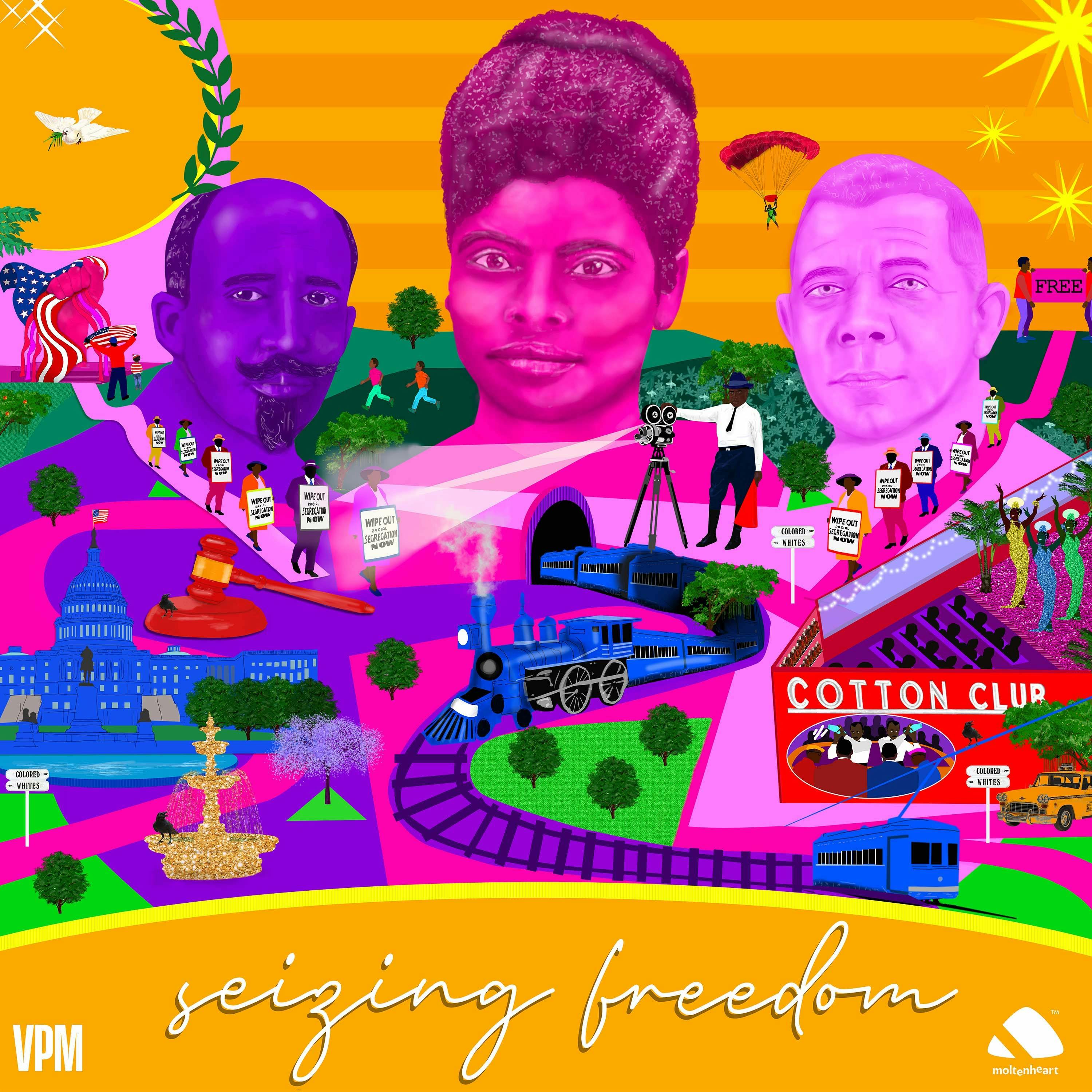
Seizing Freedom is a history show that insists on its sources. Kidada Williams hosts, writes and produces it as a production of VPM and Molten Heart, and she states its purpose plainly: to dig into archives for stories of how African Americans freed themselves during the Civil War and built new lives in Reconstruction and beyond. Freedom here is a broad idea. It takes in the press and activism, and also public health, nightlife and faith. The historical episodes are full of period voices read aloud. 'Reframing the Narrative?' starts with Ida B. Wells in the late winter of 1892 and quotes her admission that she had believed wealth, education and character would one day bring justice to all. The same episode includes a first-person account of Joseph Campbell, a prisoner accused of murdering a warden's wife and held in solitary, and of a narrator too disturbed by his treatment to eat dinner. 'Dethroning Disease' opens at a 1914 conference on Black health at Tuskegee Institute, where Booker T. Washington was among the speakers. Later it reads out strict sanitation instructions: scrub floors with lye, whitewash the walls, sun every room, clean the outhouses at schoolhouses and churches. 'Inside Harlem's Speakeasies' uses James Weldon Johnson's description of riding north through Manhattan into Black Harlem. It then follows Wilkins, whose place was frequented by Jack Johnson and who had reached kingpin status by 1924, while reformers called his business an obstruction to moral betterment. These episodes end the same way, naming the historians, archivists and librarians whose work made them possible and pointing to further reading at seizingfreedom.com. The interviews carry the questions into the present. Mariame Kaba describes abolition as a practice, informed by Marge Piercy's poem 'To Be of Use', and says safety has to be defined collectively. Saeed Jones, introduced as a writer, poet and social commentator, remembers learning to smile so he would seem less threatening, and describes white supremacy as the very atmosphere. The conversation with Julia Craven runs from her great-grandmother's Sunday cooking before church to going back for a mask to protect an elderly neighbor. Williams is more than a narrator. She says Kaba's work changed how she thinks about justice, and she opens the Jones conversation by describing her own exhaustion. The narrative episodes begin with advisories about graphic language and descriptions of violence. A listener who likes history built from documents, and wants to hear it tested against the present, gets both here.