Oxford Physics Public Lectures

39 episodes listed below

Listen to the show on

PRESS PLAY

Find your next episode

All episodes

In their own words

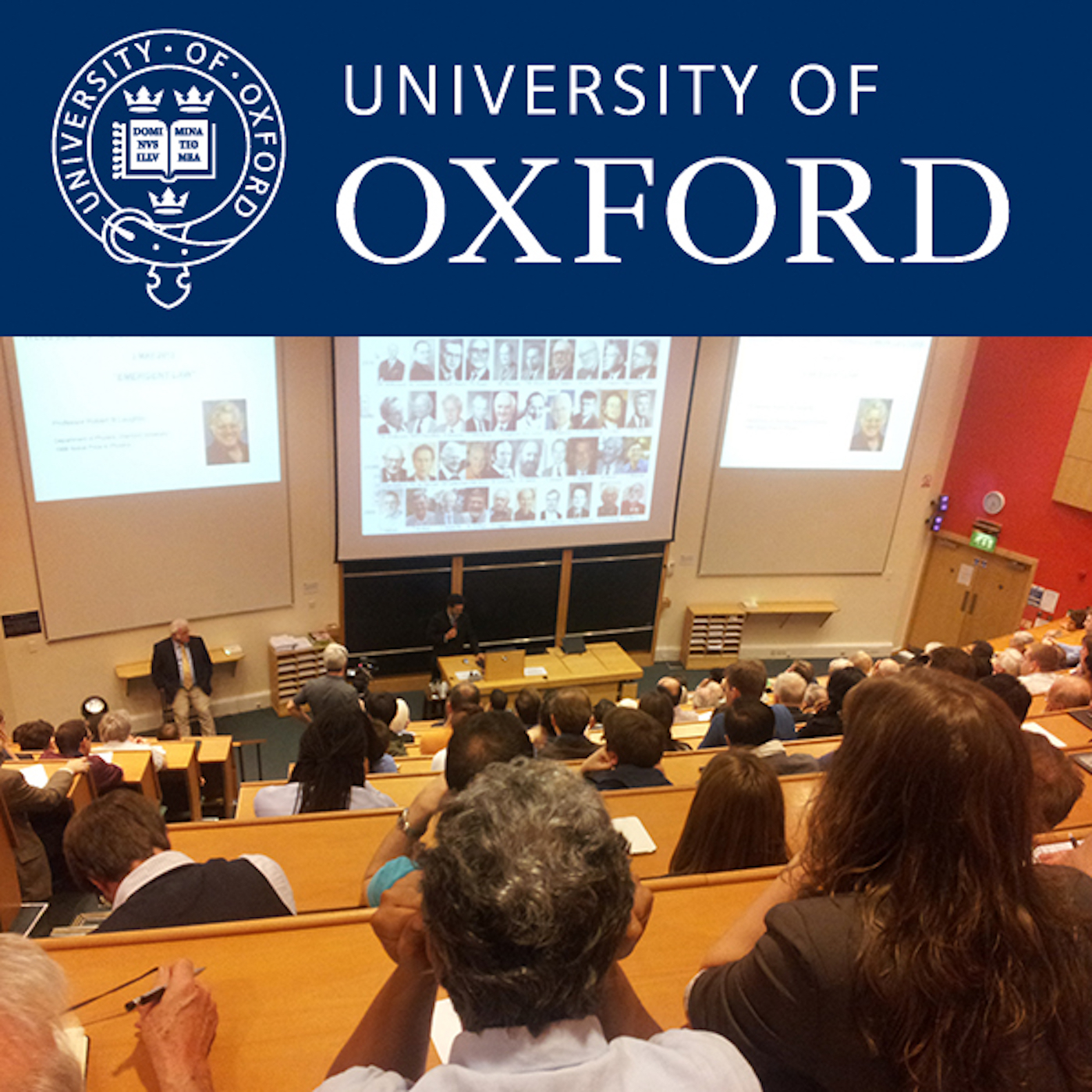
The Department of Physics public lecture series. An exciting series of lectures about the research at Oxford Physics take place throughout the academic year. Looking at topics diverse as the creation of the universe to the science of climate change. Features episodes previously published as:(1) 'Oxford Physics Alumni': "Informal interviews with physics alumni at events, lectures and other alumni related activities."(2) 'Physics and Philosophy: Arguments, Experiments and a Few Things in Between': "A series which explores some of the links between physics and philosophy, two of the most fundamental ways with which we try to answer our questions about the world around us. A number of the most p…

As heard by us

Based on 6 episodes we listened to · August 2026

Oxford Physics Public Lectures gives Science listeners full-length research lectures on cosmology and neutrino astrophysics from the researchers running the experiments.

Oxford Physics Public Lectures records the department's public lecture series, so listeners hear a working researcher at a podium talking at length about their own research rather than a produced interview segment.

Read our full review in PlayNext →

Why you'd press play

You want the universe weighed, curved, and scanned for neutrinos before lunch.

Press play if you want

  • cosmology that turns Hubble constants and curved triangles into something you can actually picture
  • neutrino astronomy with South Pole hardware, false starts, and tiny-event-count suspense left in
Read the full recommendation in PlayNext →

Talks about

Best episodes of Oxford Physics Public Lectures

Short reviews from the PlayNext desk, based on the episodes we processed.

Nuclear Physics and the development of the bombDec 21, 2023

A focused classroom path from nuclear structure to the chain reaction problem at the heart of bomb physics.

The episode frames bomb physics as a clear progression from nuclear bookkeeping to chain reaction. Georg Fierzer starts with protons, neutrons, binding energy, and the counts behind Z, N, and A, then uses uranium-235 to show how an incoming neutron can open the path to fission.
Was there a strategic alternative to the atomic bombing of 1945?Dec 21, 2023

Truman's decision is weighed against the wartime strategies that could have come before it.

The 1945 atomic bombing is handled as a pressured act of political judgment, not as a settled moral footnote. The episode puts Truman in the White House two weeks after Stimson's warning about a devastating new weapons system, then circles back to the audience's 15-to-20-percent…

Oxford Physics and the ‘remote and speculative project’Dec 21, 2023

A lecture on how Lindemann's nerve, physics, and closeness to Churchill helped turn speculation toward state policy.

The episode starts with Oppenheimer and the Manhattan Project, using that familiar frame to reach Oxford's more fragile connection to the story. From there it follows Lindemann through RAF flight experiments, his Oxford professorship, and even amateur tennis.

IceCube: Opening a New Window on the Universe from the South PoleDec 20, 2019

A clear, grounded introduction to neutrino astronomy and the limits of reading cosmic signals.

IceCube frames a one-kilometer-cube detector as a new kind of telescope, built to catch neutrinos that may trace back to cosmic sources such as exploding stars and gamma-ray bursts.

IceCube: Opening a New Window on the Universe from the South PoleDec 20, 2019

IceCube makes cosmic violence feel like a patient, numbers-driven case for larger neutrino detectors.

Neutrino astronomy finds its tension in a detector that spent two years waiting for a signal. IceCube's cubic-kilometre scale gives the lecture its central measure: a fully efficient instrument was expected to see 10 to 100 events a year, which makes the hunt for cosmic…

Seeing the High Energy Universe with IceCubeJan 6, 2016

A South Pole detector follows elusive neutrinos toward cosmic sources, dark matter, and physics beyond the standard model.

IceCube turns the South Pole into a neutrino observatory, sending the experiment deep into the ice to catch traces of particles that usually pass through matter almost untouched.

Seeing the High Energy Universe with IceCubeJan 6, 2016

A clear, measured tour of IceCube's promise, from deep-ice detection to a new window on the universe.

IceCube turns the South Pole into a strange kind of observatory, with instruments reaching two and a half kilometers into the ice to catch traces of very energetic neutrinos from outer space.

Podcasts like Oxford Physics Public Lectures

Episodes

  1. 1

    Nuclear Physics and the development of the bomb

    Hidden gem

    Georg Fierzer, a research lecturer in Oxford's Department of Physics, explains how nuclear binding energy, fission, and chain reactions connect directly to the development of the bomb.

    Dec 21, 2023·41m·2 clips
  2. 2

    Was there a strategic alternative to the atomic bombing of 1945?

    Hidden gem

    Oxford Physics Public Lectures asks whether Harry Truman had a strategic alternative to using the atomic bomb in 1945, after Henry Stimson’s letter described a weapon “like nothing else that we've ever seen before.” The lecturer rejects revisionist claims about impressing the Soviets, winning an election, or revenge for Pearl Harbor, saying his reading of the American National Archives found “absolutely no evidence” for them.

    Dec 21, 2023·25m·1 clip
  3. 3

    Oxford Physics and the ‘remote and speculative project’

    Hidden gem

    Oxford Physics Public Lectures uses Frederick Lindemann, the bowler-hatted physicist born in Baden-Baden in 1886, to tell Oxford's wartime physics story.

    Dec 21, 2023·28m·1 clip
  4. 4

    IceCube: Opening a New Window on the Universe from the South Pole

    Hidden gem

    Oxford Physics Public Lectures presents a 2019 particle-physics update before Francis Halzen turns to neutrino astronomy and IceCube at the South Pole.

    Dec 20, 2019·1h 25m·5 clips
  5. 5

    IceCube: Opening a New Window on the Universe from the South Pole

    Hidden gem

    Oxford Particle Physics Christmas Lecture speaker Francis Halzen frames IceCube as a way to solve the origin of the highest-energy cosmic rays, using neutrinos as the messenger that photons and charged particles cannot be.

    Dec 20, 2019·1h 25m·5 clips
  6. 6

    The State of the Universe

    Hidden gem

    Oxford Physics Public Lectures’ “The State of the Universe” lays out the 2017 cosmological picture: expansion since 1929, an age close to 13.8 billion years, and a universe that is nearly geometrically flat.

    Nov 20, 2017·1h 15m·5 clips
  7. 7

    The State of the Universe

    Hidden gem

    Oxford Physics Public Lectures' "The State of the Universe" argues that the cosmos in 2017 is expanding, about 13.8 billion years old, and close to geometrically flat, while being made mostly of dark energy and dark matter.

    Nov 20, 2017·1h 15m·5 clips
  8. 8

    Seeing the High Energy Universe with IceCube

    Hidden gem

    Oxford Physics Public Lectures: Seeing the High Energy Universe with IceCube follows an Oxford theorist who also works on the IceCube experiment at the South Pole, a detector that extends 2.5 kilometres underground.

    Jan 6, 2016·44m·2 clips
  9. 9

    Seeing the High Energy Universe with IceCube

    Hidden gem

    Oxford Physics Public Lectures' "Seeing the High Energy Universe with IceCube" explains how a South Pole detector buried 2.5 kilometers deep tries to use neutrinos to study cosmic accelerators and dark matter.

    Jan 6, 2016·44m·2 clips
  10. 10

    The Einstein Lens and a Tale of Two Eclipses

    Nov 24, 2015·52m
  11. 11

    The Einstein Lens and a Tale of Two Eclipses

    Hidden gem

    Oxford Physics Public Lectures covers how Thomas Grubb’s Dublin firm built telescopes, microscopes, and even a marine periscope before Howard Grubb supplied instruments to Vienna, Melbourne, Oxford, and the Lick Observatory.

    Nov 24, 2015·52m·3 clips
  12. 12

    LHC searches for dark matter

    Feb 12, 2015·40m
  13. 13

    Precision Studies of the Higgs

    Feb 12, 2015·33m
  14. 14

    Precision Studies of the Higgs

    Feb 12, 2015·33m
  15. 15

    The Standard Model and the LHC! in the Higgs Boson Era

    Feb 12, 2015·39m
  16. 16

    The Standard Model and the LHC! in the Higgs Boson Era

    Feb 12, 2015·39m
  17. 17

    LHC searches for dark matter

    Feb 12, 2015·40m
  18. 18

    Lorenz Gödel and Penrose: new perspectives on determinism and unpredictability, from fundamental physics to the science of climate change

    A physics professor delivers a lecture on the intersection of general relativity, quantum mechanics, and chaos theory, reflecting on past research and new mathematical insights.

    Apr 7, 2014·1h 6m
  19. 19

    Lorenz Gödel and Penrose: new perspectives on determinism and unpredictability, from fundamental physics to the science of climate change

    A physics professor delivers a lecture on the intersection of general relativity, quantum mechanics, and chaos theory, reflecting on past research and new mathematical insights.

    Apr 7, 2014·1h 6m
  20. 20

    Building stars, planets and the ingredients for life between the stars

    Introduction to a Halley Lecture by Professor Evin van Dissek, a molecular astrophysicist, covering her background and research on interstellar molecules and star formation.

    Apr 7, 2014·57m
  21. 21

    The Fast Track to Finding an Inhabited Exoplanet

    A lecture introducing a new astrophysics research centre and a guest speaker on exoplanets.

    Apr 7, 2014·1h 3m
  22. 22

    Turning in the Widening Gyre: Accretion Processes in the Universe

    Apr 7, 2014·57m
  23. 23

    Building stars, planets and the ingredients for life between the stars

    Introduction to a lecture by Professor Evin van Dissek on molecular astrophysics and her career.

    Apr 7, 2014·57m
  24. 24

    Turning in the Widening Gyre: Accretion Processes in the Universe

    Apr 7, 2014·57m
  25. 25

    The Fast Track to Finding an Inhabited Exoplanet

    A public lecture at Oxford Physics announcing a new astrophysics research centre and introducing a guest speaker.

    Apr 7, 2014·1h 3m
  26. 26

    Radiation and Reason

    Nov 14, 2012·57m
  27. 27

    Radiation and Reason

    Nov 14, 2012·57m
  28. 28

    Physics and Philosophy: An Introduction

    Jul 29, 2012·9m
  29. 29

    From Argument to Experiment

    Jul 29, 2012·10m
  30. 30

    From Argument to Experiment

    Jul 29, 2012·10m
  31. 31

    Space and Time

    Jul 29, 2012·16m
  32. 32

    Space and Time

    Jul 29, 2012·16m
  33. 33

    Quantum Paradoxes

    Jul 29, 2012·14m
  34. 34

    Quantum Paradoxes

    Jul 29, 2012·14m
  35. 35

    Parallel Worlds

    Jul 29, 2012·15m
  36. 36

    Parallel Worlds

    Jul 29, 2012·15m
  37. 37

    Consciousness and Computability

    Jul 29, 2012·25m
  38. 38

    Consciousness and Computability

    Jul 29, 2012·25m
  39. 39

    Physics and Philosophy: An Introduction

    Jul 29, 2012·9m