Topics / Physics
Physics Podcasts
126 shows and 9,106 episodes sit under Physics.
The best physics podcasts for every level: a friendly two-host flagship, advanced quantum-computing lectures, book-interview science history, and space-outreach shows
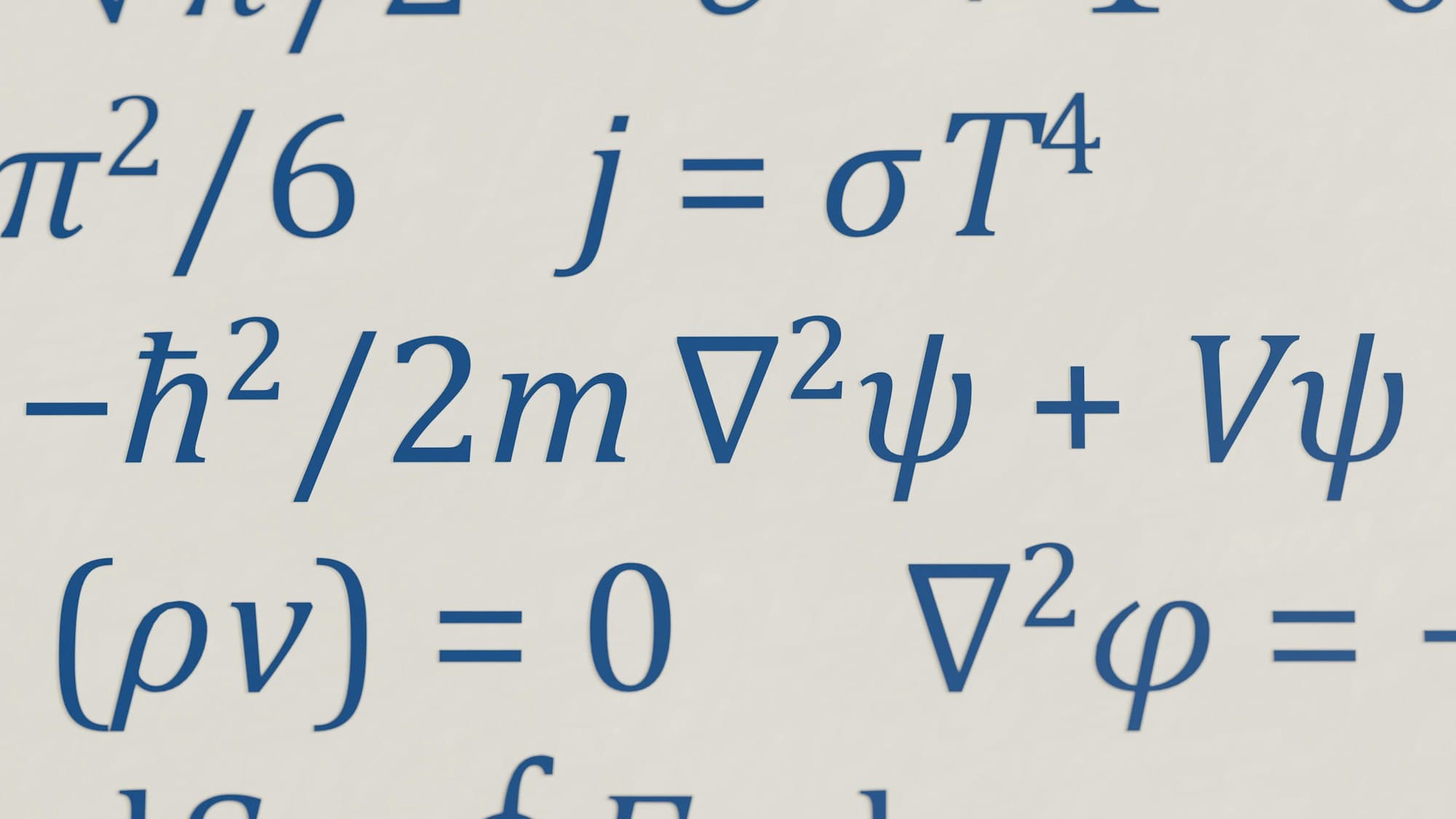
Photo: Brecht Corbeel on Unsplash · Unsplash License
Swipe · Physics only
Swipe through Physics
Save time discovering your next favourite podcast by listening to just the best minute of an episode.
The physics slate · every cover a link
All 126 physics shows →

Listening guide
Getting into Physics podcasts
A question about why a very distant galaxy can look bigger than a nearer one is reason enough to spend twenty minutes with a physics podcast. The best of these shows let you hear how an answer was reached. They tell you which measurement settled it, which signal faded once someone took more data, and where the honest answer is still that nobody knows. That standard runs through this guide. It admits shows that sound nothing alike, from co-hosts teasing chemists to a professor pausing over a step at the blackboard.
The range runs from listener mailbags and broadcast documentaries to recorded lectures, industry interviews and speculative shows that build their own theories of everything. Video presses on all of it. In June 2026 Edison Research reported that in the third quarter of 2025, 82% of weekly podcast consumers watched video podcasts and 78% listened to audio-only ones. Those are overlapping habits across podcasting as a whole. Listeners, meanwhile, argue about purpose. In a September 2026 forum thread, one poster asked whether fundamental physics has stalled, and replies pushed back that the question defines progress too narrowly. Another thread asked for plain mechanics and electromagnetism instead of quantum theory, strings and astronomy. The shows below answer both complaints in very different ways.
Questions answered out loud
Daniel and Jorge Explain the Universe answers listener questions. In the seasonal episodes discussed here Daniel Whiteson, a particle physicist at UC Irvine, takes them with guest co-hosts.
In Summer solstice listener questions the show untangles two competing effects. Further objects look smaller, but light from the oldest sources left them when they were much closer to us. So beyond about 10 billion years back, things start to look bigger again. The idea arrives in stages, starting from an imagined universe that isn't expanding.
Fall equinox listener questions, also from Daniel and Jorge Explain the Universe, is good on the gap between what equations allow and what exists. White holes are permitted, but the show admits it doesn't know how one would form. It suggests they "might just be a feature of our classical theory of general relativity." Kelly, a Rice University parasitologist who admits to B's in chemistry, keeps things loose. The running joke about provoking chemists is a matter of taste.
Vedátorský podcast does the same work in Slovak, with Jozef and Samuel. In Vedátorský podcast 326 – FAQ dobré otázky, a listener asks how ice melts under a skate, and the answer climbs through levels:
- The school version, that friction warms the ice, fails on its own because ice melts even far below zero.
- Pressure is the next idea.
- Finally, the surface layer is described, in a very simplified account, as structured differently from the ice beneath it, and easier to melt.
Naming the simple answer and saying why it breaks is the most useful thing an explainer can do. The following episode, on Alzheimer's with a guest researcher, points toward the Medical Science page.
Documentaries and long conversations
NOVA Presents and Particles of Thought both come from GBH, and they share an episode: Discovering Dark Energy and the Hubble Tension with Adam Riess. It is a 76-minute conversation hosted by astrophysicist Hakeem Oluseyi. Riess recalls answering colleagues' emails as he packed for his honeymoon. The episode explains that Hubble time went to both competing teams so their results could be cross-checked. The Hubble tension, two independent calibrations that refuse to agree, is presented as a place where a discovery may be waiting, with "potentially" attached.
Particles of Thought's Why Dark Matter Matters, with physicist and historian Kaiser, holds the moment that best explains scientific caution. A 1990s search spotted a couple of brief brightenings consistent with dark compact objects. The team kept watching for years, and "the signal kind of went away." The episode treats that as a constraint: such objects can be only a small fraction of the dark matter.
NOVA Presents plays history as drama. Einstein's Quantum Riddle sets Einstein at hotel breakfast with a fresh challenge for Niels Bohr, who would have an answer by suppertime. It recalls Einstein asking whether "the moon is not there when you are not looking at it." It then follows the entanglement experiments, sceptical physicists included, in 20 minutes. The same feed's Your Brain: Perception and Control belongs with the Neuroscience page.
The lecture hall, recorded
For the listener who wants textbook physics, the answer is a recorded course. Quantum Mechanics carries Professor J.J. Binney's lectures, numbered in sequence and dated 2010.
In 017 Einstein-Podolski-Rosen Experiment and Bell's Inequality he lays out Einstein's objection and voices the hidden-variable camp's scorn for "this clapped out quantum mechanical rubbish." He then derives Bell's inequality and reports that experiments since 1972 are inconsistent with hidden variables. 014 A Pair of Square Wells and the Ammonia Maser gets from a toy potential to a timekeeping device. Some algebra helps.

The Arnold Sommerfeld Center's feeds climb higher. Sommerfeld Lecture Series (ASC) pairs public lectures with specialist talks. In Public Lecture: Many Worlds in One, the speaker sets out inflation and the predictions it has passed. He then says the multiverse still needs "more successful predictions" before its case might be beyond reasonable doubt. In Boundaries, inclusions and disorder in active matter, particles with their own engines push unequally on a partition whose two sides differ. That is "something that would never happen for the gas in this room in equilibrium." The audience cuts in with questions throughout.
Sommerfeld Theory Colloquium (ASC) is denser still. In Structured Vacuum Fluctuations: A New Pathway to Quantum Materials Design within QEDFT, the speaker calls a predicted phase transition "a proposal still." He says experiments indicate it but have not demonstrated it.
Frontier arguments, disagreement included

FQxI Podcast, from the Foundational Questions Institute, lets physicists disagree on the record. In Dark Energy Bombshell? Cosmic Results from DESI and ACT & Rethinking Gatekeeping in Science Publishing, host Zia Merali talks with two Perimeter Institute cosmologists about a survey taken in Copenhagen. The survey's leading explanation for the Hubble tension, unrecognised systematics in supernova data, drew about 35%: "not like overwhelming consensus." The survey also predates the DESI and ACT results. The episode then visits a journal that publishes its reviews alongside every paper it reviews.

DECODE QUANTUM, hosted by Fanny Bouton and Olivier Ezratty, interviews people building quantum technology. In [DECODE Quantum] Meeting with Christian Weedbrook - Xanadu, Weedbrook says his company believes it has the lowest cooling requirements of anyone. That is a company's claim. The talk then moves into decoders and error rates and assumes fluency.
The people behind the physics

Joseph Guzman and Irene Roman's Beyond the Physics turns to the culture around the science. In How Moon Knight Changed My Life, Joe describes emotional abuse in his graduate program and his struggle over whether to leave. It is frank, and some listeners will want that warning.
New Books in Physics and Chemistry interviews authors about their books. In Matthew Bothwell, "The Invisible Universe: Why There's More to Reality than Meets the Eye" (Simon and Schuster, 2021), Bothwell jokes that astronomers call everything past hydrogen and helium "just metals." Titles like that one lead naturally to the Astronomy page.
Outside the consensus


The Roots of Reality and Mathematical basis for reality explore alternative frameworks rather than report established physics. In The Crack In Reality, The Roots of Reality walks through a 2026 paper by Philip Lillian proposing that the divide between discrete and continuous is an illusion, and calls the paper "groundbreaking." Mathematical basis for reality is closer to an essay read aloud. Physics Is a Feminine Discourse in Denial poses "Information is feminine" as an axiom. Treat both as arguments to weigh, and keep a host's confidence separate from the support behind a claim.
Where to start
- New and curious: Daniel and Jorge Explain the Universe, Summer solstice listener questions. Twenty minutes, one counterintuitive idea, followed all the way through.
- History told as drama: NOVA Presents, Einstein's Quantum Riddle.
- Caution in action: Particles of Thought, Why Dark Matter Matters, for a search that admitted its signal faded.
- Ready for the maths: Quantum Mechanics, 017 Einstein-Podolski-Rosen Experiment and Bell's Inequality. Drop back to the earlier numbered lectures if the notation loses you.
- An argument still open: FQxI Podcast, Dark Energy Bombshell? Cosmic Results from DESI and ACT & Rethinking Gatekeeping in Science Publishing.
Whichever you choose, listen for the moment a show says what would change its mind. When physics shades into other fields, the Science page is the wider map.
Featured shows below are part of the PlayNext catalog. Updated weekly.
Recommended clips
Top Physics moments
The highest-scoring 60-second moments anywhere in physics, one per show.
Drawn from 1,522 playable clips across 75 shows.
New on PlayNext
Just added to Physics
The newest physics clips in the library, one per show — ordered by when the clip was made, not when the episode came out.
1 clips, one per show, added 2026-08-05.
Featured shows
4 shows, described rather than listed
A short write-up for each, plus the job it does in this guide.
A particle physicist and a cartoonist tackle the universe together — one anchors on evidence, the other asks every question a listener might be too embarrassed to raise. The best on-ramp in the Physics shelf.
Recorded advanced-physics school sessions covering quantum computing, entanglement, and AdS/CFT. Dense, diagram-aware, and built for listeners who already know what trapped ions means.
Author interviews spanning black holes, friction, radio astronomy, and cosmic probability. The broadest path into physics for listeners who want a reading-list feel alongside the science.
An eclectic space-and-outreach show touching astrophysics, orbital mechanics, and field education. Adds texture to the Physics shelf beyond the classroom and interview formats.
Where to start
5 routes in, one per reader
Start with Fall equinox listener questions or Summer solstice listener questions — the seasonal Q&A format is built for people who have the curiosity but not the jargon.
Go straight to Quantum Error Correction with Superconducting Circuits or Quantum algorithms, part 1. These are school recordings, not pop-science; bring the technical background.
Pick by interest: Heino Falcke and Jorg Romer on black holes, Jennifer Vail on friction, or Emma Chapman on radio astronomy. Each episode is a standalone author conversation.
Try The Natural Physics Experience - The Birthday Comet! or the Gravity Assist from Jupiter to Titan episode for an astrophysics and spaceflight angle without the textbook weight.
Matthew Bothwell's The Invisible Universe and Andrew Jaffe's The Random Universe both cover how models and probability anchor our understanding of what we cannot directly see.
Glossary
Speak the language
A phenomenon where two particles remain correlated regardless of the distance between them, so measuring one instantly determines properties of the other.
Techniques that protect quantum information from decoherence and noise by encoding logical qubits redundantly across multiple physical qubits.
A theoretical duality proposing that a quantum gravity theory in anti-de Sitter space is equivalent to a conformal field theory on its boundary — a cornerstone of modern string theory and black-hole physics.
A measure of how strongly two subsystems are quantum-entangled, used in quantum information theory and as a probe of spacetime geometry in holographic models.
The process by which a quantum system loses its quantum properties through interaction with its environment, the main obstacle to building practical quantum computers.
A mathematical framework describing the large-scale structure, origin, and evolution of the universe, typically built on general relativity and observational constraints.