A quiet return to a missing-person case that still resists closure.
The episode stays with the second half of the coronial inquest into Patrick Joseph Moriarty's disappearance, and it keeps the town's grief in view without trying to tidy it away.
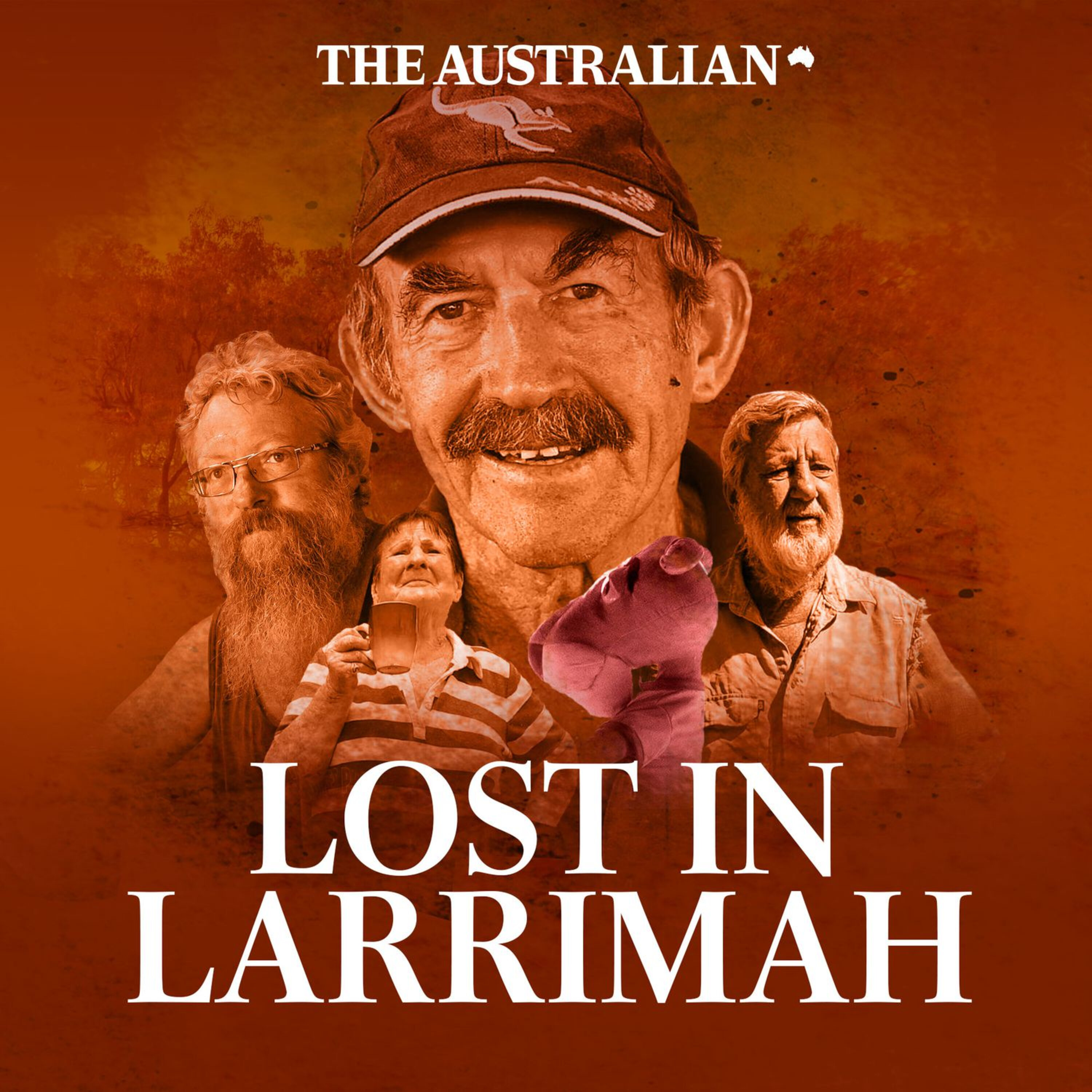
A missing man, a town left rattled.
Lost in Larrimah follows the unresolved disappearance of Paddy Moriarty and his Kelpie, Kellie, from a tiny Northern Territory town. Its power comes from resident tape, courtroom detail, and the strange local grievances that make every theory feel both plausible and incomplete.
PRESS PLAY
Lost in Larrimah begins with a disappearance, but it keeps widening into a portrait of a town under pressure. Paddy Moriarty vanished from Larrimah in late 2017, along with his Kelpie, Kellie, and the investigation left behind more suspicion than certainty. The series follows that absence through interviews, police searches, old feuds, court evidence, and the odd rhythms of a place where everyone knows too much and too little about everyone else. It is quiet, patient reporting. It is also full of sharp local texture. The Pink Panther pub, Fran’s Tea House, pie wars, road trains, crocodile talk, caravan lives, and a burned-out fuel station all become part of the case’s weather. The show never treats these details as decoration. They explain why a missing man could unsettle more than one household and why a town of so few people can hold so many conflicting accounts. Kylie Stevenson and Caroline Graham let residents speak at length, so the story often feels less like a narrated file and more like sitting in the room while people remember, deny, accuse, and drift into old grievances. That looseness is the point. Larrimah’s history matters, from the railway that stopped in the middle of nowhere to the families and workers who ended up staying by accident. The mystery also keeps returning to practical facts: no body found, no clear physical evidence, an ongoing police investigation, and an inquest that brought fresh material without delivering full closure. Later episodes add the coroner’s findings and secret tapes played in court. The tone can be dryly funny, especially when the town’s absurdities surface. Then it turns grave fast. Paddy is never reduced to a symbol or a plot device. The series keeps reminding the audience that people missed him, that his dog’s disappearance complicates easy theories, and that justice remains unfinished. For true-crime listeners tired of glossy certainty, it offers something rougher, stranger, and more human.
Made for: For true-crime listeners who prefer patient reporting, local voices, and unresolved cases over fast twists. It also suits listeners drawn to remote places, courtroom aftermath, and small communities with long memories.
What sets it apart: The series stands apart by letting Larrimah’s residents carry much of the story in their own words. The mystery is inseparable from the town’s pie wars, pub politics, outback isolation, and uneasy affection for Paddy Moriarty.
An Outback town, a missing man and 11 people who mostly hate each other. Paddy Moriarty and his beloved Kelpie, Kellie, vanished from the tiny Northern Territory town of Larrimah in late 2017. His disappearance has never been solved -- and Larrimah hasn't really been the same since. In this eight-part investigative podcast series produced by The Australian, Kylie Stevenson and Caroline Graham seek answers about Paddy's fate and explore the civil war that has been brewing in Larrimah for over a decade. Lost in Larrimah is recognised as a Series Essential by Apple Podcasts.
Based on 6 episodes we listened to · September 2026
Careful reporting connects Paddy Moriarty's disappearance to the evidence, relationships and fragile community life surrounding it.
Lost in Larrimah follows Kylie Stevenson and Caroline Graham as they investigate the 2017 disappearance of Paddy Moriarty and his dog from Larrimah.
A cleared crocodile is merely one detour between you and the truth about Paddy Moriarty.
Press play if you want
Short reviews from the PlayNext desk, based on the episodes we processed.
A quiet return to a missing-person case that still resists closure.
The episode stays with the second half of the coronial inquest into Patrick Joseph Moriarty's disappearance, and it keeps the town's grief in view without trying to tidy it away.
A careful inquest chapter that lets the tapes and court testimony do the work.
Lost in Larimer's second bonus episode returns to the second half of Paddy Moriarty's inquest, held on April 6 and 7, 2022, and follows the coroner's findings and the eight secret tapes played in court.
A missing-person story that tracks a town's decline through a burned fuel station, a pub for sale, and the space between certainty and loss.
The piece works best when it stays close to the missing-person case and lets the town do the talking. The pull is not in procedural momentum so much as in the way certainty drains away, then momentum, then a community's sense of itself.
An outback disappearance shaped by harsh country, local voices, and slow, unsettled questioning.
This episode stays with Paddy Moriarty's disappearance on a remote stretch of the Stuart Highway, and the setting carries a lot of the weight. The road, the heat, the distance, and the hard country make the mystery feel lived in.
An outback mystery that stays with the town as carefully as it stays with the missing man.
End Of The Line follows an accidental outback town as it becomes the backdrop for a missing-person story, starting with the railway that stopped short and the people who settled in its shadow.
A missing-person case told through a feud, a pub, and a town that never fully agreed on itself.
Lost in Larrimah turns a missing-person case into a study of a town that never quite settled its own faults, with the nearest thing to neighbourly ease being a pub shelf holding 13 cans of asparagus.
A missing-person story where the outback town itself becomes part of the case.
Lost in Larrimah treats a missing-person case as a portrait of a small outback town, where a cuppa, a pub, and a long pause can carry as much weight as any formal statement. The locals come through clearly: blunt, funny, guarded, and often profane.
NHPR's Jason Moon investigates the Bear Brook barrel murders and a New Hampshire wrongful-conviction case.
Payne Lindsey's season-long investigation into two disappearances from Nome, Alaska.

CBC's true crime feed tracing Cleo's case into cold cases across its investigative podcast network.
Journalists chase a decades-long trail through a coronial inquest and Rick Bloom's dozens of aliases.

A New York Times reporter reinvestigates Laramie's unsolved 1985 murder of Shelley Wiley.

Four years later, the inquest returns.
Back on the case, the inquest picks up.
One disappearance can make a tiny town feel even smaller.
Stuart Highway makes loneliness feel physical.
Larrimah began as a railway mistake.
Neighbourliness gets a hard look in Larrimah.
Larrimah is scorching, tiny, and already on edge.