A careful look at how Christian reading turned the Hebrew Bible into a map of meaning.
Typology is the habit of reading one sacred story through another, and this episode follows that idea from Augustine to medieval art and further out.
PRESS PLAY
Discussion of religious movements and the theories and individuals behind them.
Based on 6 episodes we listened to · September 2026
Scholarly panels make complex religious ideas legible by tracing how theology, history, power and practice act upon one another.
In Our Time: Religion builds each episode around the host's direct questions and a panel of scholars, giving beliefs, sacred figures and religious institutions their historical setting.
Michelangelo's ceiling has a conclave beneath it, if your art history needs a power struggle.
Press play if you want
Short reviews from the PlayNext desk, based on the episodes we processed.
A careful look at how Christian reading turned the Hebrew Bible into a map of meaning.
Typology is the habit of reading one sacred story through another, and this episode follows that idea from Augustine to medieval art and further out.
A fierce goddess becomes a careful lesson in devotion, suffering, and meaning.
Kali comes into focus as a figure of contradiction: dark blue, fierce, defiant, and still a nurturing mother figure. The episode works best when it lets that tension stand instead of smoothing it away, pairing strong images with larger ideas and allowing the meaning to build…
A careful, patient study of karma that makes a difficult idea feel clear.
Karma is treated as a doctrine with a long history, not a slogan. The discussion begins in early South Asia and moves through rebirth, transmigration, intention, free will, and the different ways Hindu, Buddhist, and Jain traditions answer the same question: what follows from…
A careful look at Barth's theology, politics, and the people around him.
This episode presents Karl Barth as a theologian determined to keep God, and especially Christ, at the center of Christianity instead of letting theology drift into a way of explaining human culture.
A careful, luminous portrait of a medieval visionary who made tenderness a theology.
Julian of Norwich emerges as a late-14th-century visionary whose Revelations of Divine Love binds suffering, theology, and tenderness into a single body of thought.
A careful account of how Eusebius shaped early Christian martyrdom.
Early Christian martyrdom is treated as both history and interpretation, with Eusebius shaping how these accounts were kept alive and what martyrdom came to mean in the first 300 years of Christianity.
A chapel where papal power, ritual, and Renaissance art meet.
This episode frames the Sistine Chapel as a meeting point of art, authority, and ritual. It follows the chapel's name back to Sixtus IV, whose papacy from 1471 to 1484 aimed to glorify Rome and strengthen the Vatican and the Catholic Church.
A clear account of Wesley, revival, and the Arminian-Calvinist split that shaped Methodism.
John Wesley is presented as a methodical religious reformer whose ideas helped define Methodism, and the account stays anchored in open-air preaching in Britain and the insistence on continued self-monitoring after conversion.
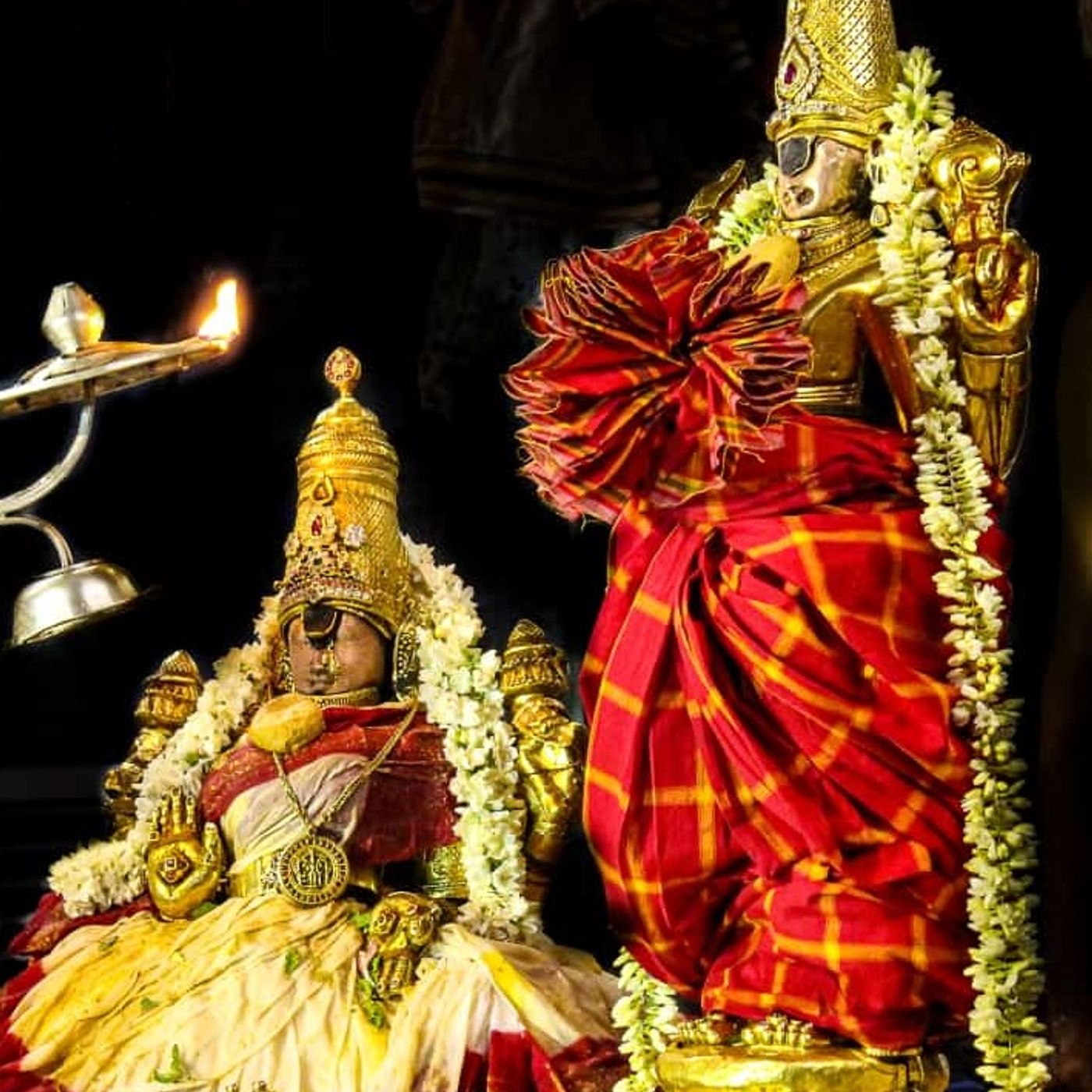
Daily Tamil SriVaishnava recitation and meaning.



Patient Krishna consciousness for lived devotional practice.
Bhakti teaching through everyday reflection.
This episode explores typology, a method of interpreting the Hebrew Bible as foreshadowing the New Testament, with experts discussing its origins in Greek philosophy, development through Christian history, and impact on art, liturgy, and literature.
This episode of In Our Time explores the Hindu goddess Kali, discussing her origins, mythology, and symbolism as a fierce yet nurturing deity.
This episode explores the medieval legend of Pope Joan, a woman said to have disguised herself as a man, become pope in the 9th century, and been exposed when giving birth.
This episode of In Our Time explores the doctrine of karma across Hinduism, Buddhism, and Jainism, tracing its origins in ancient Indian texts like the Vedas and Upanishads.
This episode explores the life and theology of Karl Barth, a 20th-century Swiss theologian who rejected liberal theology and natural theology, emphasizing God's revelation in Jesus Christ.
This episode explores the life and visions of Julian of Norwich, a 14th-century anchoress and mystic.
This episode explores the discovery and significance of the Dead Sea Scrolls, dating from 250 BC to AD 68, which include biblical texts and unknown Jewish writings.
This episode explores early Christian martyrdom from 100-300 AD, discussing how martyr stories fueled Christianity's growth, the Roman context of noble death, and Eusebius's role in shaping historical narratives.
This episode explores the history and art of the Sistine Chapel, from its construction under Pope Sixtus IV to Michelangelo's iconic ceiling and Last Judgment, discussing its political, religious, and artistic significance with experts.
This episode explores Arianism, a 4th-century Christian heresy that challenged the divinity of Christ and became influential among Germanic tribes like the Goths.
This episode explores medieval Christian pilgrimage, discussing its origins in the Holy Land, the role of relics and saints, the infrastructure and economics of pilgrimage sites, and the harsh realities of long journeys.
This episode explores the life and legacy of Saint Cuthbert, a 7th-century Northumbrian saint known for his miracles, travels, and role in early English Christianity.
This episode explores the life of John Wesley and the rise of Methodism, discussing his troubled childhood, the formation of the Holy Club at Oxford, key figures like George Whitefield, theological debates, and the movement's global spread.
This episode explores the Scottish Covenanters, a 17th-century Presbyterian movement that defied royal authority to protect their faith.
This episode explores the origins and impact of the Rapture, a belief in evangelical Christianity that true believers will be taken to heaven before a period of tribulation.
This episode explores the life and works of Sir Thomas Browne, a 17th-century physician and author known for his influential writings like Religio Medici and Urn Burial.
Art historians examine how the biblical story of Judith beheading the Assyrian general Holofernes became one of the most painted subjects in Western art.
This episode explores the historical development and theological implications of papal infallibility, from its early roots in papal primacy to its formal definition in 1870.
This episode of In Our Time explores the Thirty Years' War, featuring historians Peter Wilson, Olinka Rublak, and Toby Osborne.
This episode explores the life and ideas of Dietrich Bonhoeffer, a Lutheran theologian who resisted the Nazis through the Confessing Church and was executed for involvement in plots to assassinate Hitler.
Experts discuss the 1565 Siege of Malta, where the Knights Hospitaller defended against a massive Ottoman invasion.
This episode explores the life and martyrdom of Thomas Becket, Archbishop of Canterbury, focusing on his transformation from King Henry II's chancellor to a rigid defender of church liberties, leading to his murder and subsequent sainthood.
This episode examines Constantine the Great's life and impact, from his rise during the Roman Empire's recovery to his conversion to Christianity after the Battle of Milvian Bridge.
This episode explores the life and work of Al-Biruni, a 10th-century Muslim polymath from Central Asia.
This episode explores the historical development of purgatory in Christian theology, from early visions like St.
Experts discuss the Baltic Crusades, exploring how the Teutonic Knights and other forces used religious justification to conquer pagan tribes, leading to cultural shifts, trade expansion through the Hanseatic League, and long-term impacts on European borders.
This episode explores the Hindu goddess Lakshmi, tracing her origins from early Vedic concepts to her prominence as a goddess of prosperity, grace, and power.
This episode explores the life of Margery Kempe, a 15th-century English mystic known for her visions of Christ, extensive pilgrimages, and the first autobiography in English.
This episode examines Titus Oates' fabricated Popish Plot in 1670s England, which sparked anti-Catholic hysteria, executions, and political turmoil.
This episode explores the rise and fall of the Sikh Empire, focusing on its founder Ranjit Singh, who united the Punjab through military and diplomatic skill.
This episode explores Mary Magdalene's evolution from a biblical figure to a complex symbol in Christian history, discussing her roles in the Gospels, medieval legends like the Golden Legend, and artistic depictions.
This episode explores the Salem Witch Trials of 1692, examining the Puritan beliefs, social divisions, and legal procedures that led to the accusations and executions of over 100 people.
This episode explores the medieval legend of Prester John, a mythical Christian priest-king believed to rule a vast kingdom in the East.
This episode explores the life and works of Josephus, a Jewish historian who switched sides during the First Jewish-Roman War.
This episode explores Matteo Ricci's Jesuit mission to China during the Ming Dynasty, examining his strategies of cultural accommodation, scholarship, and mapmaking to convert the Chinese elite.
This episode explores the history and key concepts of Zen Buddhism, tracing its origins from India to China and Japan, and its spread to the West.
This episode explores the life and legacy of Hildegard of Bingen, a 12th-century nun, scholar, and musician.
This episode explores the Talmud, a central Jewish text composed of the Mishnah and Gemara, discussing its origins, structure, and historical development.
Bishop Berkeley argued that the physical world doesn't actually exist - only minds and ideas do.
Melvyn Bragg hosts theologians Janet Soskis, Martin Palmer, and Graham Ward to explore the Christian doctrine of the Trinity.