Mussolini's hold on Italy is traced through power, currency, and grain.
Benito Mussolini's hold on Italy is the subject, and the piece is at its best when it looks past the pageantry of power to the brittle machinery beneath it.
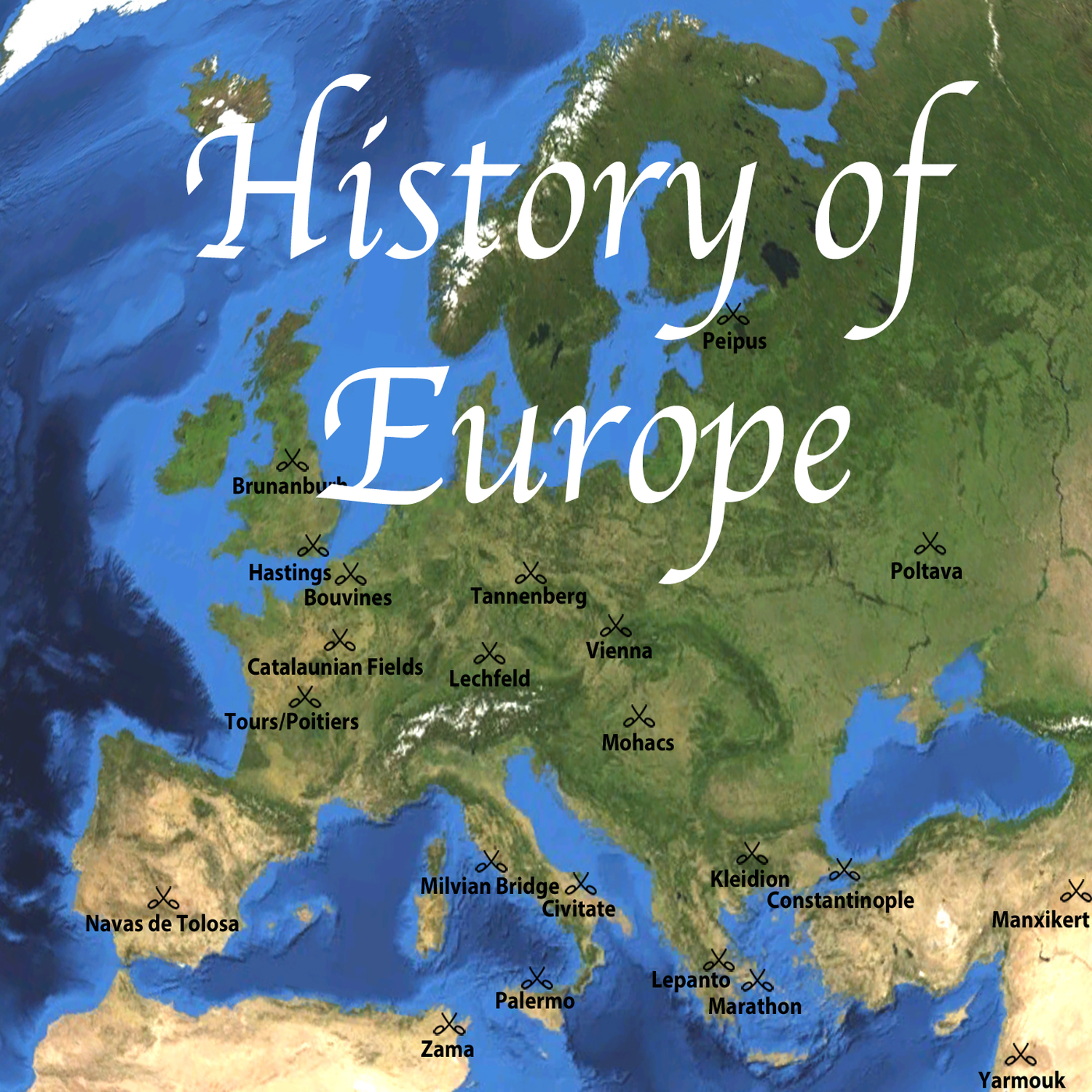
European conflict with context and consequence.
A History of Europe Key Battles follows the military and political turning points that shaped Europe, from medieval campaigns to the interwar crisis. Its recent episodes move patiently through Irish independence, post-World War I settlements, Italian fascism, Lake Peipus, and diplomacy before war.
PRESS PLAY
A History of Europe Key Battles is a long-running chronological history series about European conflict and the societies that produced it. It is not only a catalogue of battles. The show uses wars, campaigns, and famous confrontations as entry points into power, ideology, diplomacy, state formation, and public memory. Recent episodes show the range clearly. The Battle of Lake Peipus becomes a study of crusading pressure in the East Baltic, Alexander Nevsky of Novgorod, frozen terrain, later Soviet propaganda, and the gap between legend and evidence. The interwar episodes widen the frame. Europe after World War I is presented through the Treaty of Versailles, the collapse of the Austro-Hungarian Empire, Romania's territorial gains, weakened Austria and Hungary, and the grievances that followed the peace settlements. The Irish sequence is even more granular. It follows Sinn Fein MPs, Dail Eireann, the IRA, Michael Collins, British policing, emergency legislation, negotiations, partition, and the bitter split between pro-treaty and anti-treaty forces. Then the series turns to Italy. Mussolini's rise is treated as a product of wartime division, nationalist frustration, parliamentary weakness, elite accommodation, violence, and economic theatre. Short episodes are not the style. The pacing is steady, factual, and sequential, with room for names, dates, institutions, and cause-and-effect chains. The narration favors explanation over performance. It can be dense, but the density is the point: listeners hear how military events connect to constitutions, currencies, courts, propaganda, and diplomatic pressure. The show also occasionally steps outside strict battle narrative, as in an interview with Stuart E. Eisenstadt about diplomacy and conflict resolution. That makes the project feel broader than its title suggests. It is a history show for people who want the connective tissue around conflict, not just the moment of impact. Its best episodes make European crises feel less isolated and more cumulative, showing how victory, settlement, resentment, and memory keep shaping what comes next.
Made for: For listeners who enjoy detailed chronological history, especially military history tied to politics, diplomacy, ideology, and state power. It suits patient history fans who want structure, dates, factions, and consequences more than personality-led banter.
What sets it apart: The show places battles beside the surrounding political machinery: treaties, governments, propaganda, economic policy, and contested legitimacy. Its recent interwar focus gives military history a wider frame, connecting battlefield outcomes to the pressures that reshaped modern Europe.
A podcast on European conflicts from the perspective of each side to provide an alternative to the traditional national narratives. Going chronologically from the Ancient Greeks onwards I described to some extent how each battle was won or lost by particular decisions, tactics, technology or fortune. But the aim of each main narrative will be to place each battle in the context of the overall history of Europe. New series on the Interwar Years 1918-1945 begins 18th July 2025 Hosted on Acast. See acast.com/privacy for more information.
Based on 6 episodes we listened to · September 2026
Carl Reulert connects battles to the treaties, institutions, political fractures, and state-building struggles that give them lasting historical consequence.
A History of Europe Key Battles follows conflict beyond the battlefield, tracing how military pressure, political settlements, and contested authority reshape states.
Eisenstein's icy spectacle gets a reality check; you get the campaign behind the legend.
Press play if you want
Short reviews from the PlayNext desk, based on the episodes we processed.
Mussolini's hold on Italy is traced through power, currency, and grain.
Benito Mussolini's hold on Italy is the subject, and the piece is at its best when it looks past the pageantry of power to the brittle machinery beneath it.
Italy's wartime fracture is used to explain Mussolini's rise and the turn toward fascism.
Spanning interwar Europe through Italy, this episode connects the rise of fascism to a wartime public split between interventionists and neutralists.
Treaty politics, the IRA split, and March 1922 violence are set out with clarity.
The episode brings the War of Irish Independence to a close by shifting into the Irish Civil War and the treaty split that follows. Michael Collins and Arthur Griffith stand on the pro-treaty side, while de Valera and his supporters break away after the cabinet narrowly approves…
A focused account of how guerrilla warfare strained Ireland's courts and British authority.
The second installment of A History of Europe tracks the War of Irish Independence as violence rises around Michael Collins, who moves between fundraising in Ireland and directing intimidation against the police.
A clear guide to how the 1919 peace reshaped Europe and left it unsettled.
This episode offers a compact look at Europe after World War I, beginning with the 28 June 1919 signing of the Treaty of Versailles in Paris and widening out to the settlements that followed.
A frozen clash, and the film that helped turn it into Soviet legend.
The piece treats the Battle of Lake Papus, or the Battle on the Ice, as both a medieval clash and a story molded by later memory. It moves cleanly from the 5th of April, 1242, to Sergei Eisenstein's 1938 film Alexander Nevsky, showing how Stalin-era propaganda and a thin record…
Medieval power, read with institutional gravity.
Medieval Iceland, read closely and argued warmly.

Medieval Iberia, one consequence at a time.

Medieval history, criminally examined.

Empires, sieges, and final stands.

Crusades history through Byzantium’s long shadow.
This episode covers the early stages of the Russian Civil War after the October Revolution, focusing on Bolshevik consolidation and challenges from counter-revolutionary forces.
This episode covers the main events of 1915 on the Eastern and Western Fronts of World War I, including the entry of Italy and the Ottoman Empire, and the Gallipoli campaign.
This episode covers the major battles of Verdun and the Somme in 1916 during World War I, highlighting the exhaustion and total war impact on soldiers and civilians.
This episode details Mussolini's consolidation of power in Italy after the March on Rome, focusing on his initial moderate facade and coalition government.
Benito Mussolini's path to the March on Rome runs through limited suffrage, unstable coalitions, and the post-1918 crisis that made fascist violence look like political order.
A History of Europe, Interwar Years traces the Irish Civil War from the 1921 Anglo-Irish Treaty talks to Ireland's 18 April 1949 exit from the British Commonwealth.
This solo-narrated history episode, part two of a series on the Irish War of Independence, traces the conflict from the Dáil Éireann's shadow government and Michael Collins's Squad of assassins through the arrival of the Black and Tans and Auxiliaries in 1920.
This episode covers the background of the Irish War of Independence, starting with the Sinn Féin MPs' assembly in Dublin in January 1919 that declared an Irish Republic.
Germany left the Paris peace settlement facing 132 billion gold marks in reparations, a figure the episode ties to hyperinflation and political turmoil.
This episode examines the historical Battle of Lake Peipus (1242), its later Soviet propaganda portrayal, and the series of conflicts between Western Christendom and Novgorod from 1240 to 1242.
An interview with diplomat Stuart E.