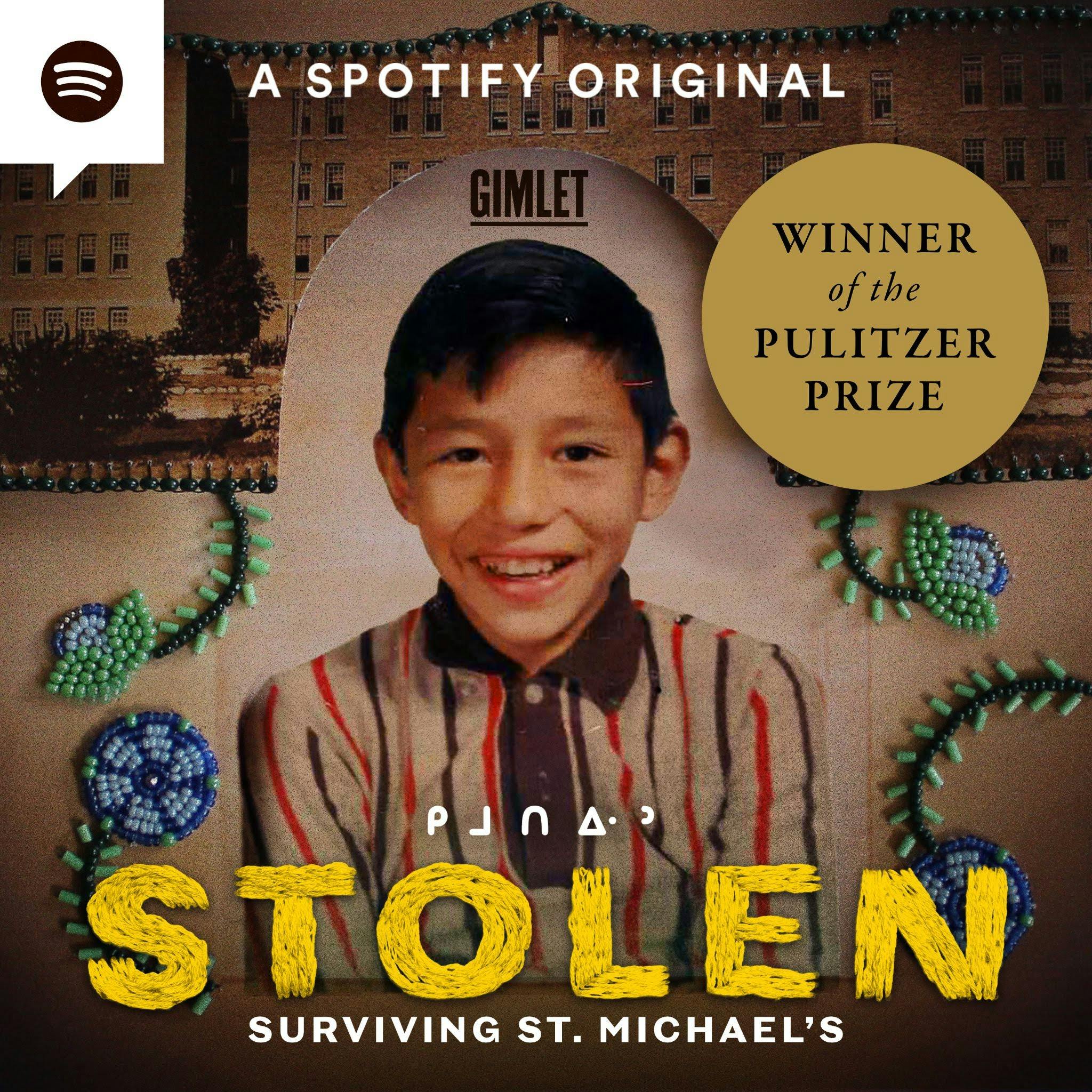
Stolen · Spotify Studios

The Shining Ones

June 28, 2022·46 min·3 clips
Howard Cameron slides down a hospital wall, telling his family, 'My baby's going to die.'
1. Stolen: Surviving St. Michael's follows Connie Walker, a Cree journalist, investigating the residential school her father attended — and discovering how its damage extended through three generations of her family. 2. Connie Walker is the host and reporter; her father Howard Cameron Sr. was a ceremonial keeper for the Beardy's and Okiimâsis First Nation, a former RCMP officer, and a survivor of St. Michael's Indian Residential School in Duck Lake, Saskatchewan. 3. The episode's central question is how the residential school trauma Connie has been investigating connects to her own childhood, and what her father became by the end of his life. 4. The episode opens with Connie watching archival video footage of her father she has never seen before, from a 2012 documentary called Chaos and Courage, in which he talks about his late daughter Robin. 5. Robin Cameron joined the RCMP because she grew up watching her father put on a uniform; Howard told Robin not to quit when she struggled in depot training, and called her every night before her shifts. 6. On July 7, 2006, Howard missed Robin's answering machine message saying she was going to work and would call later — that was the last time he heard her voice; Robin and her partner Marc Berdage were shot responding to a domestic violence call that night. 7. At the hospital, Norlaine recalls Howard being told Robin and Marc both sustained headshots — he 'absolutely knew what that meant' — and sliding down the wall in the hallway, saying 'my baby's going to die.' 8. With Robin's survival chance at 2%, Howard and Robin's mother decided to remove life support; Auntie Margaret said a prayer in Cree at the bedside — 'go home to the Creator, it's okay, we'll never forget you' — and Robin died as the prayer ended on July 15, 2006. 9. Kurt Dagenais, who shot Robin and Marc Berdage, was convicted of two counts of first-degree murder and sentenced to life in prison; Howard said that 20 years earlier, he would have hunted the man down himself. 10. At Auntie Lois's kitchen table on the reserve, Connie looks through old photo albums and finds a picture of herself at around age 7 with her father — 'reaching out to him as if I'm about to grab him or tickle him' — described as one of the first photos she's ever seen of them together. 11. Connie's cousin, who spent time with Connie's family when they were children, arrives during the visit and describes her parents' heavy drinking leaving her and her brother with 'just anybody who would babysit' them. 12. The cousin reveals that Uncle Ivan — Connie's father's younger brother, who himself alleged daily abuse by Gilles Gauthier at St. Michael's — was a regular babysitter who sexually abused her across years, not a single incident. 13. The cousin came forward at age 24, eventually joining eight other accusers; in 1993, Ivan was convicted on four counts of sexual abuse and sentenced to three years in prison — and in a later case, his lawyer argued his own abuse at Fort San sanatorium at age three was the root of his offending. 14. Connie then discloses on tape, for the first time, that Ivan also abused her as a child: 'I've never talked about this with anybody — except for today with Auntie Lois. And then now with you.' 15. Her cousin responds: 'No kid was safe in that house' — and says 'it's a cycle, it's a ripple effect' from residential school abuse passing into the next generation. 16. After the conversation, Connie attends a sweat lodge with her Auntie Carol and brother Hal at Elder Junior Yapay's house on the reserve; she says she will not describe what happened inside, but 'some of what I had been carrying was lifted.' 17. In archived audio from a 2011 Canadian parliamentary hearing on Indigenous child welfare, Howard Cameron Sr. explains that the Cree word for children, Awas Siwen, means 'the shining ones,' arguing they are sacred and that adults must 'let us learn from our mistakes and let us do better.' 18. Howard was diagnosed with incurable lung cancer in late 2012 and spent his final weeks attending sweats — not to cure himself, but to forgive: he needed to forgive the man who killed Robin before he could die at peace. 19. In his final days, Howard called Connie's mother Lorraine, held her hand on the porch, and said 'I'm sorry for the life I gave you — can you forgive me?' She told him she had forgiven him a long time ago; his family describes him as 'happy' after that. 20. The episode ends with Connie's daughter Sequin learning to identify and pick sweetgrass with Uncle Hal — the same practice Howard taught his sons — while Connie describes wanting her daughter to know the beauty of their culture alongside the truth of what happened in residential schools.

As heard by us

A quiet family reckoning that turns private memory into a wider history.

The episode centers on a daughter returning home and asking how her father's story shaped her own. From there, it moves into a family reckoning with the aftermath of residential school, drinking, and harm carried across generations.

Read the full review in PlayNext →

Why you'd press play

You want a quiet, heavy episode that starts in a family home and keeps going deeper.

Read the full recommendation in PlayNext →
Listen to the show on