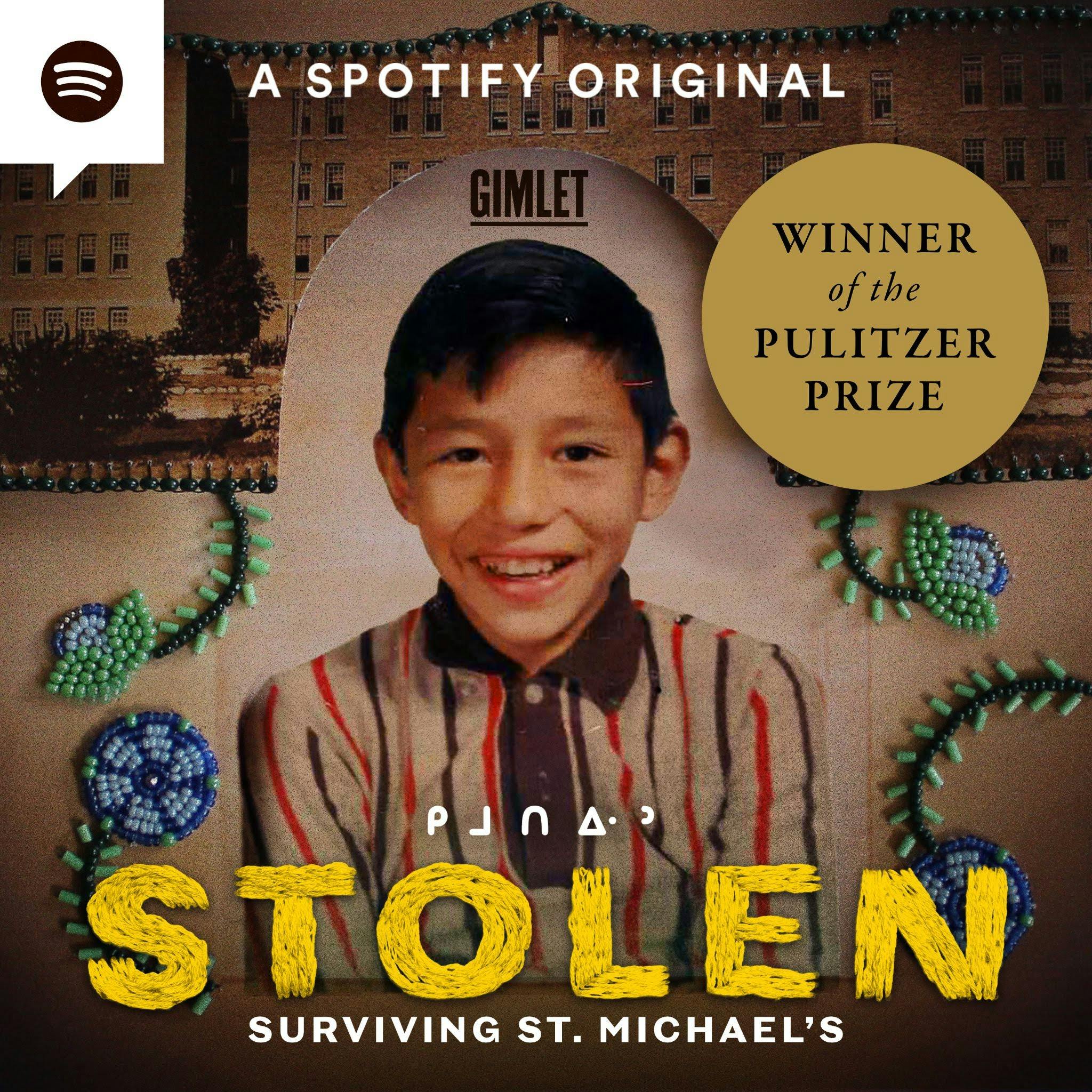
Stolen · Spotify Studios

Origin Stories: Connie Walker Discusses Stolen

September 17, 2025·33 min·2 clips
A priest is violently beaten by a cop on a dark road—the start of Connie Walker's search for justice in her father's past.
1. Origin Stories host Matthew Scher interviews Cree journalist Connie Walker about the creation of Stolen: Surviving St. Michael's, the first podcast to win both a Peabody Award and a Pulitzer Prize in the same year. 2. Connie Walker came up through the CBC in television news, moved to audio in 2016 focused on Indigenous issues, and created Missing and Murdered, an anthology series about missing and murdered Indigenous women and girls, before joining Gimlet Media. 3. The episode focuses on the second season of Stolen, Surviving St. Michael's, released in 2022 — a personal investigation into Walker's father Howard Cameron Sr.'s experience at St. Michael's Indian Residential School in Duck Lake, Saskatchewan. 4. Walker moved her family to New York on January 1, 2020 to join Gimlet, pulled her grade-school child out halfway through the school year, and was back in Canada by the end of March as the COVID-19 pandemic made New York untenable. 5. The catalyst for the second season was a Facebook post by Walker's brother Hal in May 2021, coinciding with the discovery of remains at the Kamloops Indian Residential School — a moment she describes as the first time Canada collectively stopped to understand the scale of what happened. 6. Walker describes reading her brother's post: 'I still remember the feeling I had in my stomach when I first read it. I didn't want to think about it. I didn't want to actually dig into it. But it just keeps coming back.' 7. Walker was uncertain about telling such a personal story, primarily worried about whether her family would consent — and says every family member immediately responded with enthusiastic support, the opposite of what she expected. 8. The internal Gimlet pitch was, by Walker's description, 'half-baked, quarter-baked,' but immediately approved — her hesitation was greater than the network's. 9. The series' central question came from producer Anya Schultz: 'What if we try to find the priest?' — the priest Walker's father had beaten on a dark roadside decades after leaving St. Michael's. 10. Walker explains that a podcast needs a 'compelling question' to pursue throughout; the search for the priest transformed the season from a painful memory excavation into 'a search for accountability and a search for justice.' 11. The first episode was the most labored over, with Walker trying to imagine her father's perspective at the moment of confronting his abuser — she describes driving alone on dark Saskatchewan gravel roads at night and getting scared enough to jump back in the car. 12. Walker's daughter, age nine or ten during the reporting, had a nightmare about being sent to residential school with her cousins and conserved her iPad battery so she could call home — a moment Walker says she hadn't anticipated and felt guilty about. 13. Walker describes her production approach: post-it notes and whiteboards to map structure after bulk reporting is done, relying on chronology, and writing free-form notes immediately after interviews capturing what people were wearing and how she felt. 14. She recorded late-night debrief calls with her husband Chuck and production team throughout the reporting, several of which ended up being used in the podcast itself. 15. Walker describes realizing during production that 'this is also my story' — that the trauma she had been reporting about in other people's families had been directly shaping her own life. 16. In a university Indian Studies oral history assignment, Walker recorded her grandfather — someone she was extremely close to and spent years with in cars driving to garage sales — and discovered for the first time that he had been sent to residential school at age six. 17. She describes the journalist's microphone as giving 'permission to ask questions' that unlocks a channel 'we didn't even know was there' — conversations that don't happen even between family members who spend years together. 18. Walker says her grandfather's revelation, and later her father's story, are part of a career-long pattern: she has included 'bits of myself' in all her stories, and her journalism has been 'an education into how my life has been shaped by the Indian Act and residential schools.' 19. Despite winning the Peabody and Pulitzer, Stolen was cancelled after its third season; Walker notes that the New York Times has no Indigenous affairs correspondent and the AP is the only major U.S. news outlet with a dedicated Indigenous reporter. 20. Walker says she still has hope for finding a new home for Stolen, describes the awards as only part of the impact, and emphasizes that she feels urgency to continue: 'It feels like now we have traction. We have to keep going.'

As heard by us

A family story becomes a measured, unsettling look at residential-school history.

Connie Walker traces a family story back to St. Michael's, where her father studied, and to the priest he later beat up on a rural road. The episode starts with that violence, then opens into the residential-school system and the trauma that passed through the family after it.

Read the full review in PlayNext →

Why you'd press play

A family road story opens into residential-school history.

Read the full recommendation in PlayNext →
Listen to the show on