Topics / Orson Welles
Orson Welles Podcasts
A guide to how podcasts cover Orson Welles: the shows that reference Orson Welles most, what they focus on, and where to start. 54 episodes across 39 shows in the PlayNext corpus.
Swipe · Orson Welles only
Swipe through Orson Welles
Save time discovering your next favourite podcast by listening to just the best minute of an episode.
The orson welles slate · every cover a link



Your guide
Picking your next Orson Welles podcast
Listening here divides quickly between the voice itself and the stories later told about it. Some shows preserve the sound and pacing of vintage radio; others use history, documentary, or interview formats to examine particular corners of the subject. The result is unusually varied, but concentrated: a handful of episodes offer direct treatment, while much of the surrounding fiction coverage is better understood as adjacent listening.
Start with the archival voice
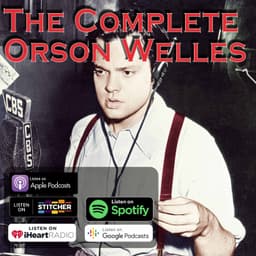
The Complete Orson Welles offers the most direct route into period broadcasting. Its measured, theatrical style moves between authoritative narration and staged dialogue, with little of the explanatory framing a modern host might add.
The range is clear from Orson Welles Commentaries || Brewing civil war in China || The future CIA, possible war with Russia || 1945, which places Welles in a commentary setting, and Suspense || The Hitch-hiker (Orson Welles) | 1942, which points toward dramatic performance. These are useful companion pieces because they present two very different kinds of listening under the same feed.
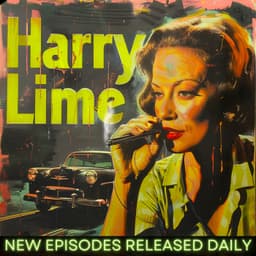
Among the show's other episodes are The Adventures of Harry Lime || Horse Play || 1951 and The Black Museum || Glass Shards | 1952. Neither title names Welles, so they should be approached as part of the surrounding archive rather than as focused accounts of him.
The grand figure and the unfinished work
It’s Not Even Past takes the most deliberately shaped historical approach. The pairing of Orson Welles and the Grandiose - Prologue with Orson Welles and the Grandiose - Scene One promises a story told in stages, with “the grandiose” supplying the organizing idea. For an argument or narrative frame rather than an isolated broadcast, this is the clearest choice.
For a compact alternative, Talking History with Patrick Geoghegan has the plainly titled Orson Welles. It is the cleanest one-episode entry point: no narrower work or theme is announced in the title.
Idiots Talk History chooses a more specific question with 78 Orson Welles and His Lost Films. That makes it the obvious stop for anyone more interested in absent or unfinished work than in a broad introduction. The show’s title also signals a lighter, less ceremonious setting than the formal archival feeds.
Legacy, memory, and one peculiar story
Julian Schlossberg's Movie Talk approaches the subject through conversation. Its warm, interview-led style is built for recollection, career lore, and digression, and Beatrice Welles on the Legacy of Orson Welles makes legacy the explicit focus. Choose this when a personal, conversational perspective sounds more appealing than a narrated history.
Radio Diaries offers a different kind of intimacy. The show typically builds documentary stories from recorded voices and small details, allowing meaning to emerge gradually rather than announcing it upfront. Orson Welles and the Blind Soldier 2: Officer X is the most intriguingly narrow title here, and the “2” marks it as a continuation rather than a self-contained general survey. It is best saved for listeners willing to enter a specific story already in progress.
From discussion back into drama
Retrospection Radio Theatre | Now Featuring Live Radio Plays & Audio Dramas moves away from commentary altogether. Orson Welles' "Dracula" | Mercury Theatre on the Air Remake | Retrospection Radio Theatre is explicitly a remake, making it the clearest performance-first option. The attraction is interpretation through reenactment, not historical explanation.
War of the Worlds - NEOZAZ' Everything War of the Worlds sits farther from direct coverage. War of the Worlds Week - The 1938 War of the Worlds Broadcast supplies relevant broadcast context, but Welles is absent from the title, as he is from the show’s other listed episodes. Treat this as subject-adjacent listening for a later detour, not as the place to begin.
Where to start
Begin with The Complete Orson Welles and Suspense || The Hitch-hiker (Orson Welles) | 1942 if you want performance without a modern interpretive layer. For a structured historical treatment, continue with the two-part Orson Welles and the Grandiose - Prologue and Orson Welles and the Grandiose - Scene One from It’s Not Even Past.
Choose Beatrice Welles on the Legacy of Orson Welles for an interview-shaped discussion, or 78 Orson Welles and His Lost Films for the most sharply defined topic. If drama is the priority, the remake in Orson Welles' "Dracula" | Mercury Theatre on the Air Remake | Retrospection Radio Theatre provides the clearest on-ramp.
Featured shows below are part of the PlayNext catalog. Updated weekly.
Featured shows
10 shows, described rather than listed
A short write-up for each, plus the job it does in this guide.
5 episode(s) referencing Orson Welles.
4 episode(s) referencing Orson Welles.
4 episode(s) referencing Orson Welles.
3 episode(s) referencing Orson Welles.
2 episode(s) referencing Orson Welles.
2 episode(s) referencing Orson Welles.
2 episode(s) referencing Orson Welles.
1 episode(s) referencing Orson Welles.
1 episode(s) referencing Orson Welles.
1 episode(s) referencing Orson Welles.