Topics / Law Enforcement
Law Enforcement Podcasts
101 shows and 9,941 episodes sit under Law Enforcement.
Hear police and corrections interviews, workplace analysis and financial-crime briefings from Mic’d In New Haven, Prison Officer Podcast and The UKFIU Podcast.
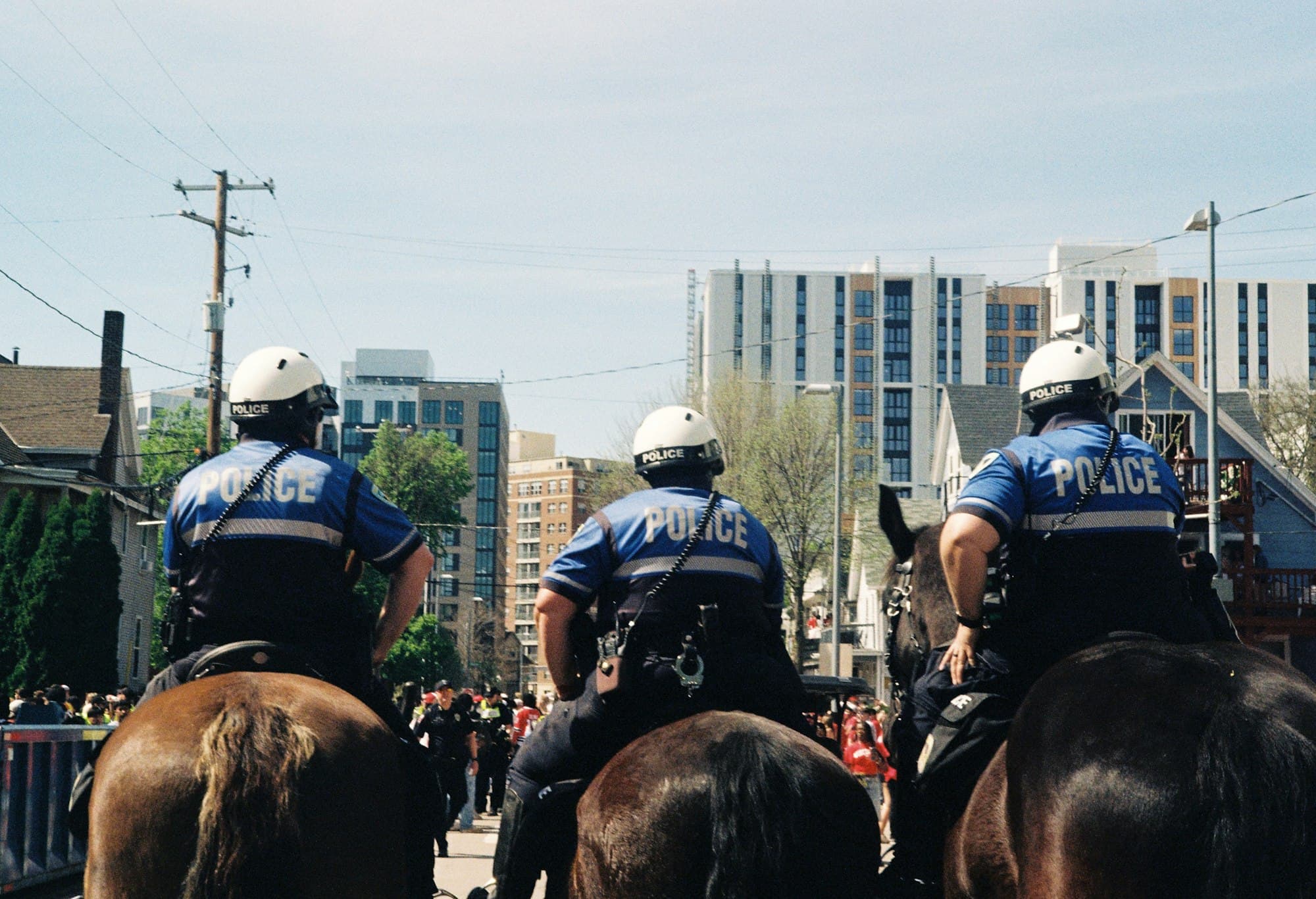
Photo: Yuang Li on Unsplash · Unsplash License
Swipe · Law Enforcement only
Swipe through Law Enforcement
Save time discovering your next favourite podcast by listening to just the best minute of an episode.
The law enforcement slate · every cover a link
All 101 law enforcement shows →




Our guide
Law Enforcement podcasts, explained
A man has a knife sheathed on his belt. A dispatcher asks how old he looks and whether the blade is in his hand. On body-camera video the call unfolds. Law enforcement podcasts work in that aftermath. The good ones slow an incident down until you can see the decisions inside it: what the officer knew, which rule governed the next move, and who answers for it.
The range is wider than the genre's reputation. A union walks through a state bill. A game warden reconstructs an elk poaching. A police chief explains why some crisis calls are better answered without a uniform. A retired officer trades stories on a borrowed yacht. Nearly all of this comes from inside the profession: officers, unions, departments and trainers speaking for themselves. That is the shelf's strength and its limit, so it helps to know which one you are hearing.
The arguments are about perspective more than reach. Edison reported in March 2026 that 58% of Americans aged 12 and over had consumed a podcast in the preceding month, a figure that says nothing about this corner in particular. In a September 2026 thread, one listener asked for more true crime about police misconduct. In August 2026, a professional policing show weighed the time AI could save agencies against the duty to check what it produces. The live tension is between explaining policing from the officer's side and scrutinising the institution.
Talk from the squad room

The plainest form is conversation among people who have done the job. Beyond The Barrel Podcast is hosted by Kenny, a K9 interdiction officer, and Attorney Mike, a patrol supervisor. In Ep 49: Pouring Purpose, Dirk’s Mission to Honor the Fallen | The End of Watch Legacy Fund, an Indiana officer describes raising $10,000 for the family of each officer in the state killed in the line of duty: "10 families so far." He admits the fund's real hope is never to write another check. Ep. 21: From the North (Toronto, Canada): Dave Haynes on Leading with Grit, Unity, and Purpose arrives at a useful idea: when an officer goes wrong, look first at that officer's supervisor and training.
Motorcop Chronicles Podcast is louder. A midweek news episode, hosted by the Iceman with Holstera and Freebird, warns off the easily offended early on, then riffs on arrests, chases and bond decisions. The interview Eugene Roy Retired CPD Chief of Detectives changes register, turning to stress and suicide, and to the reminder that "Dispatchers are first responders."
Police - British Bobbies off the Cuff, whose latest listed episode dates from 2022, is the British version, with beer on the table. In King Of The Cops!, a former nurse who joined the police recalls an interview question about whether they had ever lied. The answer: "I lied to somebody yesterday." The lie was to a dying patient.
Arguing over the footage

Two other shows put recorded incidents on the table and argue about them. Cop Talk LIVE, hosted by former officer Dominick Izzo, describes Tuesday nights for use-of-force reviews and Friday nights for guests and callers. It is openly pro-police and openly harsh about bad policing. In Being a Professional Police Officer in a Circus full of Clown Cops, the show reports obtaining 51 pages of FOIA material on a Harris County shooting. Female Cop with Taser leads to Deadly Confrontation with Armed Suspect at Dollar Tree plays the dispatch audio and insists "A knife is more dangerous than a gun seven days a week and twice on Sunday." Its closing prescription, which includes dropping tasers and removing female officers, is the show's own position. Outspoken Female Police Sergeant Speaks on STANDARDS, EXPECTATIONS and EXCELLENCE in Law Enforcement gives an active-duty sergeant the floor on standards.

LEO Round Table, hosted by Chip DeBlock with panels of officers and attorneys, reacts to headlines from street level and makes no secret of its side. In Cops Arrive In Time To Save Woman From Bad Guy With Hammer!, the panel defends qualified immunity: "We have to qualify for qualified immunity every time."
Rules, lawyers and the statehouse
Police unions can be clear explainers of how law reaches the patrol car, always from their members' side. Early in S8 E10 | Who Is a Peace Officer?: Parsing Penal Code 830 with POST’s Manny Alvarez, On the Job with PORAC, hosted by Brian Marvel with Ben Theriault, takes on California's SB 627. The episode argues that the bill will bind only local officers, because the state cannot regulate federal agents, and calls it grandstanding. S8E11 | The Path Forward: 2025 Legislative Recap and 2026 Priorities with Randy Perry covers a bill under which an AI-generated draft does not count legally as the officer's report. The Public Policy page follows lawmaking more broadly.
Covered with the Utah FOP, the flagship show of the Utah Fraternal Order of Police, takes legal defense seriously. 106. OiCi with Kresdon Bennett Part 1 turns to officer-involved critical incident protocol. It recounts a case in which investigators wanted a witness officer and his wife kept in separate hotel rooms for days. The reply: "The only way you're segregating them is to take them into custody." The Law & Courts page goes further into the legal side.
Behind the walls, out in the timber
Corrections and wildlife enforcement get less attention, and their best episodes repay it. Prison Officer Podcast, hosted by Michael Cantrell, gives guests room. 123: Leadership, Solitary Myths, And The BOP’s Legacy - Interview w/Judi Simon Garrett features a guest with 28 years at the Federal Bureau of Prisons. The conversation disputes the public picture of solitary confinement and calls restricted housing "a prison within a prison." That is one side of a live argument.

Warden's Watch, hosted by retired game wardens Wayne Saunders and John Nores, is the most procedural listen here. 170 The Ray Anderson Case – Washington State covers field necropsies on elk, done with basic tools and phone cameras. It also covers a Google warrant that took several months to return, and reports of cut gate locks on timber land in the same area that eventually led investigators to their man. 169 – PAGC Tracking Team explains micro tracking, down to "the smallest 1% of that boot print."
The department, speaking for itself

Some shows come straight from a police department. They are good at explaining how things work, and they are not built to scrutinise the agency that makes them. In The Madison Police Department Podcast's Compassion and Coordination: MPD’s approach to helping those with mental illness, Chief Shon Barnes and guests describe crisis responders who arrive in civilian clothes in a fire department vehicle. The episode states the reasoning plainly: "When you bring a uniformed, armed law enforcement officer into someone's behavioral health crisis, that can be triggering."
Inside The Squad, from the Lafayette Police Department's Community Outreach Unit, is looser in manner and sometimes hard. Standing Up for Children with the Heartford House explains how forensic interviewers question children without leading them, and that an old report still gets heard: "there's not a timeline for us." The Local Government page picks up where city services and policing meet.
Getting in, and staying well
The Police Applicant Podcast, hosted by retired LAPD background investigator Ken Roybal, is for people weighing the job. S6-Ep.3: 101 Questions to Ask Before Becoming a Law Enforcement Officer features a guest who helped start a department's mental health unit on December 1st, 2008, with two officers; it had over 22 officers and detectives when he spoke. The episode urges colleagues to talk openly so they "recover loudly so we don't die silently."
Where to start
- If you want to watch a case get built: Warden's Watch, 170 The Ray Anderson Case – Washington State.
- For an argument with the tape running: Cop Talk LIVE, Female Cop with Taser leads to Deadly Confrontation with Armed Suspect at Dollar Tree. Its conclusions are the show's own.
- If crisis calls are your question: The Madison Police Department Podcast, Compassion and Coordination: MPD’s approach to helping those with mental illness.
- For how bills reach the beat: On the Job with PORAC, S8E11 | The Path Forward: 2025 Legislative Recap and 2026 Priorities with Randy Perry.
- If you're thinking of applying: The Police Applicant Podcast, S6-Ep.3: 101 Questions to Ask Before Becoming a Law Enforcement Officer.
Pick one, and listen for whose side of the incident you are hearing. The Government page maps the wider field.
Featured shows below are part of the PlayNext catalog. Updated weekly.
Featured shows
8 shows, described rather than listed
A short write-up for each, plus the job it does in this guide.
A rapid-fire panel mixes chat shoutouts, running bits, profanity and blunt police analysis, shifting from chaotic live episodes to reflective guest-led accounts of cases and police work.
A knowledgeable local interviewer gives guests a detailed introduction, then settles into measured conversations about careers and institutional memory across police and fire services.
Long-form interviews trace how corrections professionals entered the field, handled early assignments and learned from force, training, wellness and escort work. It suits listeners who want shop-floor experience.
A law-enforcement panel talks through warrants, critical incidents, labor bills, PTSD, force standards and agency process in loose, practical exchanges. It suits listeners who know the work and its politics.
Interview-led discussions translate legal defense, insurance, benefits, legislation, retirement and discipline into practical consequences for California law-enforcement members.
Rotating department voices use informal interviews to explain police work, from internships and youth partnerships to children’s advocacy and mental health behind the badge. It suits community-minded listeners.
Formal expert interviews explain payment diversion fraud, asset recovery networks, illicit finance, financial intelligence units and professional enablers for compliance and law-enforcement listeners.
A patient institutional interview gives a guest room to explain how dialogue policing is changing Portland’s approach to public-order management. It suits listeners who prefer detailed public-service briefings.