Topics / Higher Education
Higher Education Podcasts
473 shows and 44,176 episodes sit under Higher Education.
Curated guide to higher education podcasts in 2026: college admissions counseling (Your College Bound Kid), academic-discipline shows (AnthroAlert, Anthropological Theory)
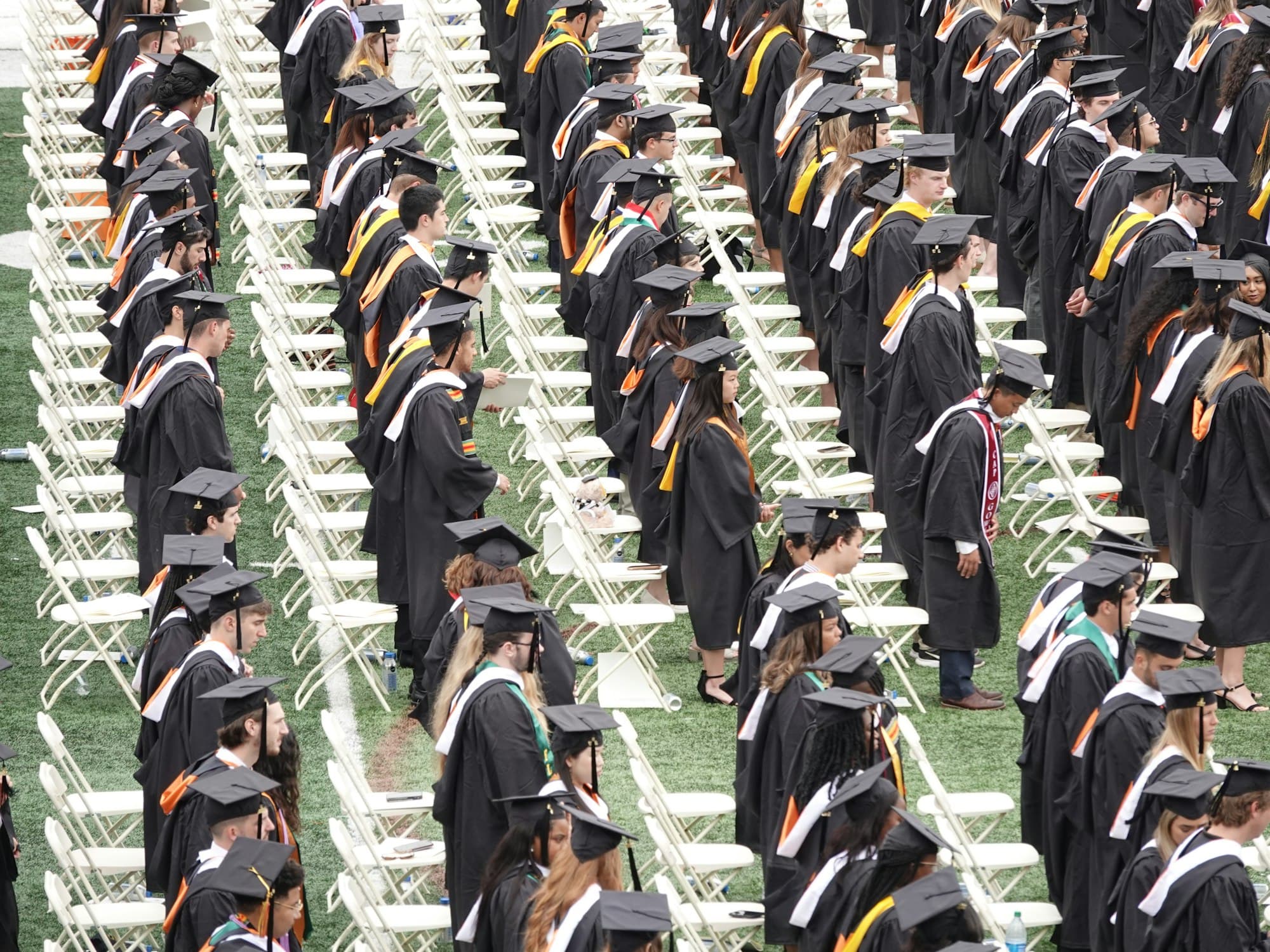
Photo: Charles Nouwen on Unsplash · Unsplash License
Swipe · Higher Education only
Swipe through Higher Education
Save time discovering your next favourite podcast by listening to just the best minute of an episode.
The higher education slate · every cover a link
All 473 higher education shows →

The rundown
Some great Higher Education podcasts to get to know
Who gets thanked when university research is published? In (Episode 164) Technicians uncovered: inside Tech Exchange at Leeds, a Research Culture Uncovered guest who works on fair attribution recalls a civil engineering PhD student asking, at a first project meeting, how the technicians wanted to be acknowledged. It was, the guest says, the first time that had happened. The best higher education podcasts work at that scale: one meeting, one supervisor, one parking ticket, and behind each the habits of an institution most people see only from outside.
The range is broad. Some shows explain how universities run and whom they fail. Some keep company with the people studying or working inside them. Others are universities speaking in public, handing the microphone to an oceanographer or a nursing professor. Campuses make many of these shows themselves, which gives them access and also a house view worth noticing. The makers are organising, too. In July 2026, Higher Ed PodCon announced its inaugural awards and, in its own press release, reported 155 nominations.
The live argument is about artificial intelligence. In August 2026, a University of Chicago spokesperson stressed fewer distractions and more discussion. In a September 2026 opinion essay, Dartmouth president Sian Leah Beilock argued that universities should teach productive AI use. The shows below meet that fork from very different rooms.
How a university actually runs
Research Culture Uncovered, from the University of Leeds, gets at research by talking to the people who hold it together. In (Episode 154) Cripping research culture: podcasting, disability justice, and counter archives (with Dr Élaina Gauthier Mamaril), Gauthier Mamaril explains why she left her tiredness audible in an episode of her own podcast instead of re-recording it. She wants that work "recognized as labor." The Academic Research page goes further down this road.

ENGINEERING CHANGE® PODCAST is sharpest on small cases. In Soapbox: The Truth about ABET, the host, an ABET engineering commissioner speaking only for herself, recalls a faculty member whose three non-minoritized students all flagged their minoritized teammate as a poor team player. Her question was what that student's own evaluation said. Her recommendation was to move the student to a team where they could thrive.

The Pickup Meeting, with Michael "Brody" Broshears and Kevin Thomas, lets the jokes in. In Ep. 28 - Kyser Lough, University of Georgia, Brody calls his inbox of perhaps 2,446 emails "a museum of unresolved intentions." Ep. 27 - A "Just Us" Episode turns to numbers. One host cites an Arkansas institution whose freshman-to-sophomore retention fell to 66%, a drop of 11%, and asks whether graduation goals that ignore that drop set people up for failure. The Educational Leadership page continues from there.
Getting through the degree
Academic Aunties starts from the premise that academia excludes first-generation, racialized and women scholars, and its advice does not pretend otherwise. In Good Supervision, Bad Supervision, a guest recalls being made to teach an early supervisor's introductory Chinese history class without pay. The guest then advises applicants to weigh a whole program and a team of possible mentors, not one name. Perimenopause and Menopause takes on the "neoliberal academy," where, the host says, "we are perpetually expected to ignore our bodies and our emotions."

PhD Lounge serves doctoral students deciding where a PhD leads. In Late-Night Talk: Andrea Grandi, PhD. A Former Postdoc Explains How To Land Your First Industry Role, Grandi, who spent six years in pharma, describes a weekly group call where his clients celebrate their rejections. He calls the number of rejections one predictor of success he has "consistently observed" over two years. That is a coach's observation, not a study. For the move out of the lab, see the Career Guidance & Transitions page.
Campus life, from the service desk

Many of these shows are campus offices explaining themselves, and the useful ones say exactly what to do. IPS's Podcast, from Michigan Tech's International Programs and Services, does this for international students. In Ask an Attorney - All about H1B, co-host Christian Montesinos, an immigration attorney of almost 15 years, covers H-1B transitions. The episode also urges travellers to carry:
- a valid visa and passport
- a travel signature on their most recent I-20
- proof of enrollment, which is suggested rather than required
On IPS's Podcast, Transportation Services explains "can the citation," which waives parking tickets, with some limitations, in exchange for food pantry donations. The rules are Michigan Tech's, but the habit of asking your own office applies anywhere.
We Are Chattin', Penn State Brandywine's show with Ava Clements and Natalie DiMario, is looser and warmer. In We Are Chattin' with David Rosenberg - Chattin' Golf, Giving and Gratitude, Rosenberg recalls a dance marathon he believes began in 1973. Its 78 dancers lost points for sitting down, and it raised $2,000.

The Catalyst, from Northeast Iowa Community College, shows the employer side. Built by Employers: New Core Manufacturing Skills Career Pathway Certificate and Industry Partnership traces a new certificate to a need its manufacturing alliance kept raising. In LECOM Presents: Heroes In Training, Finding A Path To Podiatry lets second-year podiatry students talk about boards and how they recharge. The Medical & Legal Education page picks up that path.
Lectures that leave the building

College on the Radio, Joe Moravchik's show on KYMN Radio in Northfield, gives a professor room to explain. In College on the Radio with guest Dr. Rika Anderson, 3-25-26 (48 minutes), the Carleton biologist explains how "our oceans basically rusted two and a half billion years ago." She then says it is almost impossible to separate genetic from environmental effects in genome studies of outcomes like divorce.

UNA Talks does similar work at the University of North Alabama. In What We Are Learning About Caffeine and Kinesiology (featuring Dr. Lauren Killen), Killen sorts people into positive, negative and non-responders, a useful check on one-size-fits-all advice.
Books to Battles opens up a School of Advanced Air and Space Studies seminar. In SAASS 667: Information and Cyber Power, an instructor says readers must "fight through typology" in John Lindsay's Age of Deception, but calls it "a gold mine" for practitioners who can parse it. The Science Education and Teaching & Pedagogy pages extend these routes.
AI, argued from inside

Simulcast, hosted by Victoria Brazil, Jesse Spurr and Ben Symon, shows healthcare educators how its hosts read a study. In 222 Simulcast Journal CLub April 2026, the hosts welcome an exploratory paper on AI in simulation debriefings. They also worry that a novice would "treat it as more, this is the answer," and they object to "pilot" being used to soften expectations.
On The Catalyst, The Digital Shift: AI and Technology at NICC features a guest who recalls faculty teaching how to use Google and warning about plagiarism. The guest says teachers owe students the same conversation about AI now.
ENGINEERING CHANGE® PODCAST takes a warier line in AI Can't Fix a Broken System. The host argues for fixing systems "before we introduce a tool into our systems that's going to amplify whatever is there." The Educational Technology page continues the debate.
Where to start
- If you work on a campus: The Pickup Meeting, Ep. 27 - A "Just Us" Episode (32 minutes).
- For a doctoral student eyeing industry: PhD Lounge, Late-Night Talk: Andrea Grandi, PhD. A Former Postdoc Explains How To Land Your First Industry Role (70 minutes).
- For pure curiosity: College on the Radio, College on the Radio with guest Dr. Rika Anderson, 3-25-26 (48 minutes).
- For clinical educators: Simulcast, 218 Human Factors and Translational Simulation with Dara Byrne, Paul O'Connor and Angela O'Dea (45 minutes), where a guest describes holding clinicians back to ask what the problem really is.
- To hear academia argued with: Academic Aunties, Good Supervision, Bad Supervision (52 minutes).
Pick the one closest to a question you already have, and let your next question choose the episode after it. Wider routes start from the Education category guide.
Featured shows below are part of the PlayNext catalog. Updated weekly.
Featured shows
7 shows, described rather than listed
Each one comes with a short write-up and the role it plays in this guide.
Practical college-admissions counseling for families: how admissions buckets work, teacher-rec strategy, athlete recruiting, gap years, and school-profile reads. Primary-source admissions-dean interviews are the show's strongest editorial offering.
College experience and campus-life perspective. No episodes indexed in PlayNext yet — check back as the corpus grows.
College access and equity focus. No episodes indexed in PlayNext yet.
Student-produced anthropology podcast. In the corpus; no episodes indexed yet.
Anthropology-student-produced theory discussion show. In the corpus; no episodes indexed yet.
Career advice and transfer-student guidance. In the corpus; no episodes indexed yet.
Law-medicine-life-sciences intersection at the research level. In the corpus; no episodes indexed yet.
Where to start
4 routes in, one per reader
*Understanding How Admissions Buckets Impact Admission Decisions* is the entry. Follow with *SMU Is It For You? An Interview with Dean of Admissions, Elena Hicks* for primary-source admissions-office access.
*Tips Every Athlete Needs If They Want to Play Their Sport in College* (Parts 1–3) is the sub-thread to queue.
*Does Taking a Gap Year Increase Your Chances of Getting in College* is the entry.
In the corpus; check back as episodes are indexed. *Anthropological Theory: A podcast created by anthropology students* is the companion show.
Glossary
Words hosts use without explaining
Internal classification used by admissions offices to sort applicants before holistic review — e.g. recruited athlete, legacy, development, first-generation, standard applicant. Bucket membership shapes how a file is read. Discussed directly in *Your College Bound Kid*'s April 2026 episodes.
The one-page document a high school sends with every transcript explaining its grading scale, course offerings, and class-rank practices. Admissions officers read grades in light of the school profile — a 3.8 at a rigorous school and a 3.8 at a typical school are not equivalent reads.
Application timing designations. ED is binding — if accepted, the student must attend. EA is non-binding early notification. Both carry statistical admit-rate advantages at many institutions, which is a recurring topic in college-admissions podcasting.
Discipline-specific podcasts made by graduate or undergraduate students, often as coursework or departmental projects. *AnthroAlert* and *Anthropological Theory* are the PlayNext corpus's representatives of this sub-genre.
The sub-field and advocacy space focused on helping first-generation, low-income, and underrepresented students navigate higher education. *College 4 ALL* sits in this framing.