Topics / American History
American History Podcasts
256 shows and 34,987 episodes sit under American History.
Curated guide to American history podcasts in 2026: scripted narrative (American History Tellers), chronological Revolutionary War depth (American Revolution Podcast)
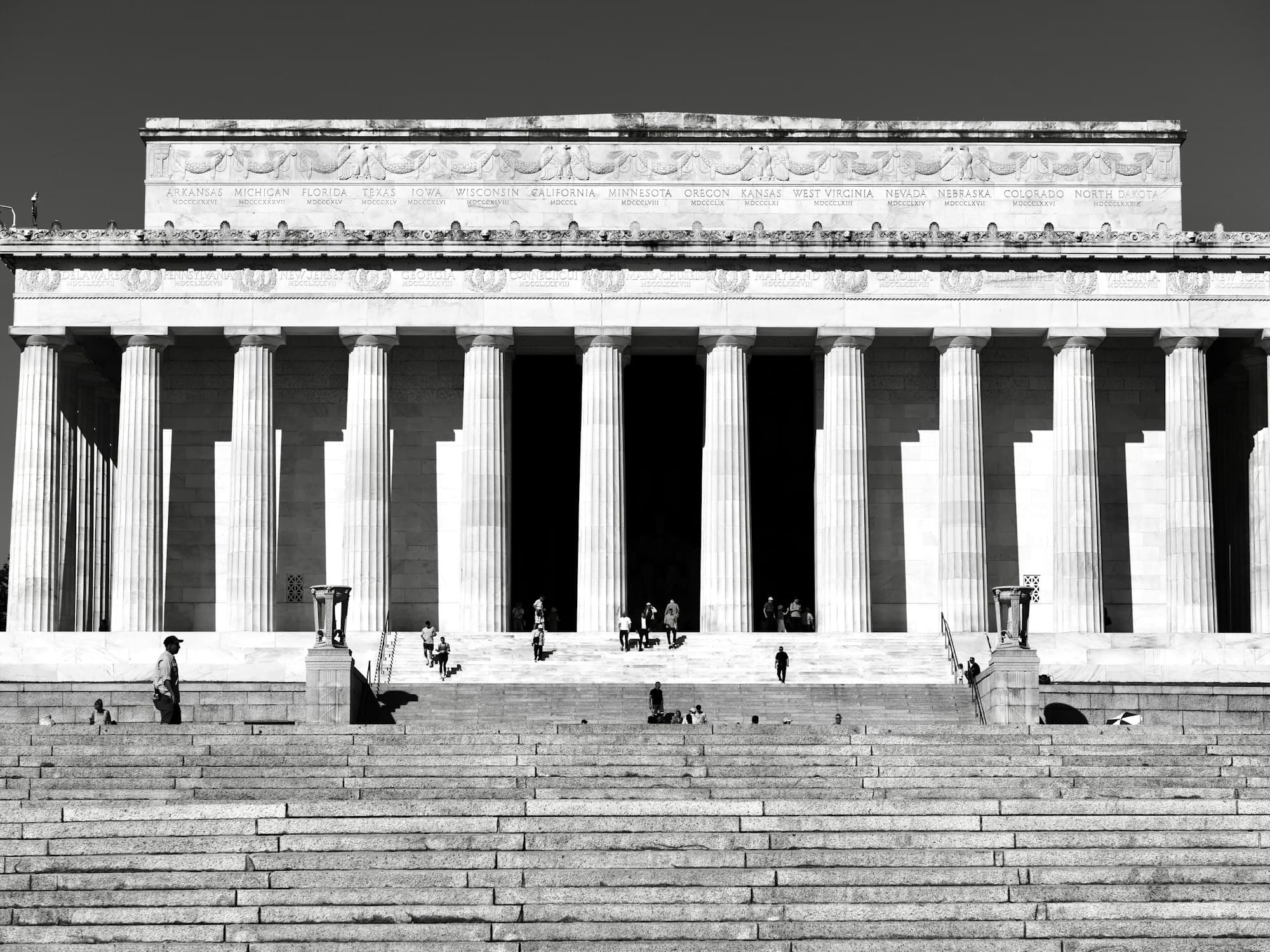
Photo: Sebastian Schuster on Unsplash · Unsplash License
Swipe · American History only
Swipe through American History
Save time discovering your next favourite podcast by listening to just the best minute of an episode.
The american history slate · every cover a link
All 256 american history shows →



A field guide
A listener's guide to American History podcasts

Ask the guides in Houston's Freedmen's Town what history looks like and they talk about bricks, wallpaper and a rain barrel. On The Monumental Project, they describe walking schoolchildren past hand-painted wallpaper. They explain how residents filled a tub with collected rainwater, then sent the bathwater out to the garden. The routine is small, and the claim behind it is large. The people who built lives there after emancipation belong in the national story as surely as anyone who signed a founding document, and a good American history podcast can make that case with one household chore.
That is the form at its best: a single object, day or decision opened up until the country shows through it. The range is wide. It runs from scripted drama with music and sound design to law professors parsing a clause, and from an 18-minute portrait of Henry Ford to a 175-minute episode on Sitting Bull. The audience is real but hard to measure. In February 2024 a Pew overview put History below 5% of the top-ranked shows it examined. In July 2026 Edison Research placed a history podcast at No. 39 in its US top 50, that show's first appearance there. It is a signal, not proof of a boom.
The arguments are about method and perspective. Some listeners love reenacted voices; others find them a distraction. Some trust a fluent storyteller; others ask what has been checked. The founding itself is contested: told as celebration, as a record of who was left out, or as both. The useful question for any show is where it starts, and whether it tells you.
History as scene
American History Tellers, hosted by Lindsay Graham, builds the episodes discussed here around second-person scenes. Conquering Polio | The March of Dimes puts you on a San Antonio porch in July 1942. A health officer arrives with quarantine signs and tells a mother she cannot visit her son, whose legs have stopped working. Then the narration steps back to explain a paradox the drama could not: polio spread faster as the nation grew cleaner, because sanitation delayed early exposure. The scenes are framed as imagined, and the facts arrive in the narration that follows.
Fan Favorite: Great American Authors | Mark Twain: Voice of a Nation moves the same way, from a dramatised pilot-house exchange to Twain's own words after his brother Henry died in an 1858 boiler explosion. If acted dialogue for real people bothers you, look elsewhere. If you want to feel a day before analysing it, start here. The Historical Events guide gathers more event-centred listening.

Dan Snow's History Hit reaches similar ground through conversation. In The Battle of Gettysburg, Snow's guest argues that enslaved labour handled much of the Confederate army's logistics, so the Union's larger headcount included teamsters and orderlies. In the guest's account, that leaves the riflemen near parity, "barely an advantage at all." Civil War Talk Radio is candid about gaps: Edward J. Hagerty regrets how few personal letters Richard Anderson left. Continue on the Civil War Era page and the Military History guide.
The founding, at different speeds
American Revolution Podcast treats the era as a chain of practical problems. ARP382 Yellow Fever and Genêt's Downfall follows the 1793 epidemic as it scatters officials from Philadelphia, while Genêt plans French squadrons against Halifax, St. Augustine and New Orleans. The new infections stop when frost kills the mosquitoes. ARP383 Eli Whitney & Dolley Madison has George and Martha Washington witnessing Katie Green's marriage to Phineas Miller in the presidential mansion. A parallel strand includes entries such as Rev250-117 Hanging Nathan Hale.

Ben Franklin's World, hosted by Liz Covart, widens the frame. In the 71-minute 438 The American Revolution & the Fate of the World, Covart says the Revolution "created Australia too." Her guest notes that Haider Ali of Mysore sent 80,000 troops against British Madras, more than ten times Washington's force at Yorktown.
This Day (An America 250 History Show), with Jody Avirgan and historians Nicole Hemmer and Kellie Carter Jackson, keeps the talk loose and funny. Liberty Trees (Revolutionary Rerun) traces Boston's giant elm, where the Loyal Nine protested the Stamp Act and hanged an official in effigy. The Only US Raid On British Soil (Revolutionary Rerun) sums up a string of failed schemes with "These guys have the worst plans."


We the People turns to social history in Women and the American Revolution. A guest argues that once women are in the story, "the military focus goes away," and describes public spinning gatherings during the boycotts of 1767 to 1769. For the raw paper, Memoir, Correspondence and Miscellanies, Volume I reads Jefferson's papers as compiled by his grandson Thomas Jefferson Randolph. 064 - Appendix Note A April 29 1779 letter from GR Clarke to the Governor of Virginia Council Proclamation includes the Governor ordering Henry Hamilton and two others into irons near the end. Go deeper on the American Revolution and Colonial & Founding America pages; readers following the war across the Atlantic can turn to the British History guide.
The Constitution as an argument
Two shows took up war powers. On We the People, Harold Koh and Michael Ramsey agree that the Constitution gives Congress the power to decide whether to initiate force against a foreign nation, and the conversation turns on why that line has eroded. Listening to America's Clay Jenkinson calls his session with Beau Breslin "almost an emergency" in The Iran War and the U.S. Constitution, and both men voice open alarm. In Is a Constitutional Convention Even Possible?, Breslin answers "Absolutely, yes" when asked whether the Constitution is broken enough to need revision.

The American Idea, from the Ashbrook Center with host Jeff Sikkenga, starts from Founding principles. In What Makes Americans a "Declarational" People? Adam Seagrave argues that such a people must treat immaterial principles as guides to practice. The American Story With Tim Barton frames the founding around faith, and The Legacy of 100 Minutes includes a pastor's account of grief. 15-Minute History, with Jon Streeter and Joe Parker, pairs compact narratives with looser debate. Henry Ford | The American Contradiction explains the assembly line as "the work moved to the workers," then turns to the side of Ford "history cannot and should not set aside." The Political History guide and Presidential History page continue from here.
Who keeps the record


Some shows make the archive the subject. On New Books in African American Studies, Katharine Gerbner describes a micro history that runs from a 1755 missionary letter mentioning Obeah to the practice's criminalisation in 1760. She explains how to read missionary sources without repeating their intentions. Past Forward's Chapters: Season Five Introduction recounts how researchers found Justice Department files from an incarceration case misfiled in the Commerce Department. More than 120,000 Japanese Americans had been incarcerated without due process. Buried Truths reads a prisoner's statement to the FBI about a policeman beating a jailed preacher, and lets the testimony carry the weight.
History on Fire takes the long road. [RERUN] EPISODE 56 Sitting Bull: Compulsory Civilization with a Side of Murder (Part 3) runs 175 minutes. It lingers on Sun Dance giveaways to poorer Lakota and on government pressure on Lakota land, and it flags a Lincoln anecdote: "there's debate on whether this dialogue ever took place." It is the third part of a series, so begin at the start. The Monumental Project moves outward from monuments: Michelle Browder describes her civil rights tours in Montgomery. Monuments in Museums, Part 2: Beyond the Display Case / Más Allá de la Vitrina was the show's first episode entirely in Spanish.
Where to start
- If you want a story first: American History Tellers, Fan Favorite: Great American Authors | Mark Twain: Voice of a Nation. A life told in scenes.
- For civilians in wartime: Ben Franklin's World, BFW Revisited: British-Occupied Philadelphia, 1777–1778. Households live under officers quartered in their homes.
- To hear scholars reframe a war: We the People, Women and the American Revolution.
- To start from a street: The Monumental Project, Protecting Freedmen's Town, Part 1: History & Advocacy.
Whichever you press first, listen for the moment a show tells you how it knows. The History category guide maps the rest.
Featured shows below are part of the PlayNext catalog. Updated weekly.
Featured shows
7 shows, described rather than listed
Each one comes with a short write-up and the role it plays in this guide.
Wondery's single-narrator arc-driven history series. Galveston hurricane, polio, the St. Valentine's Day Massacre, American literary figures. The slate's clearest large-production narrative entry.
Daniele Bolelli's source-citing, collegial monologue format. Conversational and digressive where Wondery is scripted. No clippable episodes in corpus at mid-2026 — positioning mention only.
Long-form humanities conversation grounded in US history. Covers founding-era foreign policy, public lands at 250 years, constitutional precedent, and Henry David Thoreau. Unhurried; treats the listener as patient and literate.
Chronological, week-by-week account of the Revolutionary and founding eras. Evacuation of Boston, Halifax Resolves, the Fugitive Slave Act of 1793. The slate's clearest sequential-history entry.
Thematic lenses across American history: presidential media, industrial titans, founding-era scandals. Pairs lecture episodes with discussion follow-ups.
Solo opinion-forward commentary that returns repeatedly to founding-era figures — Connecticut signers, Rhode Island delegates — as frames for arguments about American education and identity.
Covers American organized crime, cult history, and folk legend. Chicago gangster arc (Big Jim Colosimo, Torrio) and American moral-panic episodes anchor the dark-social-history end of the slate.
Where to start
5 routes in, one per reader
*The 1900 Galveston Hurricane | An Absurd Delusion* is the entry, followed by *Night of Terrors*. The polio arc (*Conquering Polio | The March of Dimes* through *There Is No Patent*) is the stronger multi-episode run.
*Rev250-073 Evacuation of Boston* is the entry. The show rewards sequential listening; *Rev250-077 Halifax Resolves* and *Rev250-078 Washington Arrives in NYC* follow in order.
*What the Medium Made | How Every New Technology Reshaped the American Presidency* is the entry. Pair with *Temptations of Power | Scandals in the American Presidency* for the full thematic arc.
*Ten Things About Foreign Policy in the Age of Jefferson* is the entry. *Is a Constitutional Convention Even Possible?* and *Assessing America's National Parks & Public Lands at 250* are natural follow-ons.
*Eulogy For Big Jim Colosimo* is the entry into the Chicago organized-crime arc. *Gangs of Chicago* gives the broader social context.
Glossary
Jargon you'll hear on American History podcasts
Sub-genre where a sole narrator delivers tightly written prose, often with voice-actor reenactments, covering a historical event or period in multi-episode arcs. *American History Tellers* is the slate's clearest example; produced in the Wondery house style.
Format that covers a period in strict sequence — week by week, battle by battle — rather than reshuffling events for narrative payoff. *American Revolution Podcast* is the slate's clearest example; listeners who want the founding period in order will find it closest.
Format that puts historical precedent in active dialogue with present political or constitutional questions. *Listening to America* is the slate's primary example: it reads Jefferson into current foreign-policy debates and treats the national parks' founding history as a frame for contemporary land-management fights.
Sub-field examining how successive communication technologies — print, radio, television, social media — reshaped the American presidency. *15-Minute History*'s *What the Medium Made* series is the clearest entry point on this slate.
Approach that recovers the criminal, cultic, and marginal strands of American history — organized crime, revivalist fraud, folk panic — that formal political history underweights. *American Hauntings Podcast*'s Chicago gangster arc is the slate's primary example.
The *American Revolution Podcast*'s weekly-anniversary tracking series, marking the 250th anniversary of Revolutionary War events as they fall in 2026. Episodes tagged Rev250-NNN run parallel to the show's main ARP-NNN chronological feed.