A magnetic survey, a possible buried engine, and a careful final push into the White Bird mystery.
Miles O'Brien and Rick Gillespie bring the White Bird search to Gull Pond for a closing chapter built around fieldwork, memory, and stubborn terrain.
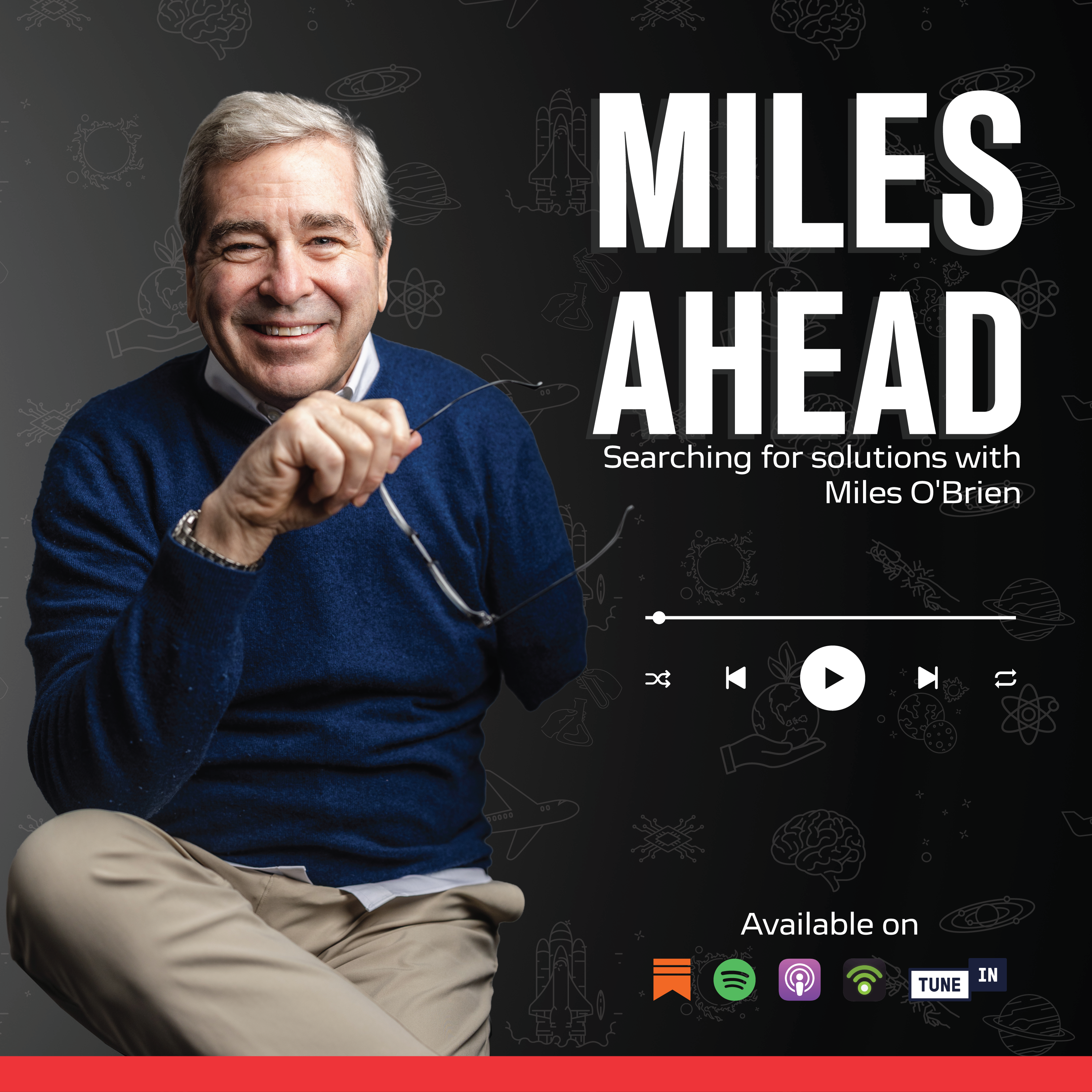
Rockets, submersibles, glaciers and a 1927 aviation cold case.
Miles O'Brien hosts conversations with people close to science and exploration stories, from Rocket Lab founder Peter Beck to OceanGate co-founder Guillermo Söhnlein. His three-part series The Hunt for the White Bird follows the clues to a French biplane that vanished in 1927 while trying to fly nonstop from Paris to New York.
PRESS PLAY
Miles Ahead is a science and exploration show hosted by Miles O'Brien, and its subjects run from a 1927 aviation mystery to commercial rockets, a deep-sea submersible disaster and a melting Antarctic glacier. It works in two modes. The first is the investigative series. The Hunt for the White Bird spends three parts on the French biplane that left Paris in May 1927 trying to fly nonstop to New York, two weeks before Charles Lindbergh's solo flight in the other direction, and vanished. Its guide is Rick Gillespie, a former insurance investigator turned historical sleuth who founded and directs TIGHAR, and the clues he follows suggest the two aviators got as far as Newfoundland. The evidence is handled at ground level. There is the wind on a likely landing approach, the rival crews chasing the same $25,000 prize, and a pond that looked like the only place with room to put the plane down, 'except for one important feature'. There is silt that may bury a Lorraine Dietrich 12-cylinder engine, remote sensing that failed for reasons the searchers did not grasp until 2021, and a call that year from Josh Gates of Expedition Unknown that brings a drone-mounted magnetic survey into the story. The series ties itself to the approaching Lindbergh centennial, and each part closes with an appeal to help fund the search. The second mode is the conversation. O'Brien visited Rocket Lab in New Zealand and asked founder Peter Beck whether there is enough business to compete against Elon Musk. Beck's answer is that commercial and government customers want alternatives. That episode, 'We Have No Money, So We Have To Think - with Peter Beck', is introduced from the bridge of a Korean icebreaker bound for Antarctica, where O'Brien is on a ship full of scientists studying how fast a glacier is melting. With OceanGate co-founder Guillermo Söhnlein, author of Titan Unfinished, the subject is the implosion that killed five people and a media response that O'Brien says lost its mind. Here the host brings his own past into the room. He recalls covering the loss of Columbia at CNN: when telemetry and radar tracking went silent, he knew the crew was gone before he could tell viewers. With Bill McKibben, a New Yorker staff writer who became a climate activist, the talk turns to solar costs that fall with every doubling of capacity and insurance bills that keep climbing. The register is plainspoken and curious, with room for a wry aside. O'Brien is open about the money, calling the show a labor of love he cannot do for free forever. He also explains the name: too many other podcasts shared the old one, and the new one nods to forward motion and a little optimism. Episodes are made to be watched as well as heard. His sign-off to the Titan conversation states the method plainly: 'the truth doesn't just bubble up on its own.'
Made for: Suits a listener drawn to aviation history told as a detective case, and to plainspoken interviews with the people behind rockets, submersibles and climate campaigns.
What sets it apart: It puts founder and activist interviews next to a three-part, clue-by-clue search for a biplane that vanished in 1927. The host also works his own reporting past, such as covering the loss of Columbia at CNN, into the questions he asks.
Join Emmy award-winning journalist, PBS collaborator, and CNN analyst Miles O'Brien as he explores the biggest stories in science, technology, aviation, space, and the environment. With each episode of Miles Ahead, Miles brings his unique perspective, signature clarity, and a lifetime of curiosity to each episode, striving to make the future accessible, understandable, and fascinating.For even more of Miles's insights, subscribe to his Substack: https://milesobrien.substack.com/
That rocky Newfoundland pond might be your next aviation cold case.
Press play if you want
Short reviews from the PlayNext desk, based on the episodes we processed.
A magnetic survey, a possible buried engine, and a careful final push into the White Bird mystery.
Miles O'Brien and Rick Gillespie bring the White Bird search to Gull Pond for a closing chapter built around fieldwork, memory, and stubborn terrain.
A Newfoundland pond turns a vanished flight into a careful test of evidence and landing judgment.
This single-episode review follows an aviation mystery to a remote Newfoundland pond, where French aviators Charles Nungesserre and Francois Collie may have brought the White Bird down in 1927.
A 1927 aviation mystery finds fresh momentum in a remote Newfoundland lead.
Miles Ahead begins its three-part Hunt for the White Bird with Loiseau Blanc, the French biplane that disappeared in 1927 after leaving Paris for New York.
An Antarctic voyage leads into a grounded Rocket Lab conversation about engineering new routes to space.
This Miles Ahead episode uses an Antarctic voyage as its offbeat frame, with Miles O'Brien aboard the Korean icebreaker Arang and headed toward Thwaites Glacier on a mission focused on how it is melting.
OceanGate co-founder Guillermo Sonline reflects on Titan's loss, the media storm, and the risks surrounding the project.
Miles O'Brien returns to the Titan implosion through a measured conversation with Guillermo Sonline, who co-founded OceanGate with Stockton Rush years before the Titanic dives and was no longer with the company when Titan was lost.

Power, history and the lives shaped by both.


Political power, tested under scrutiny.

One question, one expert, explained at 101 level.

Patient interviews for the deeply curious.

Evidence for the next newsroom.
Miles O'Brien investigates the 1927 disappearance of French aviators Nungesser and Coli, exploring evidence they may have reached Newfoundland.
Miles O'Brien opens this Miles Ahead installment with the May 2027 centennial of Charles Lindbergh's New York-to-Paris flight and the claim that Charles Nungesser and Francois Coli may have reached Newfoundland in the White Bird on May 9, 1927.
Miles O'Brien opens a three-part series on the 1927 disappearance of the Oiseau Blanc, the French White Bird flown by Charles Nungesser and François Coli from Paris toward New York.
Peter Beck says Rocket Lab grew from a New Zealand startup into a publicly traded space company valued at $37 billion, built on the line “We have no money, therefore we have to think.” He describes how Electron uses 3D printing, electric pumps, and a small-launch market niche to serve payloads that need precise timing and orbit placement.
Miles O’Brien talks with Guillermo Söhnlein, the OceanGate co-founder and author of Titan Unfinished, on the same day the book was released on November 18.
Miles O'Brien interviews Bill McKibben about his book "Here Comes the Sun," which argues that cheap solar, wind and batteries now give the world a scalable weapon against climate change.
Michael Mann connects ExxonMobil’s early 1980s climate warnings with tactics used against Peter Hotez and public health scientists.
NASA's 2030 target is a 100-kilowatt lunar fission plant, while lunar nights last about 14 Earth days.
Geologist Mike Garcia discusses the ongoing Kilauea volcano eruption, including earthquakes, lava flows, and evacuations.
Miles O'Brien continues his conversation with Cyrus Massoumi, a pioneer in junk news, discussing the impact of provocative headlines and plans to consolidate political publishers on Facebook.
Miles O'Brien introduces an investigation into the origins of junk news, leading to an interview with a pioneer in the field.
Miles O'Brien interviews researcher Jonathan Albright about the ecosystem of online misinformation and its role in the 2016 election.
Miles O'Brien interviews astronaut Scott Kelly about his year in space, the twin study, and his book 'Endurance'.