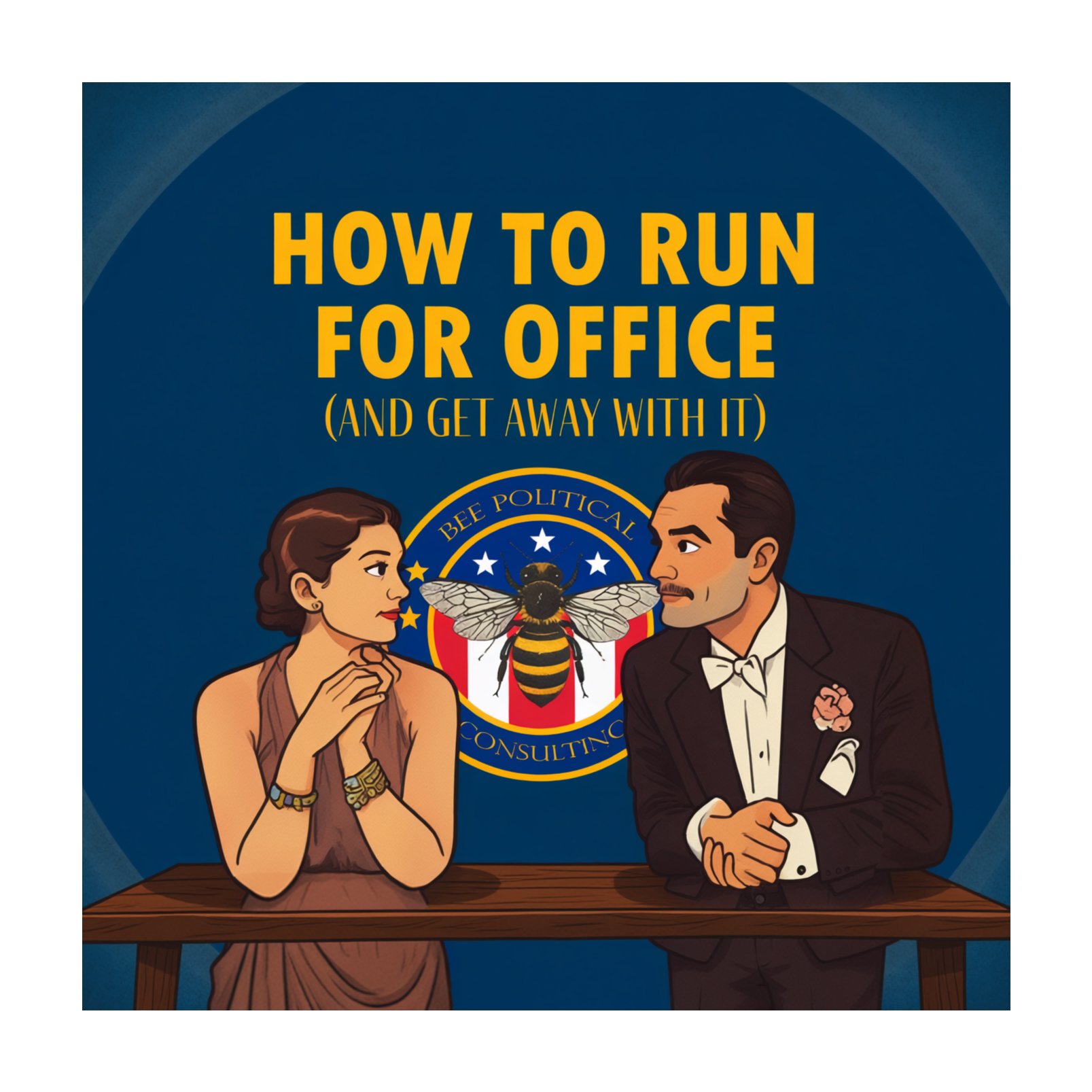
How to Run for Office (And Get Away With It)
14 episodes listed below
Campaign mechanics, without the polish.
The gist
How to Run for Office (And Get Away With It) treats campaigning as practical work: names, colors, staff, call time, events, volunteers, and local relationships. Scott and Bee keep the advice conversational, opinionated, and grounded in the messy details candidates usually meet after the launch.
PRESS PLAY
Find your next episode
About How to Run for Office (And Get Away With It)
How to Run for Office (And Get Away With It) is a practical campaign show about the parts of politics that slogans leave out. Scott and Bee talk about running for office as a working operation, not just a public identity. That means colors, signs, fonts, websites, Facebook pages, fundraising events, call time, staff roles, volunteer jobs, permits, and the people in a district who actually move trust. The show is conversational and occasionally rowdy. It is also unusually interested in logistics. A campaign kickoff is not treated as a vibe; it is a stack of infrastructure, from the PA system to the person sent back to get the thing someone forgot. Fundraising is not only a donation link; it can be a 5K, a golf tournament, a community talent show, sponsors, entry fees, and the candidate’s name attached to something people want to attend. Endorsements are not presented as abstract clout; they come through firefighters, union halls, local gathering places, first responders, and other community anchors. Branding gets a similar treatment. The show connects color, shade, typography, name ID, and digital consistency to the impression a candidate projects before saying much at all. It also keeps asking what success means, especially when winning the seat is not the only possible outcome of a race. Scott and Bee bring a teasing rhythm to the work, with quick asides and historical references cutting through the instruction. Julius Caesar, LBJ, Sir Galahad, and San Francisco’s royal purple all sit beside spreadsheets, calendars, and campaign staff. The result is political advice that feels local, specific, and operational rather than grandiose. It suits someone trying to understand how a campaign is assembled from the inside.
Made for: Suits a listener who wants practical campaign guidance before a launch, especially someone thinking through staffing, fundraising, branding, events, and local visibility. It also fits political observers who enjoy hearing how small campaign decisions become strategy.
What sets it apart: The show spends less time on ideology and more time on the machinery of a run: call time, event kits, community validators, digital naming, campaign colors, and the people who keep the operation moving. Its loose humor gives dry campaign logistics a sharper, more memorable shape.
In their own words
Before the slogans and the selfies and the campaign launch comes the part nobody tells you about the kitchen table conversation. Because when you run, your family runs to the long nights, the missed dinners, the strangers with opinions, it all becomes part of their world. So in this premiere episode, we're talking about what to do before you decide to run, how to bring your family into the decision early, what to ask, and how to know if everyone is ready for the ride. So grab your coffee, your campaign notebook, and maybe your family therapist and let's get into it.
Talks about
Podcasts like How to Run for Office (And Get Away With It)
 Politics by Jake
Combative civics for an unstable political moment.
 Jessea's Fireside Chats
Homespun conservative reactions to public disorder.
 Scott Horton Show - Just the Interviews
Antiwar interviews without institutional politeness.
 Kudzu Vine
Georgia politics, climbing fast.
 The Gadget Man - Technology News and Reviews
Practical tech, local questions, plain answers.
Episodes
- 1
True Blue, Resolute Red and Royal Purple for San Francisco
Hidden gemHow to Run for Office and Get Away With It: True Blue, Resolute Red and Royal Purple for San Francisco is an episode about campaign branding, color psychology, and candidate presentation.
Apr 13, 2026·1h 26m·5 clips - 2
Spoiler Alert
Hidden gemHow to Run for Office and Get Away With It uses the episode "Spoiler Alert" to ask whether campaign success means winning a seat, moving a policy window, or changing the race itself.
Mar 30, 2026·51m·5 clips - 3
It's Shake and Bake, and They Help
Hidden gemScott and Bee use episode 12.3 of How to Run for Office and Get Away With It to map the people who actually shape a district, from former officeholders to faith leaders.
Mar 23, 2026·1h 12m·5 clips - 4
Confirmations, Quinceaneras and Campaign Kickoffs
Hidden gemScott and V frame episode 11 of How to Run for Office and Get Away With It around campaign kickoffs, which they call a candidate's coming out party and a readiness checklist.
Mar 15, 2026·1h 14m·5 clips - 5
We Should Totally Stab Caesar
Hidden gemScott and Bea of How to Run for Office (And Get Away With It) explain how candidates can build a campaign calendar before the campaign fully begins.
Mar 9, 2026·51m·3 clips - 6
Death, Taxes and Call Time
Hidden gemScott and Dee open episode 10 of How to Run for Office and Get Away With It with 'Death, taxes, and call time,' then frame the hour around campaign fundraising before filing.
Mar 9, 2026·1h 19m·5 clips - 7
Come @ Me, Bro!
Hidden gemScott and Bee explain how candidates should establish a consistent name, handle, domain, and email before launching campaign social media.
Feb 23, 2026·1h 2m·4 clips - 8
Bee's Campaign Anatomy
Hidden gemScott and B of How to Run for Office (And Get Away With It) break down the staff structure behind a political campaign in episode seven, “Bee’s Campaign Anatomy.” They identify the campaign manager as the candidate’s operational partner, responsible for coordinating staff, protecting the candidate’s focus, and keeping the campaign on track.
Feb 16, 2026·1h 6m·4 clips - 9
There is No Campaign Fairy
Hidden gemScott and Bea explain why filing for office does not provide campaign t-shirts, bumper stickers, flyers, or yard signs, repeating that there is “no campaign fairy.” They outline first-priority expenses including palm cards, drop literature, targeted mailers, five initial yard signs, a name tag costing about $10–$20, and a professional website budgeted at roughly $1,000.
Jan 26, 2026·1h 7m·5 clips - 10
5-3-1 Hut! Hut!
Hidden gemScott and Vee explain the 5-3-1 messaging method for political campaigns: maintain five core topics, rotate three, and connect them to one central theme.
Jan 18, 2026·45m·3 clips - 11
Rabble, Rabble, Rabble
Dec 15, 2025·47m - 12
Don't Run for Office if You're Allergic to Running for Office
Dec 7, 2025·1h 27m - 13
Know Your Zone
Dec 7, 2025·54m - 14
Family Matters
Dec 1, 2025·55m