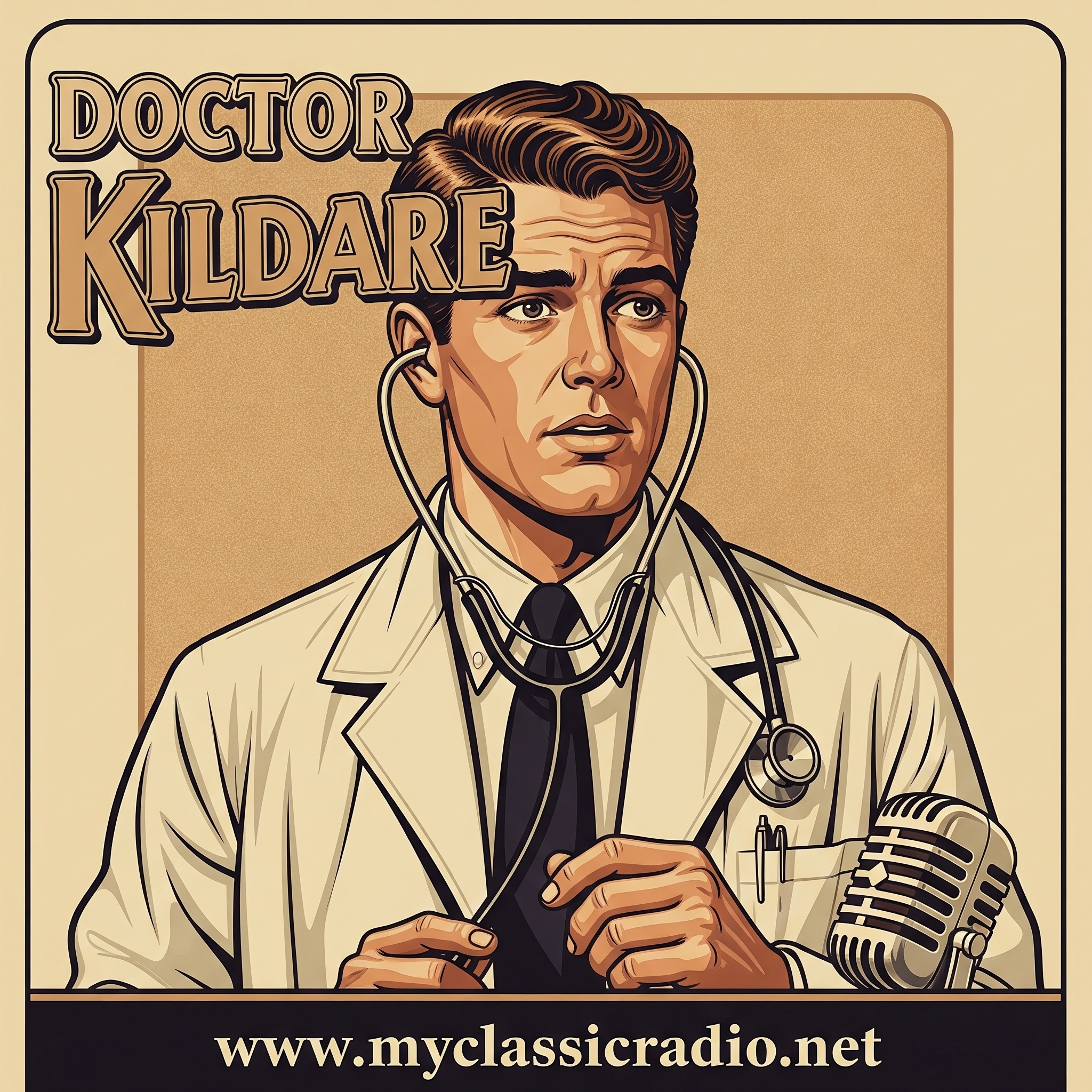
Doctor Kildare is old-time radio's version of the hospital drama, centered on two doctors at Blair General Hospital in New York. Lew Ayres plays Dr. Kildare. Lionel Barrymore plays Dr. Gillespie, who calls his colleague Jimmy and has little patience with nearly anyone else. The opening ties the series to Metro-Goldwyn-Mayer's famous motion pictures and promises an 'exciting, heartwarming series' for radio. First, though, comes an oath: 'Whatsoever house I enter, there will I go for the benefit of the sick.' It is a solemn way in, and the announcer's framing of the hospital matches it: 'Where life begins, where life ends, where life goes on.' The medicine in these stories is specific. In one scene, the two doctors notice that one eye is dilated and the other normal, and they identify an extra-dural hemorrhage that calls for an immediate operation. Kildare then explains it to the patient's wife in terms anyone could follow, comparing the skull to a closed box. Other moments are smaller and more human. Walter Benton is recovering from heart surgery and, as Kildare tells it, plans to celebrate his release with a box of cigars. The stories also leave the hospital. One follows the search for a young mother who gave her baby away, and the dialogue turns clipped and hard-boiled as the searchers pick over a 25-cent room, an empty quart of milk and a registration under the name Eleanor Mason, from nowhere. Another puts a man named Pete in a room with a gun while someone presses him about whether a child is inside the wardrobe closet. Most of the humor comes from Gillespie. When Parker asks whether Kildare is around, he says Kildare is in Honolulu, though Kildare is standing right there. In a lighter scene, Kildare and a woman named Molly follow someone's evening out, from dinner to dancing on the Waldorf roof, through reports from an ambulance driver and a nurse, and trade opinions about a Millicent Forbes. Episode titles show the wider range: an amnesia victim, a mentally ill man, an abandoned baby, a murder. The credits are worth a listen too, naming Walter Schumann for original music, writers including Joel Murcott and Les Crutchfield, and supporting players such as Virginia Gregg, Ted Osborne and Jack Webb. The period shows in the attitudes, with talk of dames and a remark about women having to act dumb. What a listener gets is a hospital drama that takes its emergencies seriously and its senior doctor's temper lightly.