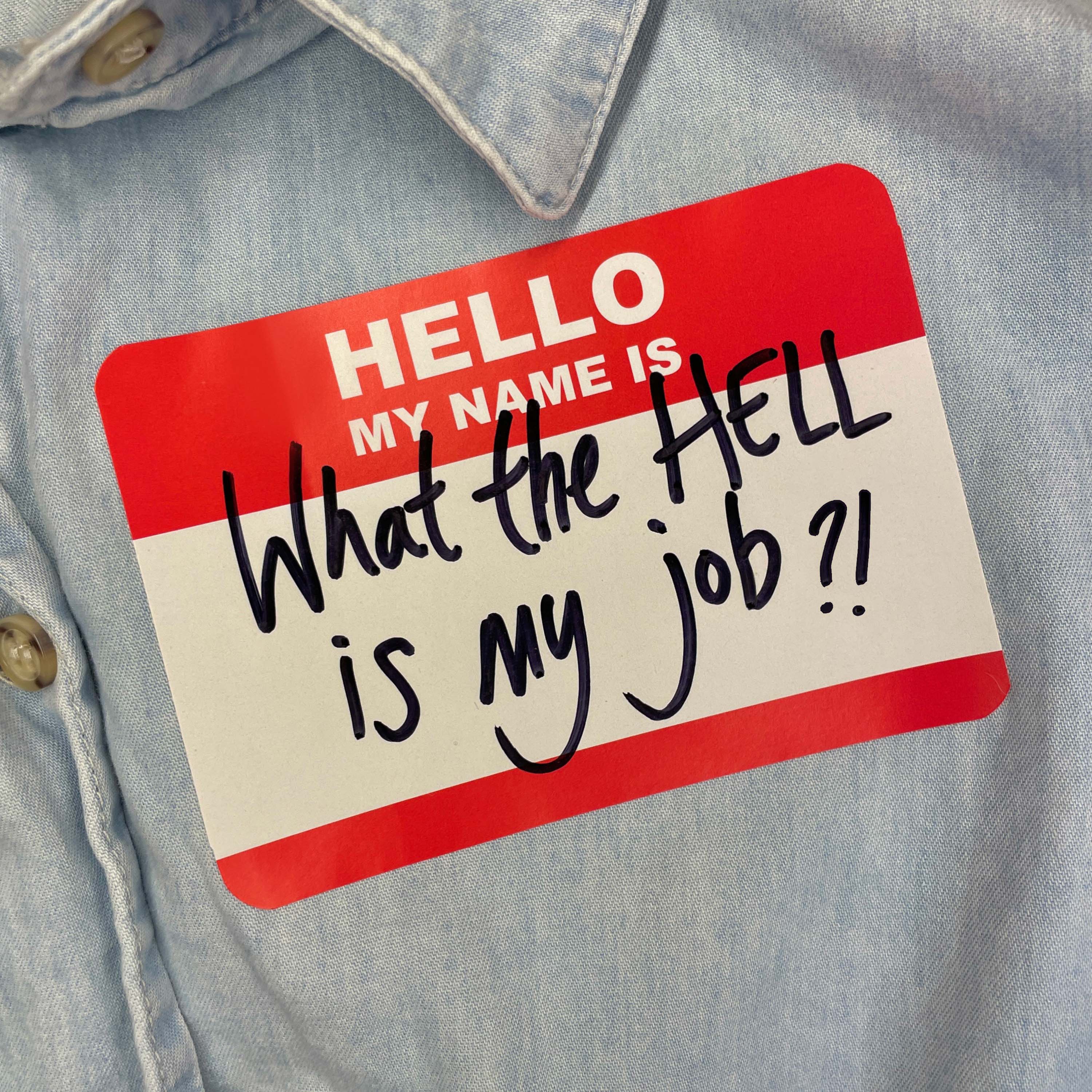
What The Hell Is My Job?! · Mondegreen

Best Of Season 1 (pt.1)

January 20, 2025·35 min·2 clips
A broken-down car pulls the Jenga piece that collapses into job loss, eviction, homelessness, and child-protection involvement.
1. "What The Hell Is My Job?" (Best Of Season 1 pt.1) collects six guests describing unconventional or unexpected career paths. 2. Guests include an unnamed San Diego adventure designer, the founder of The Lift nonprofit in Minneapolis, a UK-trained midwife and hypnobirthing practitioner, a tattooist with 10+ years of experience, a former Best Buy corporate salesman turned entrepreneur, and a London-born finance professional now living in Stone Mountain, Georgia. 3. The episode's core thesis is that fulfilling work rarely follows a straight path — nearly every guest describes leaving or being ill-suited to conventional employment. 4. The adventure designer has run 114 custom experiences combining logistics, props, and actors to create personalised days for clients; he describes his earliest disaster on adventure number 18, a Margarita-themed San Diego scavenger hunt that fell apart when bars refused entry and he rebuilt it mid-event by ripping open and re-wax-sealing envelopes in a parking lot. 5. He also describes a current engagement where a woman will find a puzzle on a coffee cup sleeve, use it to decode a cryptex, and discover plane tickets to San Diego — a 'drip feed' of clues spread over weeks. 6. The Lift founder trained as a social worker with a master's in pastoral ministry, then returned to school at 38 for an automotive technology degree specifically to fix cars for people who couldn't afford repairs. 7. She describes poverty using a Jenga metaphor: a broken car pulls the single wrong piece that collapses the tower — job, rent, housing, child-protection involvement — while a repaired car can rebuild the whole structure. 8. The Lift now owns a building with five repair bays, employs 15 staff including both auto technicians and social workers, and must raise approximately $1.8 million per year because client fees cover only 12% of operating costs. 9. The hypnobirthing practitioner decided to train two years into working as a midwife after noticing that couples who arrived prepared — knowing birth preferences, with informed birth partners — left her feeling 'elated,' while unprepared couples left her feeling depleted. 10. She describes a birth that stayed with her: a solo mother by choice, supported by a doula, who got into a birth pool and within moments delivered her baby into the water, then pulled the infant to her chest saying, in effect, 'of course I just did that.' 11. The tattooist of 10 years observes that virtually no client who arrives with headphones actually keeps them in — including people who specifically said they would — because the vulnerability of being tattooed opens people up to unexpected conversation. 12. She notes that when she first entered the industry it was heavily male-led, and describes a 2020-era wave of revelations about misogyny and abuse of power in tattooing that she felt many male colleagues failed to respond to with visible allyship. 13. The entrepreneur began selling water filters as a 25-cent-per-filter side hustle while still at Best Buy's corporate office in Minneapolis, eventually making a 100-mile drive two days a week to a partner's warehouse before going full time. 14. He and his partner grew the water-filter business from $3 million to $50 million in five to six years, but he describes that period as one where he 'forgot about his new bride and new kid' and carried two instances of infidelity for four years while weight and anger accumulated. 15. His turning point was a moment of physical aggression toward his child, which prompted him to enter counseling; he later told his wife about the affairs, and she began her own counseling, eventually addressing childhood trauma she had previously refused to examine. 16. The Atlanta-based guest moved from London to Stone Mountain, Georgia in 2012 to be with a partner, and left formal finance employment to have flexible time with her four children, describing the ability to take her toddler to library story time at 10am as something she had never been able to do in 18 years of parenting. 17. She was diagnosed with PMDD (premenstrual dysphoric disorder) — which she describes as affecting 1 in 12 women and leaving 1 in 5 undiagnosed — and credits understanding the diagnosis with helping explain episodes of extreme anxiety, smashing objects, and punching a hole in a wall. 18. The episode's tone is conversational and intimate: each segment is a single first-person monologue with no audible host; transitions are minimal and the guests speak without interruption. 19. Listeners who enjoy hearing people describe career pivots driven by values or crisis — especially stories involving nonprofit work, parenting tradeoffs, or personal reckoning — will find the material substantive. 20. Listeners wanting a single cohesive narrative or deep expert analysis of one topic are likely to find the compilation format fragmentary.

As heard by us

A candid, fast-moving look at risk, improvisation, and making unusual ideas work.

The episode treats work as a string of calculated gambles. Some ideas get shut down fast, while others are bold enough to make it through, and the speaker keeps one eye on the eject button before things go sideways.

Read the full review in PlayNext →

Why you'd press play

Press play for candid stories about risky gambits, the eject button, and what it takes to write the ship.

Read the full recommendation in PlayNext →
Listen to the show on