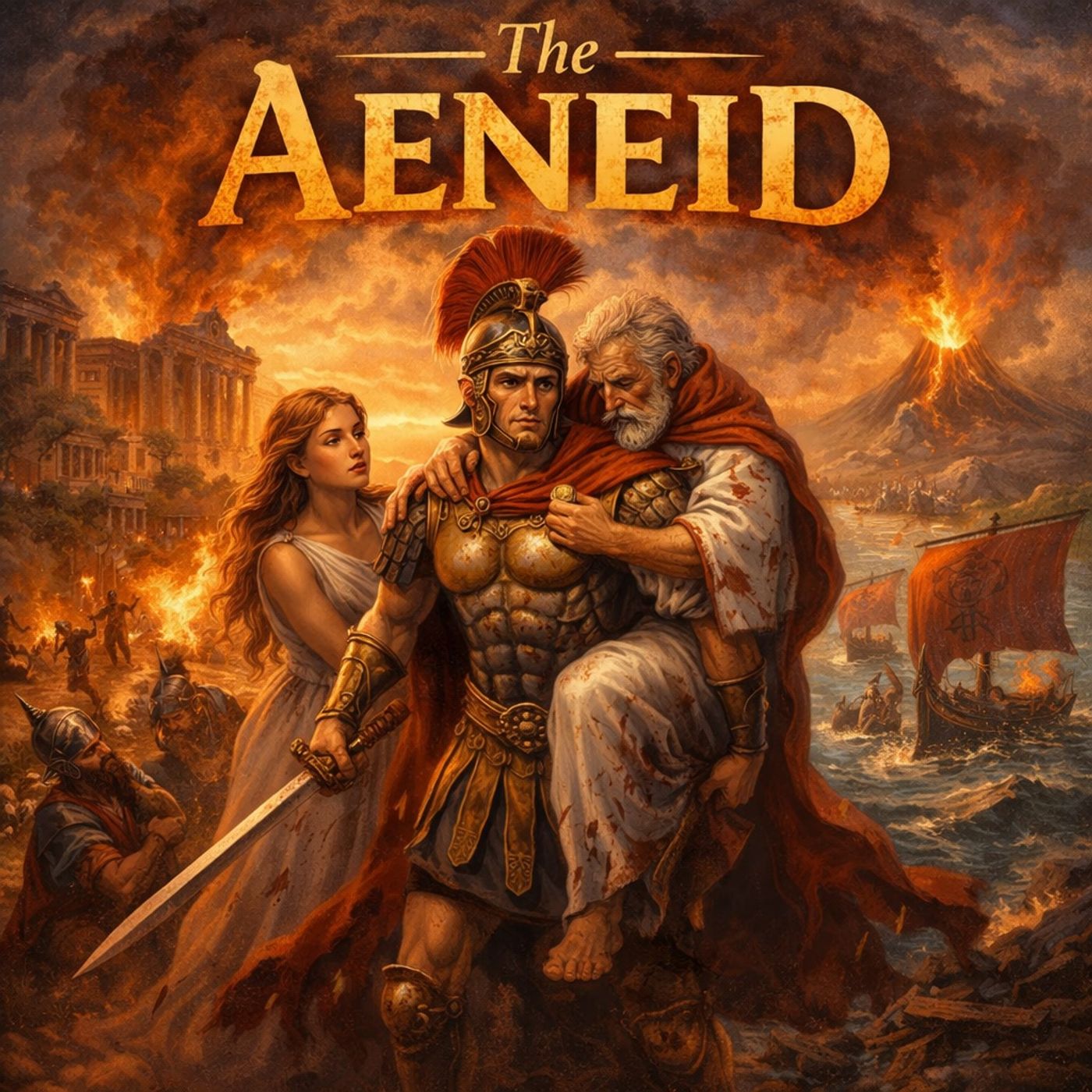
Aeneas challenges a stranger's identity, suspecting she might be a goddess in disguise.
This episode continues the narrative of Book 1 of Virgil's "Aeneid," focusing on Aeneas's arrival in Libya. The story is presented through a direct reading of the epic poem's translation. The central characters in this segment are the Trojan hero Aeneas and the goddess Venus, who is disguised as a huntress.
Aeneas, having survived a storm, encounters a figure he believes to be a goddess and asks for information about the land. The disguised Venus reveals they are in Libya, near the rising city of Carthage. She states Carthage is a Tyrian colony ruled by Phoenician Dido. Dido fled her home in Tyre to escape her brother Pygmalion's hatred. Venus begins to recount Dido's tragic backstory, mentioning her marriage to Sychaeus. Sychaeus was a wealthy man and the brother of the Tyrian king. Venus describes the mutual love between Dido and Sychaeus as a wound from an equal dart.
The narration reveals Pygmalion, Dido's brother, is a ruler who condemned both divine and human law. Aeneas specifically pledges to offer sacrificial victims at the altars of whoever helps him. Venus, in her disguise, explicitly denies being a goddess, attributing her appearance to Tyrian hunting attire. She describes the local people of Libya as "rude in peace and rough in war."
The interaction showcases Aeneas's piety and immediate reverence for what he perceives as the divine. Venus's elaborate deception adds a layer of dramatic irony to the epic's narrative. The description of Dido's past introduces a theme of flight and tyranny parallel to Aeneas's own journey. The promise of future sacrifices highlights the Roman cultural and religious values embedded in the poem.
The tone is formal and literary, adhering closely to the structure of classical epic poetry. The style is narrative and descriptive, advancing the plot through direct speech.
Listeners who enjoy classical literature and foundational Western epics will appreciate this direct storytelling. Those seeking modern analysis or casual conversation about the text might find this dramatic reading less engaging.