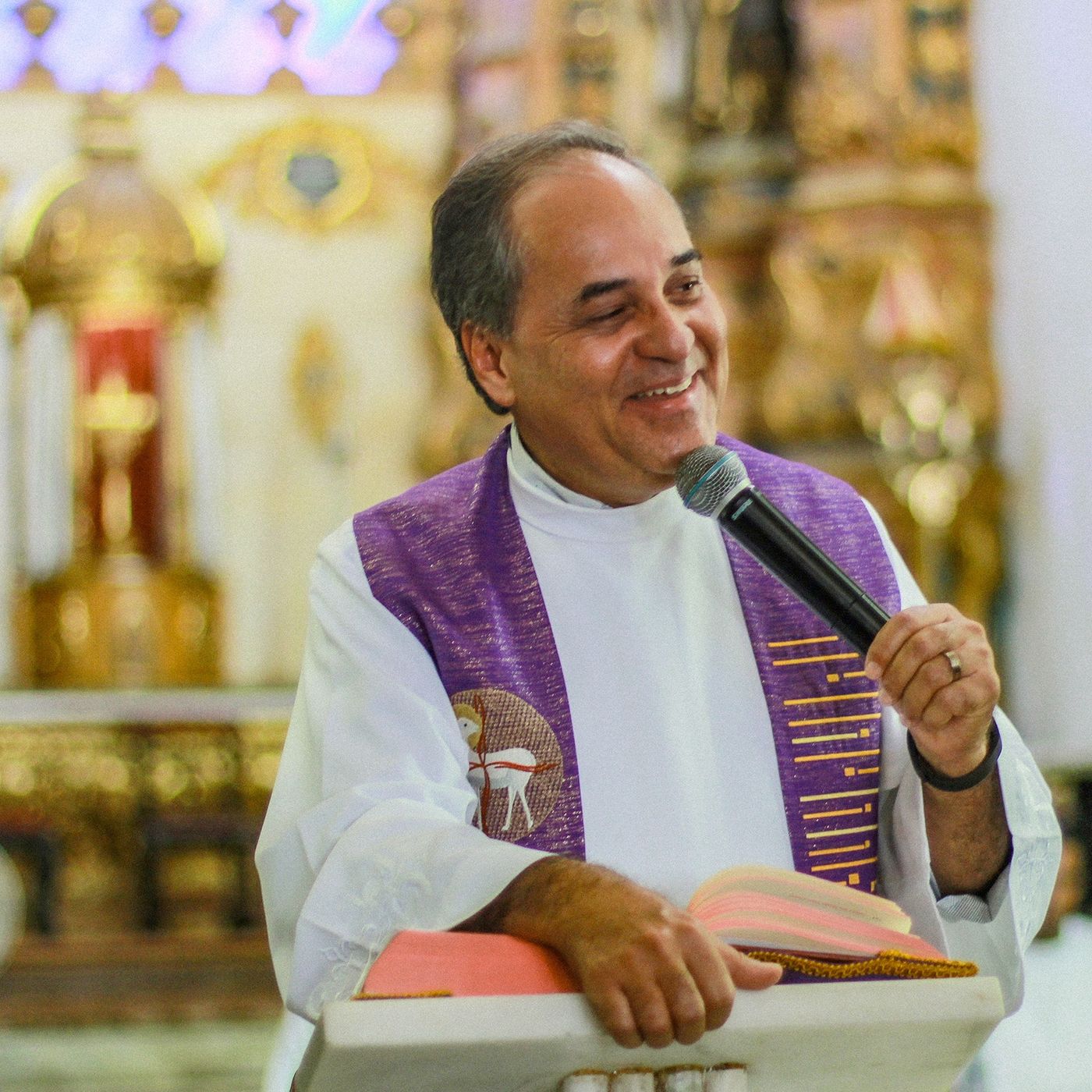
Pe. João Carlos - Meditação da Palavra · Padre João Carlos, SDB

11/04/26 - Programa Padre João Carlos | Tempo de Paz

·56 min·4 clips
Psychologist Verônica Guedes says 'we got out of the pandemic, but it seems the pandemic didn't get out of us' — families still isolated, not seeing each other.
1. 'Tempo de Paz' with Father João Carlos is a Portuguese-language Catholic radio program broadcast on April 11, the Saturday within the Easter octave, the eve of Divine Mercy Sunday. 2. Father João Carlos hosts; psychologist Verônica Guedes from Campina Grande, Paraíba, appears as a guest expert; multiple listeners from across northeastern Brazil and São Paulo contribute to the call-in discussion. 3. The episode's dual focus is on the meaning of Divine Mercy Sunday and a pastoral survey: whether people in Brazilian families are managing to resolve conflicts through dialogue. 4. Divine Mercy Sunday, established by Saint John Paul II in the year 2000, is described as an invitation to encounter the Risen Christ through the example of Thomas, whose doubt Jesus transforms into the confession 'My Lord and my God.' 5. Father João Carlos outlines four practical actions for Divine Mercy Sunday: practice mercy by forgiving someone; strengthen faith through prayer and Scripture; be a bearer of peace in family and community; trust in Divine Mercy through the Sacrament of Confession. 6. The episode's listener survey asks: 'In your opinion, are people managing to resolve conflicts at home through dialogue?' 7. Listener Quitéria from Porto de Pedras, Alagoas argues that dialogue has disappeared in families because everyone is absorbed in their own phone screen and no one converses anymore. 8. Listener Estela from São Paulo argues that the internet has created not just a generation gap in attitudes but 'a change in mental structure — in how you learn, in how you relate to people.' 9. Father João Carlos affirms Estela's structural framing, distinguishing cognitive change driven by technology from moral failure on the part of younger generations. 10. Psychologist Verônica Guedes connects the collapse of family dialogue to the COVID-19 pandemic, arguing that the isolation patterns people adopted during lockdowns have persisted: 'we got out of the pandemic, but it seems the pandemic didn't get out of us.' 11. She identifies the specific danger: families are the space where children learn to win and lose and develop behavioral reference points — but this function has broken down, leaving children to seek those references outside the home. 12. Verônica Guedes describes the internet as 'a lawless land' where children are now left unsupervised, and says the time to address this has 'already passed.' 13. Father João Carlos extends the concern to religious formation, noting that families may also be failing to transmit sensitivity to the transcendent and values that cannot be measured materially. 14. Listener Maximiliano Jesusa from São Vicente says his four-year marriage resolves all conflicts through dialogue, offering a positive counterpoint: 'there is no use for one to be blurred on one side and the other on the other.' 15. In the Gospel commentary, Father João Carlos notes that the disciples in Mark 16 disbelieved Mary Magdalene's testimony and then disbelieved the two travelers — a pattern of hardened unbelief that Jesus overcomes not by abandoning but by recommissioning the eleven. 16. He identifies the paradox at the heart of the mission: Jesus entrusts the most universal calling — announcing the Gospel to all creation — to the most humanly inadequate group imaginable. 17. The practical application of the Gospel invites listeners to examine whether their own faith is 'vague' assent to the resurrection or active recognition of Jesus as present in the Eucharist, Confession, Scripture, and the church assembly. 18. The episode includes devotional songs, a Paschal blessing in three parts, a liturgical water-blessing ceremony, and the announcement of 15 wall calendar giveaway winners across Brazilian stations. 19. Best for Portuguese-speaking Brazilian Catholics who follow daily devotional radio programming and want both Easter season liturgical guidance and pastoral social commentary. 20. Listeners who do not speak Portuguese, prefer secular content, or are not interested in Catholic devotional practice will not find this episode relevant.
Listen to the show on