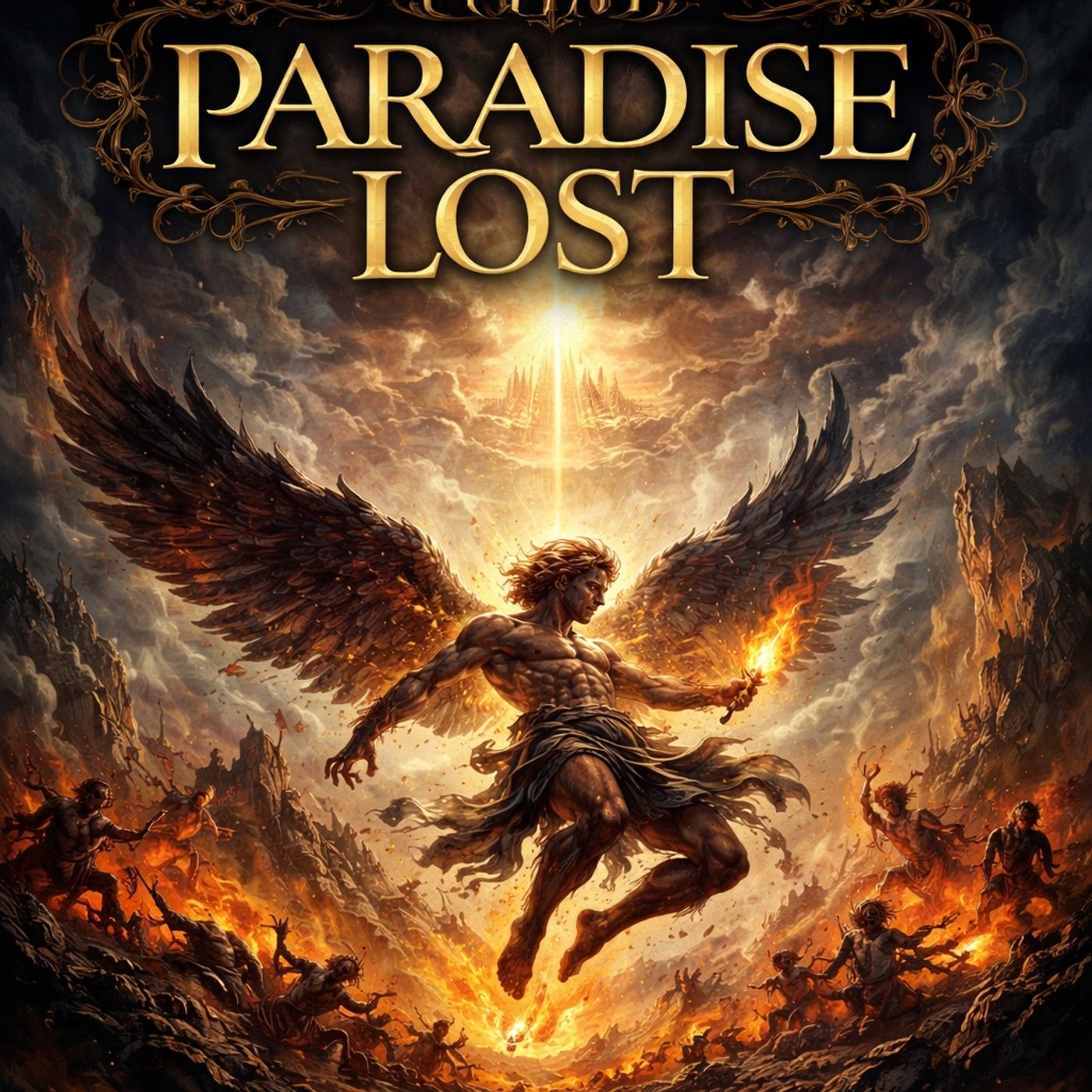
Milton declares he must change from divine discourse to the tragic story of man's disloyal revolt against heaven.
This episode presents the opening of John Milton's epic poem "Paradise Lost," read as an audiobook. The text is the poem itself, narrated in a formal, dramatic style. It establishes the monumental subject: humanity's fall from divine grace.
The narrator declares a shift from tales of peaceful communion between God and man to a tragic story of disobedience. The core conflict is introduced as mankind's "foul distrust" and "breach disloyal" against heaven. This act brings "woe, sin," and death into the world. Milton contrasts his "heroic argument" with traditional epic subjects like the wrath of Achilles in the Trojan War. He also mentions the rage of Turnus from Virgil's *Aeneid* and the ire of classical gods like Neptune and Juno. The poet states his aim is to surpass these tales of physical combat. He seeks to sing of "the better fortitude of patience and heroic martyrdom," which he considers unsung. Milton invokes his "celestial patroness," a muse who visits him nightly to inspire his "unpremeditated verse."
A key insight is Milton's conscious elevation of spiritual struggle over earthly warfare as the true subject for epic poetry. He explicitly rejects merely recounting "battles feigned" or describing ceremonial tournaments and "emblazoned shields." The poet frames the fall of man not just as a catastrophe but as a story of greater heroic scale than classical myths. The language itself, with phrases like "venial discourse unblamed," paints a vivid picture of lost innocence and intimacy with the divine. The invocation of divine inspiration positions the poem as a received work of prophetic vision, dictated to the slumbering poet.
The tone is solemn, elevated, and profoundly literary, directly addressing the reader with rhetorical grandeur. The style is dense, allusive, and uses the formal structure of blank verse, characteristic of 17th-century epic poetry.
Listeners who love classic literature, poetic performance, and philosophical explorations of myth and theology will be captivated by this recitation. Those seeking casual conversation, modern analysis, or a simplified narrative might find the archaic language and formal delivery challenging.