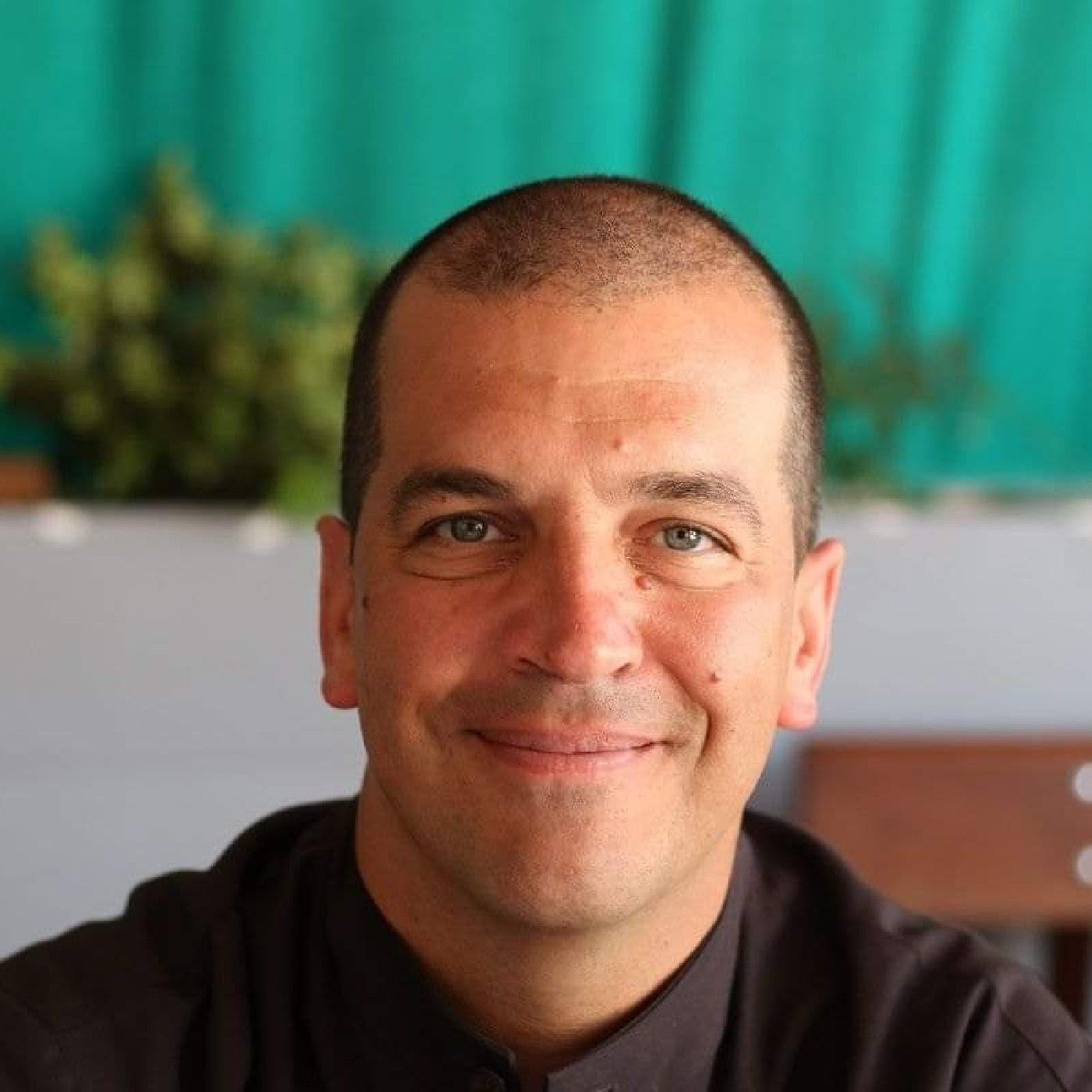
Il podcast di don Andres Bergamini · Andres Bergamini

Il cammino ecumenico - San Domenico Savio

·53 min·4 clips
A priest shares how living in Jerusalem's diverse church community forced him to 'masticate' ecumenism daily.
1. Don Andres Bergamini, priest and director of the Bologna Archdiocesan Office for Ecumenism and Inter-religious Dialogue, gives a talk to a parish community about ecumenism. 2. He speaks as a practitioner rather than a theologian, drawing on his years of formation and ministry in Jerusalem and his current role as director of the diocesan ecumenism commission. 3. The episode's core argument is that inter-religious and ecumenical dialogue strengthens Catholic identity rather than compromising it, because encountering difference clarifies what you actually believe. 4. In Jerusalem, Don Andres experienced daily ecumenism by necessity: all Christian denominations combined represent only 2% of the city's population, and Catholics, Greek Orthodox, Armenians, Copts, and Syrians share the physical space of the Church of the Holy Sepulchre. 5. He studied at the Franciscan seminary in Jerusalem, which offered courses in Islam, Judaism, and inter-religious dialogue as part of formation for priests destined to serve there. 6. His Bologna commission meets monthly or every two months and has approximately 15 members including religion teachers, a specialist in Judaism, an Islam expert, and Sr. Maria Cristina Ghitti of Montesole who participates in the DIMM (monastic inter-religious dialogue) network. 7. The Council of Christian Churches in Bologna brings together the Catholic Church, the Greek Orthodox Church of Constantinople, the Romanian Orthodox Church, the Anglican Church, the Evangelical Waldensian-Methodist Church, and others for shared witness and practical coordination. 8. Two main annual ecumenical events: the SPUC (Week of Prayer for Christian Unity, ending January 25, the feast of St. Paul's conversion) and initiatives around creation care in September-October. 9. He describes a recent ecumenical walk in Casteldebole: participants walked from a Catholic church to the Romanian Orthodox Church of Via Olmetola, stopping for scripture readings and meditations by a Waldensian pastor named Casolari, then sharing a buffet provided by the Romanian community. 10. The Bologna Archbishop, Cardinal Zuppi, actively participates in ecumenical initiatives including a joint Easter service at the Basilica of Santo Stefano, where Romanian Orthodox children sang resurrection hymns in Moldavian. 11. The January 17 Jewish-Christian Dialogue Day, now in its 37th year, rotates between the Jewish and Catholic communities and follows a shared scriptural text; the 2026 theme is Genesis 12:3 on Abraham and the blessing of all peoples. 12. He describes the recently published 24 'schede per conoscere l'ebraismo' — short Catholic-Jewish collaborative reference cards on Jewish feasts, terms, and practices, produced jointly by rabbis and Catholic scholars. 13. The war in Gaza has created significant friction in Jewish-Catholic dialogue: meetings that previously ran smoothly now involve the contested word 'genocide,' and Bologna Jews have faced antisemitic incidents due to association with the Israeli government. 14. Don Andres draws the analogy: associating a Bologna Jew with Netanyahu is as unfair as people abroad associating any Italian with Berlusconi. 15. With Islam, he describes approximately 60,000 Muslims in the Bologna metropolitan area (half of all 120,000 foreigners), and parish-level iftar dinners during Ramadan as a regular dialogue format. 16. A Muslim scout's integration into a Catholic scout group is described as an unexpected catalyst for Catholic self-examination: the scout's visible fidelity to prayer and halal practices prompted Catholic members to ask themselves what they believed. 17. He mentions that a Jewish student at the Hebrew University in Jerusalem once asked if she could attend Christmas Eve Mass in Bethlehem, illustrating Jewish curiosity about Christian practice. 18. He cites the upcoming December 2 ecumenical celebration in Venice commemorating the 1965 revocation of the 1054 mutual excommunications between Rome and Constantinople, calling it a significant anniversary that parishes should mark. 19. The tone is pastoral, discursive, and improvisational — a practitioner speaking to a local parish audience, using personal anecdotes and concrete local names rather than abstract theological language. 20. Listeners interested in Catholic ecumenism, inter-religious dialogue, or the practical challenges of multi-faith community life in a European city will find this most valuable; those seeking doctrinal depth or academic theology will find it too introductory.
Listen to the show on