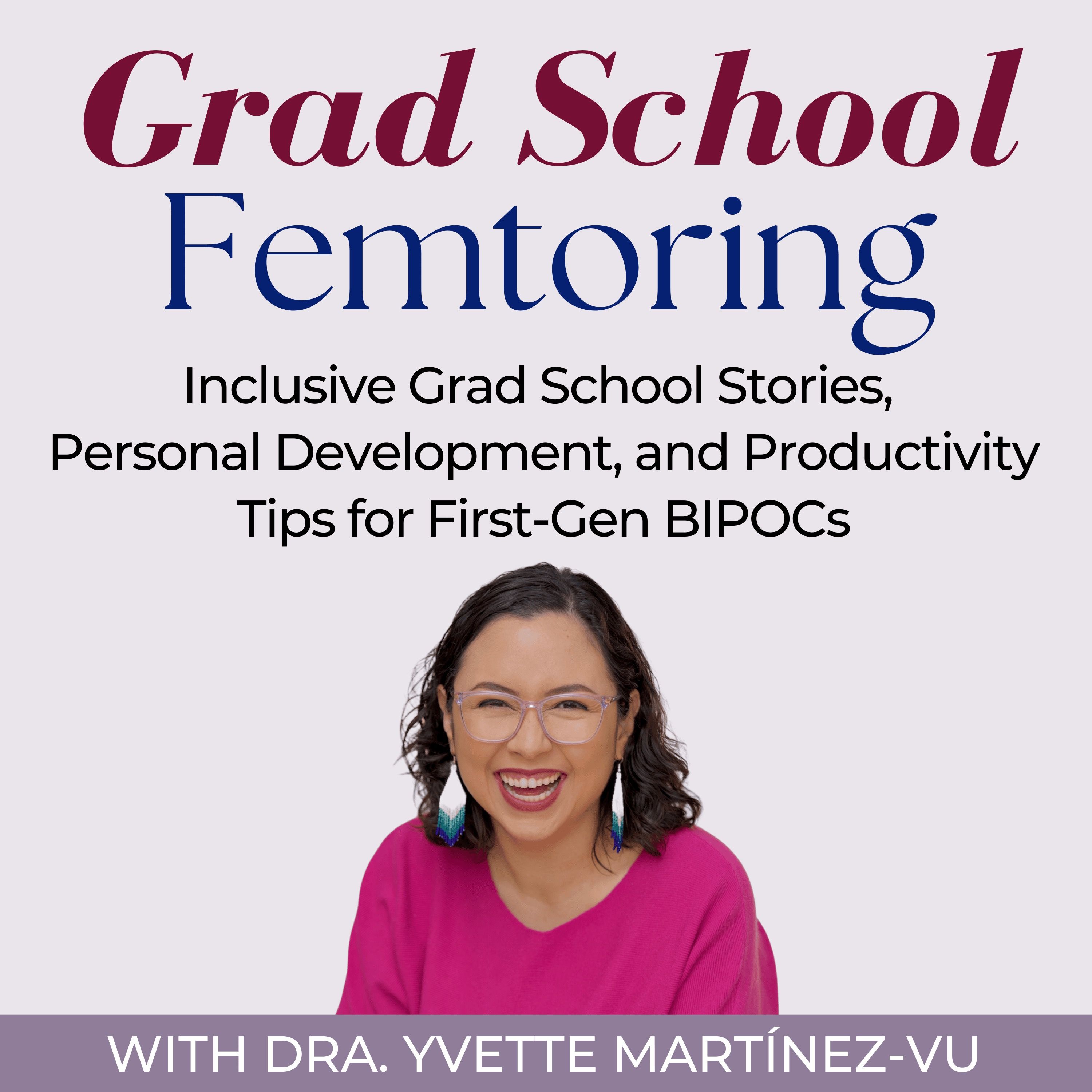
Grad School Femtoring: Inclusive Grad School Stories, Personal Development, and Productivity Tips for First-Gen BIPOCs · A podcast on thriving in graduate school for first-generation BIPOC students, offering insights on academic success, career development, mental health, and navigating diversity and inclusion in higher education.

338: Five Gentle Productivity Tips for Chronic Illness, Autism, and ADHD (Replay)

·27 min·1 clip
Dr. Yvette says productivity advice often assumes the reader is non-disabled, white, and middle class.
1. Grad School Femtoring: Inclusive Grad School Stories, Personal Development, and Productivity Tips for First-Gen BIPOCs centers on Dr. Yvette Martinez-Boo’s replay about five gentle productivity tips for chronic illness, autism, and ADHD. 2. Dr. Yvette Martinez-Boo is the host, a certified coach, consultant, author, and speaker, and she says the episode is for people who need to work while not feeling their best. 3. The episode asks how to make productivity more flexible for disabled, autistic, ADHD, and chronically ill listeners who do not fit standard advice. 4. She opens by saying many productivity books assume a reader who is “non-disabled,” “white,” and “middle class,” which makes the advice feel unusable to her. 5. She says she has had to adapt strategies over the years because she is disabled, neurodivergent, autistic, and living with several chronic illnesses. 6. She says the episode was inspired by a “moment of inspiration and hyper-focus” during her holiday break. 7. She describes building a spreadsheet of productivity tips and categorizing them by chronic illness support, autism support, ADHD support, and executive functioning skill. 8. She names task initiation, working memory, and motivation as examples of executive functioning skills she tracks in the spreadsheet. 9. Her first strategy is to complete tasks by energy, using the ABC method from episode 144 as an energy-management system. 10. She explains that A tasks take the most energy, B tasks take less, C tasks take the least, and the list should match the listener’s own energy patterns. 11. She says circadian rhythm matters because morning, afternoon, and evening people have different energy windows for difficult work. 12. Her second tip is to set minimum and maximum goals, which she says gives people a range instead of one rigid target. 13. She defines minimum goals as the bare minimum for a rough week and maximum goals as the most sustainable amount of work in a good week. 14. She says the range can be used for weekly, monthly, or daily goals, and she mentions writing daily goals on a Post-it and in her free daily focus planner. 15. Her third tip is to identify a single focus or theme for the day, and she describes a planner with a “today’s area of focus” box, three work priorities, three personal priorities, and a “got done” list. 16. She says a focus planner helps people who do not do well with time blocking because it reduces the feeling of being restrained. 17. Her fourth tip is to organize with folders and baskets, and she gives examples such as naming digital folders with future-searchable keywords and placing baskets where she naturally leaves things. 18. She also says storing duplicate cleaning supplies in multiple bathrooms can remove one hurdle and make action easier in the moment. 19. The episode sounds conversational and practical, with a lot of direct address to listeners, repeated examples from her own life, and a workshop-like structure. 20. Listeners who want adaptable productivity systems for chronic illness, autism, or ADHD will likely get the most value, while people wanting rigid, one-size-fits-all advice may skip it.
Listen to the show on