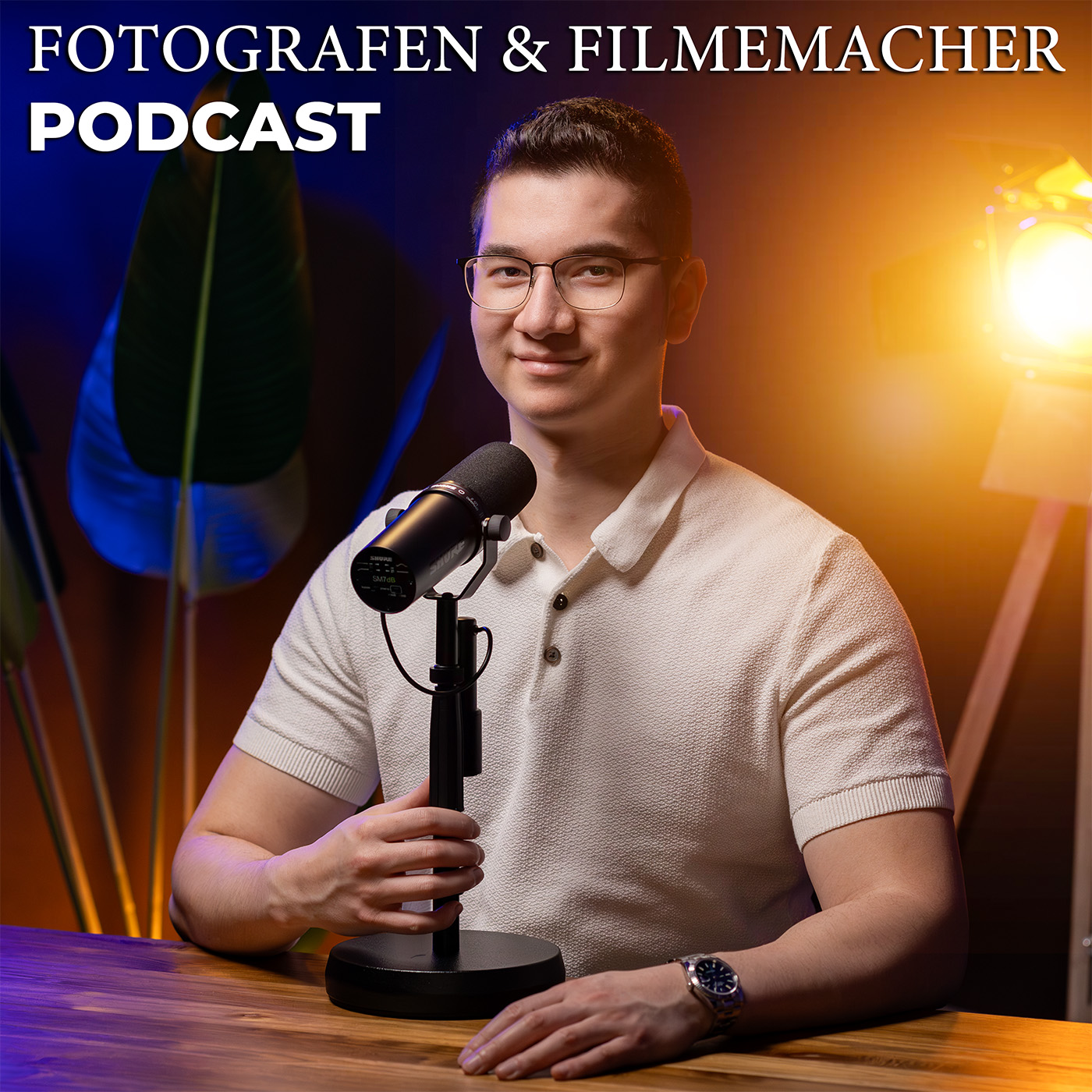
Fotografen und Filmemacher Podcast - Fotografie und Film · Anja Rätzel & Edmond Rätzel - edmond-raetzel.de

#503 - Warum geben so viele ihr Online Business auf?

·21 min·2 clips
Why are more and more successful YouTube stars and influencers suddenly announcing they're stopping?
1. The Fotografen und Filmemacher Podcast, hosted by Edmond Rätsel, examines why so many creators with large social-media followings ultimately quit their online businesses. 2. Edmond Rätsel is introduced as an experienced photographer and marketing expert who coaches creative professionals on building profitable businesses. 3. The core thesis is that follower count is a poor proxy for business health, and that most creator burnout is a symptom of wrong product strategy rather than lost passion. 4. Rätsel notes a wave of YouTube stars, Instagram influencers, and photo stars publicly announcing they are quitting, citing exhaustion from constant content production. 5. He points out that creators with 500,000 or even millions of Twitch subscribers often cannot pay their monthly bills, directly contradicting the assumption that scale equals income. 6. One major reason creators quit is that their private life becomes the product, leaving no separation between personal experience and content obligation, which becomes unsustainable after several years. 7. A single public misstep or major negative online reaction can end a personal-brand career, adding existential risk to the daily grind of content creation. 8. Rätsel diagnoses 'shiny object syndrome' — the impulse to abandon a mature channel for a new idea — as typically counterproductive, because the original platform took years to build and generates the most revenue. 9. He observes that many creators who publicly quit return within six to twelve months, often damaging their credibility, because the new venture could not match the revenue of the established one. 10. His recommended alternative to quitting is automation: hiring employees, using AI tools, and reducing personal involvement to roughly 10 percent while retaining the revenue-generating asset. 11. The central product argument: creators who sell only cheap items such as a 10-euro photo album cannot sustain a business from content, whereas a wedding image film priced at 2,000 to 5,000 euros requires only four or five clients per month for a comfortable income. 12. Rätsel contrasts income from platform advertising — which requires millions of monthly views — with income from high-ticket services, framing the latter as the only viable model for most photographers and filmmakers. 13. He references building his own YouTube channel since 2018, noting the channel had fewer than 800 subscribers when it was already generating 20,000 euros per month through coaching and other backend programs. 14. His channel currently has slightly over 7,000 subscribers, and he explicitly states that reaching 100,000 subscribers is not a goal because subscriber count without a product behind it is worthless. 15. Rätsel argues that creators should build an independent ecosystem — owning their products, courses, and books — rather than depending on sponsor relationships that can be terminated for any content misstep. 16. He illustrates this with his own product range: photography coaching, books, audiobooks, and video courses that all feed into a single photography-business niche. 17. The episode includes a psychological observation: humans tend to focus on the single negative comment of the day and forget the ten positive ones, a pattern Rätsel calls the primary emotional driver of burnout. 18. He uses the example of any song by Usher or Bruno Mars on YouTube — no matter how popular, every video accumulates dislikes alongside likes — to normalize the inevitability of negative feedback. 19. The tone is direct and instructional, with Rätsel speaking as a solo host; he draws on client case studies and his own business metrics rather than abstract advice. 20. The episode suits photographers and filmmakers considering or already running an online presence who want a business-first framework; those seeking motivation or creative inspiration without a commercial angle may find it transactional.
Listen to the show on