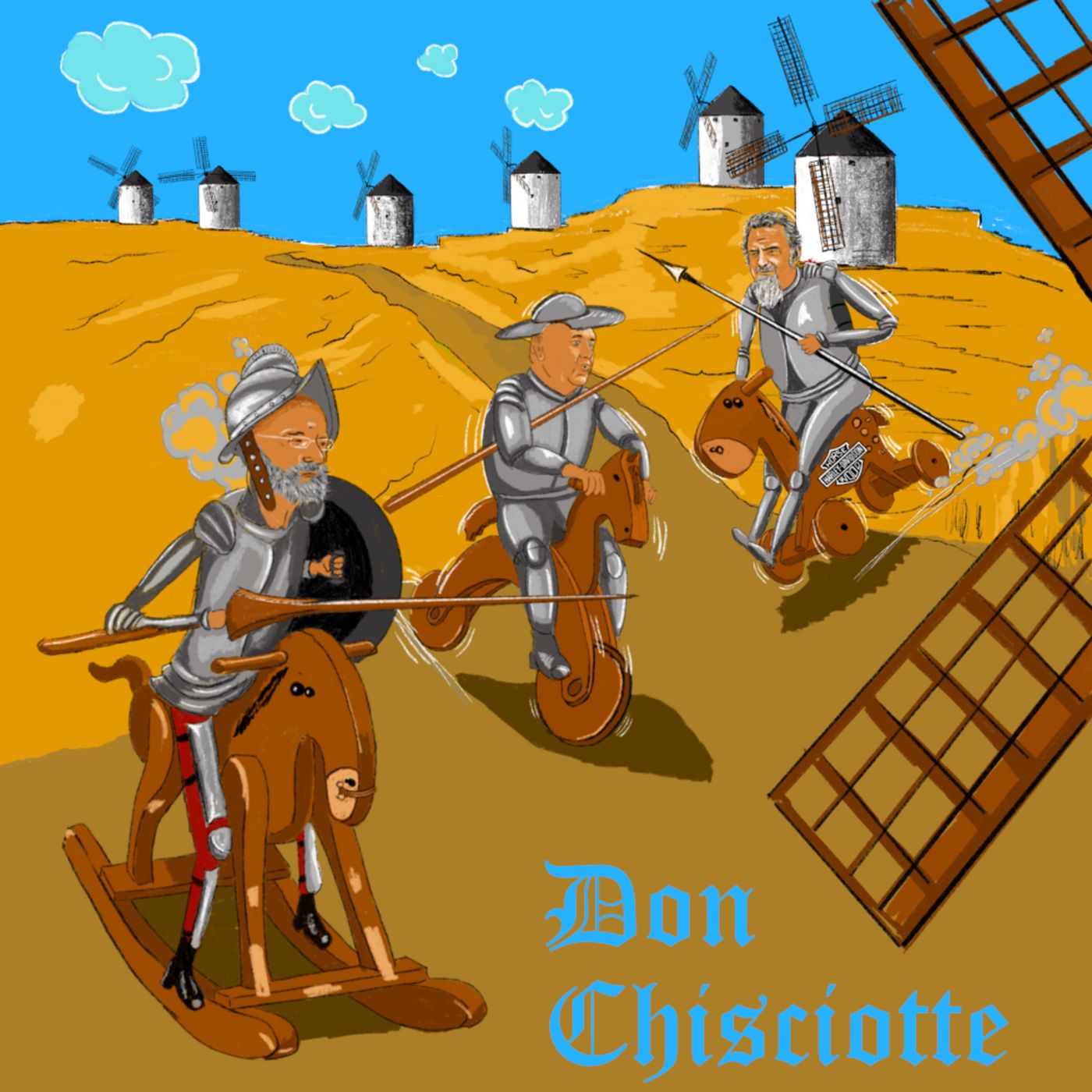
Don Chisciotte · DigitalMDE

Giorgia e le pulizie di primavera

·1 hr 7 min·5 clips
Social platform algorithms are designed as slot machines—intermittent reinforcement engineered to trigger dopamine dependency, which Carlo Alberto argues is legally equivalent to 'failure to warn' as required on cigarette packaging.
1. Don Chisciotte Podcast, season 6 episode 23, covers three topics: a US court ruling against platform algorithms, the Confindustria Spring Report on Gulf conflict economic scenarios, and Italian domestic politics. 2. Hosts are Oscar Giannino, identified as the main commentator, and Carlo Alberto (referred to as Renato Cifarelli in the introduction), with Danciò Panza also mentioned as a regular contributor. 3. The episode's central tension is whether judicial and regulatory intervention in platform algorithm design is a legitimate protection of users or an overreach that misattributes the cause of dependency. 4. A US court ruled that Meta (Instagram) and Google (YouTube) violated law through algorithm engineering designed to induce unavoidable dependency in users, condemning the technical design rather than the content. 5. Carlo Alberto argues the condemnation rests on 'failure to warn'—the same legal obligation printed on cigarette packs—applied to Instagram's infinite scroll and YouTube's autoplay as instruments of intermittent reinforcement identical to a slot machine. 6. Oscar challenges this, arguing that television, radio, Spotify, and Netflix all use similar personalization and autoplay mechanics, asking whether condemning the algorithm is a 'sentence against free will.' 7. Carlo Alberto counters that the key difference is that platform algorithms start from a perfected individual profile and feed exclusively content from that profile's interest thread, unlike linear or even multi-channel media. 8. Oscar shares a personal experiment in which he consumed flat-earth and conspiracy videos for approximately one month to break his Instagram profile and recover algorithmic free will, framing understanding the algorithm as a prerequisite for governing it. 9. Oscar and Carlo Alberto agree that generations have always considered the young susceptible to new media—from Sturm und Drang novels in the 18th century to Diabolik comics—and that blanket condemnation of the engineering does not restore individual critical capacity. 10. The Confindustria Study Center Spring Report, presented on March 25, runs 175 pages and models three scenarios for the economic impact of the Gulf conflict on Italy, Europe, and globally. 11. Scenario one (conflict ends in three months): Italian GDP growth in 2026 is +0.5%, recovering from a 2025 baseline of 0.5%. 12. Scenario two (conflict lasts six months through summer): Italy reaches zero growth—stagnation—in 2026. 13. Scenario three (conflict lasts a full year with persistent effects): Italy enters recession in 2026. 14. Italy's primary exposure is through gas prices: 66% of Italian gas arrives by pipeline (Algeria 34%, Azerbaijan/Turkey via Puglia), and 34% as LNG from the United States (first supplier) and Qatar (second supplier), making Italy and Latvia the two most gas-exposed EU economies. 15. Italy uses gas for industrial continuity energy—unlike France (nuclear) and Spain (renewables plus retained nuclear and gas)—meaning energy price shocks multiply through industrial competitiveness and corporate margins. 16. Italian corporate credit costs began rising in the final months of 2025 not due to ECB rate increases but due to rising risk premiums on Italian companies, a leading indicator of the tightening conditions. 17. Italy's public debt is projected to rise from 137.4% of GDP to 138% or higher for at least two years under the conflict scenarios, narrowing fiscal margins. 18. The episode's tone is fast-paced, combative, and discursive, with Oscar and Carlo Alberto frequently interrupting and challenging each other; the format is an unscripted live-style conversation with a mix of economic analysis and media criticism. 19. Listeners engaged with Italian macroeconomics, European energy policy, and debates about platform regulation will find the Confindustria scenario analysis and the algorithm-regulation debate substantive. 20. Listeners who do not follow Italian domestic politics or who prefer structured single-topic analysis will find the episode's three-topic format and frequent digressions difficult to follow.
Listen to the show on